Saturday, November 21, 2009

Second Temple Era: Magnificent Arch, Ritual Baths

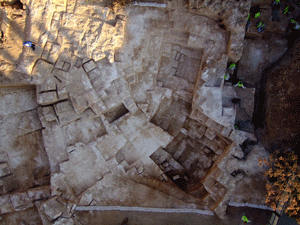
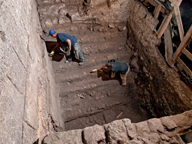
The remains of a Jewish settlement that dates from the latter part of the Second Temple period (the first century BCE)have been discovered.

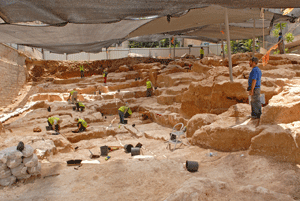
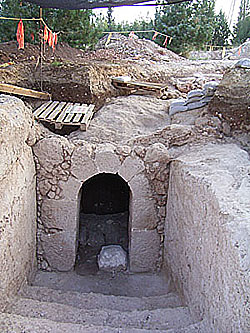
A magnificent arch built of large well-dressed stones was uncovered in the excavations. The arch was attached to the side of a ritual bath (miqve) that was discovered there and led to a subterranean chamber. Installations were also discovered that are ascribed to a Jewish settlement that existed there at the time of the Second Temple period, among them a number of ritual baths that were used by the residents in maintaining the halachic practices of purity.


Blocked openings were revealed inside the installations at the site. These raise the possibility that behind them are tunnels similar to the hiding refuges that were discovered in this region in the past. The latter were also dug inside of installations during the time of the Bar Kokhba uprising (132 CE) and were used by the rebels in concealing themselves from the Romans. The openings that were found in this excavation were probably used for a similar purpose, but have not yet been uncovered.

The excavation director has noted that in addition to the discovery of the finds, this excavation clearly shows that the area of the Jewish settlement that was excavated in this region in the past extends across a larger area than was previously believed.

During the excavation a very large amount of pottery sherds was found that date to the Roman, Byzantine and later periods. The vessels include different kinds of oil lamps, jars, cooking pots, amphorae, and juglets. Among the other small finds that were recovered in the excavation are numerous glass vessels, some of which are kinds that were previously unknown from this period, various coins and an object that is believed to be a part of a pendant.

Crusader Era Marble Hoard in Akko

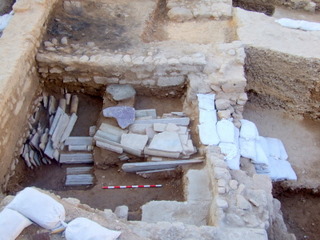
In an excavation that was recently conducted c. 100 meters north of the Old City wall of Akko, a unique find was discovered from the Crusader period (the thirteenth century CE) – a hoard of 350 marble items that were collected from buildings that had been destroyed.


The hoard was found within the framework of an archaeological excavation conducted by the Israel Antiquities Authority before the AkkoMunicipality began building a new structure to house classrooms in the Hilmi Shafi Educational Campus.


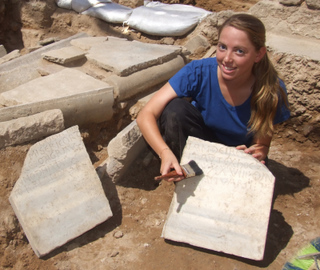
According to Dr. Edna Stern, excavation director on behalf of the Israel Antiquities Authority, “We have here a unique find, the likes of which have never been discovered in the Kingdom of Jerusalem in the Crusader period (the capital of which was Akko). During the archaeological excavations we came upon a cellar that was sealed by collapse comprised of building stones and charred beams. Beneath the cellar floor a hoard of c. 350 marble items and colored stones was discovered, including two broken marble tombstones with Latin inscriptions (one belonging to a person by the name of Maratinus), flat marble slabs and marble tiles of various sizes and colors, etc. Some extraordinary items were also found, among them a large stone cross and a large fragment of porphyry (a rare precious purple stone, which has been the color of royalty from Roman times). The quality of the marble is excellent and it was undoubtedly imported from abroad.”


Dr. Stern added, “Everyone knows that Crusader Akko was an important center for international trade and the marble hoard reflects the magnificent buildings that were erected here but have not survived, as well as also the commerce and the wealth of its residents. Just as there is a trend today to incorporate wooden doors from India or roof tiles from old buildings in Italy in modern villas, at that time they used to integrate ancient architectural items from the Roman and Byzantine periods in their construction. And just like today, people at that time also yearned for the classic and the exotic. We know from written sources that they bought and sold such stones, which were exceptionally valuable, to be reused in buildings. We can assume that the owner of the hoard, whether he was a merchant or he collected the stones for his own construction, was aware of impending danger and therefore buried the valuable stones until such time as the tension abated.

However, the cache of stones was not sold in the end. According to Stern, “We can reasonably assume that the collapse that was found above the hoard is evidence of the building’s destruction in 1291 CE, when Crusader Akko was conquered by the Mamluks and was completely devastated”.

The marble hoard was removed from the field and transferred to the Israel Antiquities Authority for further study.

Tuesday, November 17, 2009

Ancient Weapons Dug Up in England

Staff at the University of Leicester Archaeological Services (ULAS) have been excited by the results from a recently excavated major Prehistoric site at Asfordby, near Melton Mowbray, Leicestershire. The Mesolithic site may date from as early as 9000 BC, by which time hunter-gatherers had reoccupied the region after the last ice age. These hunters crossed the land bridge from the continental mainland -- 'Britain' was only to become an island several thousand years later.

The site was excavated during 2009 by ULAS in advance of a residential development for Jelson Homes Ltd. Initial trenching work identified several worked flint blades of characteristic Mesolithic type, and clearly in an unworn and undisturbed state. Further work confirmed that these rare flint finds were preserved in a Mesolithic soil, buried by a much later ploughsoil. Because this early soil had survived intact, it was thought possible that original features such as hearths and structures might still remain, and activities linked to the flint scatter could also be found.


Excavation targeted an area just ten metres square, where the limits of the flint scatter had been identified from test results. Within this small area, a charcoal rich former hearth was found, and also several postholes and arcs of stones that may show the position of tent-like structures. Burnt animal bone and further charcoal chips were also found indicating cooking activities. The site is probably located where it is at least partly because the local soils have natural flint chunks or 'nodules' that could have been used for flintworking. Also, the site would have been a shallow valley in Mesolithic times, and sheltered from the elements.

As important as this evidence was however, the worked flint from site was what really made the excavations significant. Over 5000 worked flints came from this small area, including flint cores used for tool creation, blades, flakes and 'debitage' (small chips from tool-working), and scrapers, piercers and microlith tools with the latter being used in composite arrowheads. The Mesolithic people were occupying this site making and repairing broken flint weapons and tools on a large scale. Some of the microlith projectile points have impact fractures indicating that they had been used in arrowheads which had then been collected and reused. These tasks would have been carried out as part of a range of activities associated with their hunting expeditions.

Further work on the finds from this regionally unique site is still to be carried out at the University of Leicester. The finds -- worked flint, animal bone and charcoal, will allow archaeologists to identify the flintworking processes and other tasks carried out, the different animals that were hunted, and the environment at the time of the Mesolithic hunters.

Monday, November 9, 2009

Minoan-style painting in Canaanite palace

Remains of Minoan-style painting discovered during excavations of Canaanite palace

Tel Kabri is the only site in Israel where wall paintings similar in style to those found in the Aegean 3,600 years ago have been found; researchers say this was a conscious decision made by the city rulers to lean toward Mediterranean culture.

The remains of a Minoan-style wall painting, recognizable by a blue background, the first of its kind to be found in Israel, was discovered in the course of the recent excavation season at Tel Kabri. This fresco joins others of Aegean style that have been uncovered during earlier seasons at the Canaanite palace in Kabri. "It was, without doubt, a conscious decision made by the city's rulers who wished to associate with Mediterranean culture and not adopt Syrian and Mesopotamian styles of art like other cities in Canaan did. The Canaanites were living in the Levant and wanted to feel European," explains Dr. Assaf Yasur-Landau of the University of Haifa, who directed the excavations.


Pieces of Minoan-style blue pottery found in the excavations.

The remains of a Canaanite city from the Middle Bronze Age (2000-1550 B.C.) have been exposed at Tel Kabri, next to Kibbutz Kabri near Nahariya. A palace for the city's rulers stands in the center of the city, which was the most important of the cities in the Western Galilee during that period. Excavations began at Tel Kabri in 1986, conducted by the late Prof. Aharon Kempinski, and were halted in 1993. Over the past years, excavations have been renewed by teams directed by Dr. Yasur-Landau of the Leon Recanati Institute for Maritime Studies at the University of Haifa and Prof. Eric Cline of The George Washington University. Tel Kabri is unique in that after the city was deserted, no other city was built over its remains. Therefore, this is the only Canaanite city that can be excavated in its entirety. The palace too, which has been measured with geophysical tools at 1 to 1.5 acres, is the only such palace of this period that can be excavated fully. "The city's preservation enables us to get a complete picture of political and social life in the Canaanite period. We can reveal whether or not it had a central government, whether taxes were levied, what sort of agriculture there was and how politics were conducted at the time," Dr. Yasur-Landau explains.


The recent excavation season has enabled researchers to conclude what the rulers' cultural preferences were. While excavations at Tel Hazor in the northern Galilee, the largest Canaanite city of that period, revealed numerous remains of sculpture works of Syrian and Mesopotamian style, no such evidence of this style of artwork were discovered at Tel Kabri. Until now the remains of a fresco in a style that had been common on the island of Santorini (Thera), discovered during previous seasons at the Tel Kabri site, might have been considered a solitary occurrence. However, the remains of additional works reinforce the conjecture that this was a city that not only had trade relations with Mediterranean kingdoms, but also preferred to be culturally associated with them. "Unlike Hazor, which held trading and cultural ties with Syria and Mesopotamia, the rulers of the city at Tel Kabri consciously chose the Mediterranean alternative, relating to Aegean cultures, which doubtlessly seemed more exotic to the local inhabitants," Dr. Yasur-Landau explains.


Ancient cup uncovered in the palace corridor.


Additional findings during the past season illuminate other angles of day-to-day life in the Canaanite city. The researchers discovered that the rulers confiscated privately owned lands in order to build both the palace and a ceremonial path encircling the palace. The researchers also began digging a corridor that had been discovered last year and found tens of pottery vessels there, such as storage jars, shallow bowls, cups, and jugs. The corridor, which probably served as a storage area, was blocked off by the ancient inhabitants, and therefore remnants of the substances held in these pottery vessels still remains, as did many animal bones. "We sent the bones and substance remains to be examined, so we should soon be able to know more about the standard diet of that time and in this particular area," Dr. Yasur-Landau added.
Saturday, October 31, 2009

Inscription from the Period of the Kings of Judah

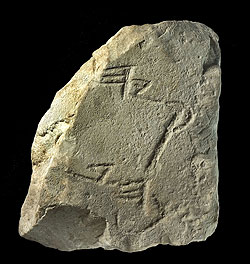
A fragment of a limestone plaque bearing several letters of ancient Hebrew script was discovered while sifting soil that was excavated in the vicinity of the Gihon Spring, within the precincts of the “Walls around Jerusalem National Park”.


The stone fragment dates to the eighth century BCE and this is based on the numerous pottery sherds that were discovered together with it, as well as the shape of the Hebrew letters that are engraved in the inscription.

The plaque is broken on all sides. All that remains of the inscription are two lines of writing: In the upper line the last part of a given name is preserved: ...]קיה, or as it is transliterated into English …]kiah. Unfortunately the remains of another letter before the kof cannot be discerned. If the letter preceding the kof was a zayin, we could complete the name to read חזקיה, or Hezekiah in English, and perhaps ascribe historical importance to the inscription. On the other hand, there are other first names that were used in Judah and Jerusalem at that time that could be mentioned here such as Hilkia, Amekiya, etc.

In the second line are the remains of two words. Here too, is a suffix of a word: ...]כה, or as it is transliterated into English …]ka. Here we have several possibilities for completing the word such as: בְּרָכָה, or birqa, that is, a greeting expressing best wishes (a possible ending for some sort of commemorative inscription). Another possibility is the word בְּרֵכָה, or brecha, meaning water reservoir. The reconstruction of this word is possible based on the fact that Brechat HaShiloah, or the Shiloah Pool in English, is located nearby, and also based on the fact that a pool is mentioned in the famous Shiloah inscription that was discovered close by.

In any event the fact that we are dealing with a stone plaque indicates that this is a commemorative inscription that may have been meant to celebrate some sort of building project.

All that remains is to wait and hope that in time other fragments of the inscription will be found.

Wednesday, October 28, 2009

Quarry from the End of the Second Temple Period

.

An ancient quarry, c. 1 dunam in area and dating to the end of the Second Temple period (c. 2,030 years old), was uncovered in excavations being conducted on Shmuel HaNavi Street in Jerusalem, under the direction of Dr. Ofer Sion and Yehuda Rapuano of the Israel Antiquities Authority, prior to the construction of residential buildings.


Dr. Ofer Sion, the excavation director on behalf of the Israel Antiquities Authority, believes, “The immense size of the stones (maximum dimensions: length 3 m, width 2 m, height 2 m) indicates it was highly likely that the large stones that were quarried at the site were destined for use in the construction of Herod’s magnificent projects in Jerusalem, including the Temple walls. It seems that a vast number of workers labored in the quarry where various size stones were produced: first they quarried small stones and when the bedrock surface was made level they hewed the large stones. The stones were quarried by creating wide detachment channels that were marked by means of a chisel which weighed c. 2.5 kilograms. After the channels were formed the stones were severed from the bedrock using hammers and chisels”.

“We know from historical sources that in order to build the Temple and other projects which Herod constructed, such as his palace, hundreds of thousands of various size stones were required – most of them weighing between two and five tons each”, said Dr. Sion. “The dimensions of the stones that were produced in the quarry that was revealed are suitable for the Temple walls. The large section that was exposed is actually a small part of an enormous series of quarries that was spread across the entire slope – from the Musrara Quarter to the Sanhedria Quarter. The massive quarrying effort, on the order of hundreds of thousands of stones, lowered the topography of Jerusalem in the vicinity of the Old City. Today, with the exposure of this quarry, the intensity of the building projects as described in the historical sources can be proven: Flavius Josephus wrote that before Herod built the Temple he prepared the infrastructure for it: the quarrying of the Temple’s stones lasted eight whole years. The Temple itself was built in a relatively short period of time of two years. With the exposure of the quarries in Sanhedria and Ramat Shlomo, it is clear that Herod began quarrying closest to the Temple and worked away from it: first he exploited the stone on the nearby ridges and subsequently he moved on to quarry in more distant regions”.


According to Dr. Sion, “In those days the world of hi-tech focused on quarrying, removing and transporting stones. Historical sources record that Herod trained more than 10,000 people to be involved in this work: they prepared suitable transportation routes and then moved the huge stones in a variety of ways – on rolling wooden fixtures that were drawn by camels, in pieces on carriages, etc.

Among the artifacts that were discovered in the excavation on Shmuel HaNaiv Street were metal plates (referred to in the Talmud as ‘cheeks’) that were used as fulcrums to severe the stones from the bedrock, and coins and pottery sherds that date to the end of the Second Temple period (the first century BCE).

2,000 Year Old Miqve in Jerusalem

-

A large and impressive ritual bath (miqve) from the end of the Second Temple period was recently uncovered in archaeological excavations the Israel Antiquities Authority is carrying out in the Western Wall tunnels, in cooperation with the Western Wall Heritage Foundation.


The miqve was discovered inside the western hall of a splendid structure that is located just c. 20 meters from the Western Wall. Parts of the building were discovered in the past and the Israel Antiquities Authority is currently exposing another one of the three halls inside it. It is one of the most magnificent structures from the Second Temple period ever to be uncovered.

The edifice is built of very delicately dressed ashlar stones and the architectural decoration in it is of the highest quality. From an architectural and artistic standpoint there are similarities between this structure and the three magnificent compounds that King Herod built on the Temple Mount, in the Cave of the Patriarchs and at Allonei Mamre, and from which we can conclude the great significance that this building had in the Second Temple period.

In his book The War of the Jews, Josephus Flavius writes there was a government administrative center that was situated at the foot of the Temple. Among the buildings he points out in this region were the council house and the “Xistus”- the ashlar bureau. According to the Talmud it was in this bureau that the Sanhedrin – the Jewish high court at the time of the Second Temple – would convene. It may be that the superb structure the Israel Antiquities Authority is presently uncovering belonged to one of these two buildings.

According to archaeologist Alexander Onn, director of the excavation on behalf of the Israel Antiquities Authority, “It is interesting to see that in the middle of the first century CE they began making changes in this magnificent structure – at that time it was no longer used as a government administrative building and a large miqve was installed inside its western hall where there were c. 11 steps that descend to the immersion pool. It seems that the city of Jerusalem grew in this period and it became necessary to provide for the increased ritual bathing needs of the pilgrims who came to the Temple in large numbers, especially during the three pilgrimage festivals (Shlosha Regalim). Immersing oneself in the miqve and maintaining ritual purity were an inseparable part of the Jewish way of life in this period, and miqve’ot were absolutely essential, especially in the region of the Temple.”

The Western Wall Heritage Foundation acts to uncover the Jewish people’s past at the Western Wall, and the miqve is further evidence of the deep ties the Jewish people have with Jerusalem and the Temple.

Rabbi Shmuel Rabinowitz, the rabbi in charge of the Western Wall and the holy places, pointed out the cooperation between the Western Wall Heritage Foundation and the Israel Antiquities Authority which have joined together in order to discover the rich history of Jerusalem there, while strictly ensuring that no excavations approach the Temple Mount compound, contact with which is forbidden by Halachic law.