Wednesday, December 9, 2020

Fatty residues on ancient pottery reveal meat-heavy diets of Indus Civilization


UNIVERSITY OF CAMBRIDGE

Research News

IMAGE

IMAGE: LEAD AUTHOR AKSHYETA SURYANARAYAN SAMPLING POTTERY FOR RESIDUE ANALYSIS IN THE FIELD. view more 

CREDIT: AKSHYETA SURYANARAYAN

New lipid residue analyses have revealed a dominance of animal products, such as the meat of animals like pigs, cattle, buffalo, sheep and goat as well as dairy products, used in ancient ceramic vessels from rural and urban settlements of the Indus Civilisation in north-west India, the present-day states of Haryana and Uttar Pradesh.

The study, published in Journal of Archaeological Science, was led by Dr Akshyeta Suryanarayan, former PhD student at the Department of Archaeology, University of Cambridge and current postdoctoral researcher at CEPAM, UMR7264-CNRS, France.

Dr Suryanarayan said: "The study of lipid residues involves the extraction and identification of fats and oils that have been absorbed into ancient ceramic vessels during their use in the past. Lipids are relatively less prone to degradation and have been discovered in pottery from archaeological contexts around the world. However, they have seen very limited investigation in ancient ceramics from South Asia."

"This study is the first to investigate absorbed lipid residues in pottery from multiple Indus sites, including the Indus city of Rakhigarhi, as well as other Indus settlements of Farmana and Masudpur I and VII, allowing comparisons to be made across settlements and across time."

The identification of specific compounds in the lipid extracts enables the detection of different plant or animal products, such as fatty acids, previously used in the vessels. Additionally, isotopic analysis of fatty acids enables the differentiation of different types of animal meat and milk. These analyses enable an understanding of vessel use and what was being cooked in them.

Suryanarayan said: "Our study of lipid residues in Indus pottery shows a dominance of animal products in vessels, such as the meat of non-ruminant animals like pigs, ruminant animals like cattle or buffalo and sheep or goat, as well as dairy products. However, as one of the first studies in the region there are interpretative challenges. Some of the results were quite unexpected, for example, we found a predominance of non-ruminant animal fats, even though the remains of animals like pigs are not found in large quantities in the Indus settlements. It is possible that plant products or mixtures of plant and animal products were also used in vessels, creating ambiguous results."

"Additionally, despite the high percentages of the remains of domestic ruminant animals found at these sites, there is very limited direct evidence of the use of dairy products in vessels, including in perforated vessels that have been previously suggested to be linked to dairy processing. A recent Scientific Reports study has reported more evidence of dairy products, primarily in bowls in Gujarat. Our results suggest that there may have been regional differences. The analysis of more vessels from different sites would help us explore these potential patterns."

Senior author Dr Cameron Petrie, University of Cambridge, said: "The products used in vessels across rural and urban Indus sites in northwest India are similar during the Mature Harappan period (c.2600/2500-1900 BC). This suggests that even though urban and rural settlements were distinctive and people living in them used different types of material culture and pottery, they may have shared cooking practices and ways of preparing foodstuffs."

"There is also evidence that rural settlements in northwest India exhibited a continuity in the ways they cooked or prepared foodstuff from the urban (Mature Harappan) to post-urban (Late Harappan) periods, particularly during a phase of climatic instability after 4.2 ka BP (c.2100 BC), which suggests that daily practices continued at small rural sites over cultural and climatic changes," Petrie said.

This study adds to existing research in the region which suggests the resilience of rural settlements in northwest India during the transformation of the Indus Civilisation, and during a period of increasing aridity.

The results also have major implications for broadening our understanding of the foodways of South Asia, as well as the relationship between pottery and foodstuffs.

Dr Suryanarayan concluded: "Our understanding of the culinary history of South Asia is still very limited but these results demonstrate that the use of lipid residues, combined with other techniques in bioarchaeology, have the potential to open exciting new avenues for understanding the relationship between the environment, foodstuffs, material culture, and ancient society in protohistoric South Asia."


Warm oceans helped first human migration from Asia to North America


UNIVERSITY OF WASHINGTON

Research News

IMAGE

IMAGE: THE PACIFIC OCEAN'S CURRENTS SUPPORT A DIVERSE ECOSYSTEM, SEEN HERE FROM SPACE WITH GREEN INDICATING BLOOMS OF PHOTOSYNTHESIZING PLANKTON. WARMER CURRENTS DURING THE ICE AGE MAY ALSO HAVE SUPPORTED EARLY... view more 

CREDIT: NASA/GODDARD SPACE FLIGHT CENTER, THE SEAWIFS PROJECT AND GEOEYE, SCIENTIFIC VISUALIZATION STUDIO


New research reveals significant changes to the circulation of the North Pacific and its impact on the initial migration of humans from Asia to North America.

The new international study led by the School of Earth and Environmental Sciences at the University of St Andrews and published Dec. 9 in Science Advancesprovides a new picture of the circulation and climate of the North Pacific at the end of the last ice age with implications for early human migration.

The Pacific Ocean contains around half the water in Earth's oceans and is a vast reservoir of heat and CO2. However, at present, the sluggish circulation of North Pacific restricts this heat and CO2's movement, limiting its impact on climate.

The international team of scientists used sediment cores from the deep sea to reconstruct the circulation and climate of the North Pacific during the peak of the last ice age. Their results reveal a dramatically different circulation in the ice age Pacific, with vigorous ocean currents creating a relatively warm region around the modern Bering Sea.

"Our data shows that the Pacific had a warm current system during the last ice age, similar to the modern Atlantic Ocean currents that help to support a mild climate in Northern Europe", said Dr James Rae, from the University of St Andrews who led the study.

The warming from these ocean currents created conditions more favourable for early human habitation, helping address a long-standing mystery about the earliest inhabitants of North America.

"According to genetic studies, the first people to populate the Americas lived in an isolated population for several thousand years during the peak of the last ice age, before spreading out into the American continents", said co-author Ben Fitzhugh, a professor of anthropology at the University of Washington.

This has been termed the "Beringian Standstill" hypothesis and a significant question is where this population lived after separation from their Asian relatives before deglaciation allowed them to reach and spread throughout North and South America. The new research suggests that these early Americans may have lived in a relatively warm refugium in southern Beringia, on the now submerged land beneath the Bering Sea. Due to the extremely cold climate that dominated other parts of this region during the ice age, it has been unclear, until now, how habitable conditions could have been maintained.

"The warm currents revealed by our data would have created a much more pleasant climate in this region than we might have previously thought", said co-author Will Gray, a research scientist at the Laboratory for Sciences of Climate and Environment institute in France.

"This would have created milder climates in the coastal regions of the North Pacific, that would have supported more temperate terrestrial and marine ecosystems and made it possible for humans to survive the ice age in an otherwise harsh climatic period."

"Our work shows how dynamic Earth's climate system is. Changes in the circulation of the ocean and atmosphere can have major impacts on how effectively humans may inhabit different environments, which is also relevant for understanding how different regions will be affected by future climate change", added co-author Robert Jnglin Wills, a postdoctoral researcher in atmospheric sciences at the University of Washington. 

New evidence: Neandertals buried their dead


CNRS

Research News

IMAGE

IMAGE: EXAMINING MATERIAL FROM THE 1970S EXCAVATIONS AT THE MUSÉE D'ARCHÉOLOGIE NATIONALE, FRANCE. THOUSANDS OF BONE REMAINS WERE SORTED AND 47 NEW FOSSIL REMAINS BELONGING TO THE NEANDERTAL CHILD 'LA FERRASSIE... view more 

CREDIT: © ANTOINE BALZEAU - CNRS/MNHN


Was burial of the dead practiced by Neandertals or is it an innovation specific to our species? There are indications in favour of the first hypothesis but some scientists remain sceptical. For the first time in Europe, however, a multi-disciplinary team led by researchers at the CNRS and the Muséum national d'histoire naturelle (France) and the University of the Basque Country (Spain) (1) has demonstrated, using a variety of criteria, that a Neandertal child was buried, probably around 41,000 years ago, at the Ferrassie site (Dordogne). Their study is published in the journal Scientific Reports on 9th December 2020.

Dozens of buried Neandertal skeletons have been discovered in Eurasia, leading some scientists to deduce that, like us, Neandertals buried their dead. Other experts have been sceptical, however, given that the majority of the best-preserved skeletons, found at the beginning of the 20th century, were not excavated using modern archaeological techniques.

It is within this framework that an international team (1) led by paleoanthropologists Antoine Balzeau (CNRS and Muséum national d'histoire naturelle, France) and Asier Gómez-Olivencia (University of the Basque Country, Spain), analysed a human skeleton from one of the most famous Neandertal sites in France: the La Ferrassie rock shelter, Dordogne. After six Neandertal skeletons were discovered at the beginning of the 20th century, the site delivered a seventh between 1970 and 1973, belonging to a child of around two years old. For almost half a century, the collections associated with this specimen remained unexploited in the archives of the Musée d'archéologie nationale.

Recently, a multidisciplinary team, assembled by the two researchers, reopened the excavation notebooks and reviewed the material, revealing 47 new human bones not identified during excavation and undoubtedly belonging to the same skeleton. The scientists also carried out a thorough analysis of the bones: state of preservation, study of proteins, genetics, dating, etc. They returned to La Ferrassie in the hope of finding further fragments of the skeleton; although no new bones were discovered, using the notebooks of their predecessors, they were able to reconstruct and interpret the spatial distribution of the human remains and the rare associated animal bones.

The researchers showed that the skeleton had been buried in a sedimentary layer which inclined to the west (the head, to the east, was higher than the pelvis), while the other stratigraphic layers of the site inclined to the north-east. The bones, which were relatively unscattered, had remained in their anatomical position. Their preservation, better than that of the bison and other herbivores found in the same stratum, indicates a rapid burial after death. Furthermore, the contents of this layer proved to be earlier than the surrounding sediment (2). Finally, a tiny bone, identified as human by the proteins and as Neandertal by its mitochondrial DNA, was directly dated using carbon-14. At around 41,000 years old, this makes it one of the most recent directly dated Neandertal remains.

This new information proves that the body of this two-year-old Neandertal child was purposefully deposited in a pit dug in a sedimentary layer around 41,000 years ago; however, further discoveries will be necessary to understand the chronology and geographical extension of Neandertal burial practices.

Friday, December 4, 2020

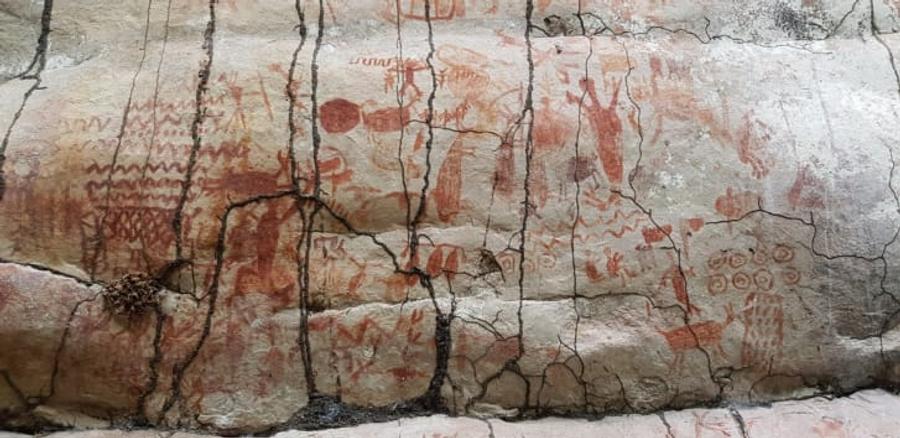
Incredible Ice Age Rock Art Featuring Extinct Animals Discovered In The Amazon


Rock art found in the Amazon rainforest. Image: Professor José Iriarte via CNN

Researchers from Colombia and the U.K. have found nearly eight miles of ancient rock art depicting numerous now-extinct Ice Age beasts, from mastodons to giant sloths.

The Amazon rainforest discovery in the Serranía La Lindosa (Colombia) is thought to be made around 11,800 to 12,600 years ago. Created with red ochre, the vivid images document megafauna, human figures, hunting scenes and a vast array of creatures such as deer, tapirs, alligators, bats, monkeys, turtles, serpents and porcupines.

"It is likely art was a powerful part of culture and a way for people to connect socially. The pictures show how people would have lived amongst giant, now extinct, animals, which they hunted," José Iriarte, Professor of Archaeology at Exeter, told CNN.

A new TV series, "Jungle Mystery: Lost Kingdoms of the Amazon," will showcase the rock art on the UK's Channel 4, and the findings are also described in an article in the journal Quaternary International.

Thursday, December 3, 2020

Ancient migration was choice, not chance - Paleolithic people likely colonized the Ryukyu Islands intentionally


IMAGE

IMAGE: A CANDIDATE BAMBOO CRAFT FOR THE RYUKYU MIGRATION BUILT FOR A RE-ENACTMENT OF THAT CROSSING. view more 

CREDIT: © 2020 YOSUKE KAIFU

The degree of intentionality behind ancient ocean migrations, such as that to the Ryukyu Islands between Taiwan and mainland Japan, has been widely debated. Researchers used satellite-tracked buoys to simulate ancient wayward drifters and found that the vast majority failed to make the contested crossing. They concluded that Paleolithic people 35,000-30,000 years ago must therefore have made the journey not by chance but by choice.

Human migration over the last 50,000 years is an essential part of human history. One aspect of this story that fascinates many is the ways in which ancient people must have crossed between separate land masses. Professor Yosuke Kaifu from the University Museum at the University of Tokyo and his team explore this subject, in particular a crossing known to have taken place 35,000-30,000 years ago from Taiwan to the Ryukyu Islands, including Okinawa, in southwestern Japan.

"There have been many studies on Paleolithic migrations to Australia and its neighboring landmasses, often discussing whether these journeys were accidental or intentional," said Kaifu. "Our study looks specifically at the migration to the Ryukyu Islands, because it is not just historically significant, but is also very difficult to get there. The destination can be seen from the top of a coastal mountain in Taiwan, but not from the coast. In addition, it is on the opposite side of the Kuroshio, one of the strongest currents in the world. If they crossed this sea deliberately, it must have been a bold act of exploration."

This issue of the intentionality of this journey is less straightforward to solve than you might imagine. To investigate the likelihood of the journey occurring by chance, the effect of the Kuroshio on drifting craft needed measuring. To do this, Kaifu and his team used 138 satellite-tracked buoys to trace the path of a would-be drifter caught on this journey.

"The results were clearer than I would have expected," said Kaifu. "Only four of the buoys came within 20 kilometers of any of the Ryukyu Islands, and all of these were due to adverse weather conditions. If you were an ancient mariner, it's very unlikely you would have set out on any kind of journey with such a storm on the horizon. What this tells us is that the Kuroshio directs drifters away from, rather than towards, the Ryukyu Islands; in other words, that region must have been actively navigated."

You might wonder how we can be so sure the current itself is the same now as it was over 30,000 years ago. But existing evidence, including geological records, tell researchers that currents in the region have been stable for at least the last 100,000 years. As for the researchers' confidence that Paleolithic voyagers would not dare face stormy conditions that might otherwise explain chance migrations, prior research suggests that these voyagers were groups including families, whose modern-day analogues do not take such risks.

"At the beginning, I had no idea how to demonstrate the intentionality of the sea crossings, but I was lucky enough to meet my co-authors in Taiwan, leading authorities of the Kuroshio, and came across the idea of using the tracking buoys," said Kaifu. "Now, our results suggest the drift hypothesis for Paleolithic migration in this region is almost impossible. I believe we succeeded in making a strong argument that the ancient populations in question were not passengers of chance, but explorers."


The impact of Neandertal DNA on human health


A researcher at the University of Tartu described new associations between Neandertal DNA and autoimmune diseases, prostate cancer and type 2 diabetes.

Modern humans migrated out of Africa more than 60,000 years ago and met and interbred with Neandertals and other archaic human groups. As a consequence, we can find that a few percent of the genomes of people outside of Africa contain traces of archaic ancestry. Large-scale resources with genetic and medical data are needed to find out how this archaic remains affect modern human health. Most previous studies have examined European population-specific cohorts. However, the Neandertal DNA content is quite different between Europeans and Asians and our knowledge limited about non-European Neandertal DNA. A new study by Senior Research Fellow of Evolutionary and Population Genomics Michael Dannemann analyzed Neandertal associated phenotypes in an Asian cohort and compared it to those discovered in a European cohort.

This study provides evidence that the impact of Neandertal DNA on the immune system has not been population-specific. "My findings show that while the Neandertal DNA in European and Asian populations differ they both contain variants that increase the risk of autoimmune diseases like dermatitis, Graves' disease and rheumatoid arthritis," said Dannemann.

Another disease for which associations were found in both populations was prostate cancer. Dannemann said that the difference is here that this gene variant had a protective effect which means it reduces the risk for prostate cancer.

Of particular interest were the Neandertal associations with type 2 diabetes, a disease influencing many people today. The result of this study showed that Neandertal-linked associations were only found in Asians and showed evidence for an over-proportional effect on this disease given the Neandertal DNA content in this population.

However, given the different associated archaic variants in both European and Asian cohorts, the results of this study also suggest that the effects of how Neandertal DNA influences immunity might be population-specific. "This is highlighting the importance of studying a wider range of ancestries to help us to ascertain how the phenotypic legacy of Neandertals influences modern humans today," added Dannemann.

Wednesday, December 2, 2020

Videoscope analysis of a Neanderthal skeleton reveals detailed dental information


IMAGE

IMAGE: AN IMAGE OF THE SKULL, COMBINED WITH A DETAIL OF THE PALATE, WITH THE MAXILLARY TEETH VISIBLE. view more 

CREDIT: SOPRINTENDENZA ABAP PER LA CITTÀ METROPOLITANA DI BARI.

In situ observations on the dentition and oral cavity of the Neanderthal skeleton from Altamura (Italy)

Funding: This work was supported by Ministero dell'Istruzione, dell'Università e della Ricerca, PRIN 2015 grant to G.M., J.M.-C. and D.M., number 2015WPHSCJ, prin.miur.it. The Soprintendenza A.B.A.P. per la città metropolitana di Bari (formerly Soprintendenza Archeologia per la Puglia); the "G. Sergi" Museum of Anthropology (Sapienza University of Rome) and the Museo delle Civiltà (section "L. Pigorini", Rome) granted access to fossil specimens. The company Olympus (Olympus Italia S.r.l. and Olympus Europe) provided the endoscopic equipment. DentaForm S.r.l. (Pistoia, Italy) provided the NOMAD™ Pro 2 X-ray system and the KaVo ScanXam™. The funders had no role in study design, data collection and analysis, decision to publish, or preparation of the manuscript.

Competing Interests: The authors have declared that no competing interests exist.

Article URL: https://journals.plos.org/plosone/article?id=10.1371/journal.pone.0241713