Around one million years ago, early humans
were skillful at using the landscape features of the Kenyan Rift to
ambush and kill their prey, according to new research published in
Scientific Reports.
The area was a popular grazing site for larger animals (e.g., giant
gelada baboons, elephants, hippopotami and the spotted hyenas) due to
its locally high nutrient levels and the presence of an ancient
freshwater lake, together with the relative lack of dangerous predators,
such as lions.
An interdisciplinary team of anthropologists and earth scientists
have shown that animal movements were constrained to particular pathways
due to the restrictions imposed by the landscape.
Early humans became adept at predicting these pathways enabling them
to ambush large and dangerous animals as evidenced by the butchered
remains present at the site, in association with numerous stone tools.
Previous discoveries in the Olorgesailie region of the Kenyan Rift
include a large number of Acheulean hand axes, associated with the
butchery of large mammals and indicated that the area was well populated
with hominins, who returned to the site repeatedly.
The region looks significantly different today than it would have
done a million years ago due to a combination of climate changes,
earthquakes and volcanism.
However, the research teams were able to adjust for the effects of
fault motion, making corrections for erosion and the deposit of
sediment, to create a model of the ancient landscape and show how our
ancestors could have exploited it.
Dr Sally Reynolds (Bournemouth University), lead researcher in the
UK, explains how innovative modelling methods enabled the team to make
their discoveries, "By reconstructing the topographic setting in the
area and examining the trace nutrients in soils there now and
interviewing local Maasai leaders about current animal grazing
activities, we were able to build up a picture of animal movements
around one million years ago."
Explaining why the landscape of the area a million years ago would
have been conducive to ambush-based hunting techniques, Dr Reynolds
said, "The Olorgesailie region was particularly well placed for
ambushing larger animals because the landscape limited the routes taken
by those animals as they travelled through the area.
"Areas of higher elevation provided excellent lookout points as well.
There was also good access to reliable drinking water and a ready
supply of workable stone for the creation of hunting tools, making it an
ideal location for hominin occupation."
The work provides a new and exciting landscape based framework in
which to evaluate this and other hominin sites and as such will change
the way we interpret our ancestral record.
Skeletal fossils of the hand of Homo naledi pictured in the Wits bone vault at the Evolutionary Studies Institute at the University of the Witwatersrand, Johannesburg, South Africa, on Sept. 13, 2014. The fossil hand is one of many fossils representing a new species of hominin. The broad thumb of Homo naledi suggests it was an expert climber. The Rising Star Expedition, a project that retrieved and analyzed the fossils was led in part by paleoanthropologist John Hawks, professor of anthropology at the University of Wisconsin-Madison.
CREDIT (Photo by John Hawks/University of Wisconsin-Madison)
MADISON, Wis. -- Working in a cave complex deep beneath South Africa's Malmani dolomites, an international team of scientists has brought to light an unprecedented trove of hominin fossils -- more than 1,500 well-preserved bones and teeth -- representing the largest, most complete set of such remains found to date in Africa.
The discovery of the fossils, cached in a barely accessible chamber in a subterranean labyrinth not far from Johannesburg, adds a new branch to the human family tree, a creature dubbed Homo naledi.
The remains, scientists believe, could only have been deliberately placed in the cave.
So far, parts of at least 15 skeletons representing individuals of all ages have been found and the researchers believe many more fossils remain in the chamber. It is part of a complex of limestone caves near what is called "The Cradle of Humankind," a World Heritage Site in Gauteng province well known for critical paleoanthropological discoveries of early humans, including the 1947 discovery of 2.3 million-year-old Australopithecus africanus.
"We have a new species of Homo, with all of its interesting characteristics," says John Hawks, a University of Wisconsin-Madison paleoanthropologist and one of the leaders of a team that painstakingly retrieved the fossils under excruciatingly cramped and difficult conditions. "We now have the biggest discovery in Africa for hominins."
The find was reported today (Sept. 10, 2015) with the publication of two papers in the open access journal eLife by a group led by paleoanthropologist Lee R. Berger of the University of Witwatersrand. The expedition to retrieve the fossils and their subsequent analysis was supported by the National Geographic Society.
With a small head and brain, hunched shoulders, powerful hands and thin limbs, Homo naledi was built for long-distance walking, says Hawks, an expert on early humans. Fully grown, it stood about five feet tall, was broad chested, walked upright and had a face, including a smile that was probably more human than apelike. Powerful hands imply it was also a climber.
The fossils have yet to be dated. The unmineralized condition of the bones and the geology of the cave have prevented an accurate dating, says Hawks. "They could have been there 2 million years ago or 100,000 years ago, possibly coexisting with modern humans. We don't yet have a date, but we're attempting it in every way we can."
So far, the remains of newborns to the aged have been retrieved from the cave and the researchers expect that many more bones remain in the chamber, which is nearly 100 feet underground and accessible only after squeezing, clambering and crawling 600 feet to a large chamber where the brittle fossils cover the floor.
"We know about every part of the anatomy, and they are not at all like humans," notes Hawks, who co-directed the analysis of the fossils. "We couldn't match them to anything that exists. It is clearly a new species."
The astonishing find was made initially by amateur cavers and thought at the time to be a single hominin skeleton. The fossils were retrieved by a band of diminutive paleoanthropologists, all women, recruited for their size. (See below)
"Naledi" means star in the Sesotho language and is a reference to the
Rising Star cave system that includes the chamber, known as the Dinaledi
Chamber, where the fossils were found. The circuitous and difficult
passage to the chamber narrows at one point to a bare seven inches.
In
addition to identifying an entirely new species in the genus Homo, the
collections of fossils, which bear no marks from predators or
scavengers, are strong evidence that Homo naledi was deliberately
depositing its dead in the cave, according to Hawks, a UW-Madison
professor of anthropology.
"We think it is the first instance of
deliberate and ritualized secreting of the dead," says Hawks. "The only
plausible scenario is they deliberately put bodies in this place."
The
cave, according to Hawks, was likely more accessible to Homo naledi
than it is today for modern humans. Geochemical tests, however, show
that the cave was never open to the surface, raising intriguing
questions about the behavior and technologies available to the
creatures.
"We know it was not a death trap," says Hawks,
referring to natural features like hidden sinkholes that sometimes trap
and doom creatures over long periods of time. "There are no bones from
other animals aside from a few rodents. And there are no marks on the
bones from predators or scavengers to suggest they were killed and
dragged to the chamber. We can also rule out that it was a sudden mass
death."
Instead, Hawks, Berger and their colleagues believe the
chamber was something like a repository. "It seems probable that a group
of hominins was returning to this place over a period of time and
depositing bodies," Hawks explains, adding that the supposition is akin
to discovering similar behavior in chimpanzees. "It would be that
surprising."
The way the bodies are arranged and their
completeness suggests they were carried to the cave intact. "The bodies
were not intentionally covered and we're not talking about a religious
ceremony, but something that was repeated and repeated in the same
place. They clearly learned to do this and did it as a group over time.
That's cultural. Only humans and close relatives like Neandertals do
anything like this."
So far, no other organic materials or evidence of fire have been found in the cave complex.
Dating
the fossils remains a key problem to solve, says Hawks. "We depend on
the geology to help us date things, and here the geology isn't much like
other caves in South Africa. And the fossils don't have anything within
them that we can date. It's a problem for us."
One hope, he
says, is finding the remains of an animal that may have been a
contemporary of Homo naledi. The fossils are embedded in a matrix of
soft sediment and there are layers that remain unexcavated.
According
to Hawks, years of work remain at the site and to document and analyze
all of the materials excavated from the Dinaledi Chamber. Plans, he
says, include bringing many new technologies to bear on analyzing the
fossils to help determine diet, rate of aging and where on the landscape
the creatures may have been from.
The project to excavate the
fossils and the May 2014 scientific workshop to analyze them were
supported by the National Geographic Society, the South African National
Research Foundation, the Gauteng Provincial Government, and Wits
University. The Wisconsin Alumni Research Foundation also provided
support, as did the Texas A&M College of Liberal Arts Seed Grant
Program.
Berger led the Rising Star expedition as National
Geographic Explorer-in-Residence. The expedition involved an
international team of scientists, including six "underground astronauts"
who descended into the Dinaledi chamber to excavate and retrieve the
fossils of Homo naledi.
JOURNEY TO AMAZING HOMININ DISCOVERY STARTED ON FACEBOOK
MADISON, Wis. - The Facebook query was both exacting and cryptic:
"We need perhaps three or four individuals with excellent archaeological/paleontological excavation skills for a short term project that may kick off as early as November 1st 2013 and last the month if all logistics go as planned. The catch is this - the person must be skinny and preferably small. They must not be claustrophobic, they must be fit, they should have some caving experience, climbing experience would be a bonus. They must be willing to work in cramped quarters, have a good attitude and be a team player."
Although University of Wisconsin-Madison anthropology graduate student Alia Gurtov didn't quite know why she was raising her hand in response, she fit the bill. Slight in stature with a background in paleoanthropology, including work at famed Olduvai Gorge in Tanzania, Gurtov took a flyer.
"I just applied," Gurtov recalls. "In a very bizarre email, I gave my dimensions and my CV" and soon after, the Wisconsin researcher was on a flight to South Africa -- where she would play a lead role in discovering and retrieving the largest, most complete store of hominin fossils on a continent famous for such discoveries.
A bantam frame was needed because Gurtov and five other small women scientists were about to enter a difficult and dangerous subterranean labyrinth. Going down into the South African earth, Gurtov and her diminutive colleagues would clamber, crawl, climb and, finally, drop into a space where they could enter a chamber last visited hundreds of thousands or perhaps millions of years ago by creatures that, scientists believe, were repeatedly secreting their dead companions, protecting them from scavengers and, at the same time, creating an astonishing paleontological record of a lost member of the tribe of humanity, a hominin species dubbed Homo naledi.
"It was very, very narrow," recalls Gurtov. "There is a 7-inch chokepoint. The only way I could fit in is if I had my head turned to the side."
The grueling 20- to 25-minute commute from daylight to the chamber of fossils included technical climbing, where the researchers, aided by an experienced caver, donned harnesses to mount a feature called the "Dragon's Back." Gurtov and her colleagues were forced to navigate several "squeezes," including one 15-foot section called the "Superman Crawl," where forward progress required wriggling on one's belly with arms extended like the soaring Man of Steel. The final leg of the underground foray, "the worst chokepoint," involved slithering down a 12-foot, crag-studded chute in the dark.
The expedition, overseen by noted paleoanthropologist Lee Berger of the University of Witwatersrand, was organized to investigate what was believed to be a single hominin skeleton, first spotted by cavers.
"You're in this initial chamber and then you have to squeeze through a crevice that opens into the chamber where the skull was observed," Gurtov explains.
Entering for the first time, she recalls, was a solemn moment. "It had the feeling of a tiny cathedral. It was just so still and dynamic at the same time. There was a sense of ages. It was absolutely silent. The floor was covered in skeletal material."
"We knew there was a skull in there. We had no idea we were going to find more than that," says the Wisconsin researcher.
Typically at the site of a hominin discovery, the first thing examined are the teeth, because they are telltale and -- as the hardest materials in the body -- tend to preserve well, says Gurtov, who spends much of her time at Tanzania's Olduvai Gorge looking at the teeth of animals preyed upon by ancient hominins. "We saw pretty quick that we had more teeth than would fit in a single mouth," Gurtov happily notes. When not in the cave, she lent her expertise on dentition to the group assembled to analyze the fossils.
Over that month in the field, Gurtov and her companions returned many times to the chamber, now known as the Dinaledi Chamber. Working 6- to 8-hour shifts below ground, the team recovered more than 1,500 pieces of bone by clearing the floor and excavating one small section of soft cave floor sediment, a puzzle box of fossils. "It was like pick-up sticks," says Gurtov. "You couldn't get one thing out without excavating something else. The sheer volume of material makes it unique."
The fossils were excavated according to the forensic techniques prescribed by paleontology, often with a toothpick, from the cave's clumpy, wet sediment. Wrapped in paper and nested in plastic containers, the bones of Homo naledi were prepped for the journey out to another kind of vault where they would be measured, documented, studied and reconstructed to reveal an entirely new species of hominin.
An intriguing find consisting of an
impressive pyramid-shaped staircase constructed of large ashlar stones
was uncovered in an archaeological excavation currently conducted by the
Israel Antiquities Authority. The excavation is located in the
Jerusalem Walls National Park in the City of David, site of ancient
Jerusalem, and is being carried out in cooperation with the Israel
Nature and Parks Authority and the City of David Foundation.
This structure, situated alongside the
2,000 year old Second Temple stepped street, which carried pilgrims on
their way from the Shiloah (Siloam) Pool to the Temple, which stood atop
the Temple Mount. The street, a section of which was excavated in the
past, is remarkably well-preserved and is built of enormous stone slabs.
The street most likely runs above the 2,000 year old drainage channel,
discovered a number of years ago, which carried rain water out of the
city. It was constructed sometime in the fourth decade of the first
century CE, and was one of the largest construction projects undertaken
in Jerusalem during the Second Temple period. Dozens of whole pottery
vessels, stone vessels and glassware were found at the foot of the
pyramid-shaped staircase.
According to archaeologists
Nahshon Szanton and Dr. Joe Uziel, who direct of the excavation on
behalf of the Israel Antiquities Authority, "The structure
exposed is unique. To date such a structure has yet to be found along
the street in the numerous excavations that have taken place in
Jerusalem and to the best of our knowledge outside of it. For this
reason, its exact use remains enigmatic. The structure is built along
the street in a place that is clearly visible from afar by passers-by
making their way to the Temple. We believe the structure was a kind of
monumental podium that attracted the public’s attention when walking on
the city’s main street. It would be very interesting to know what was
said there 2,000 years ago. Were messages announced here on behalf of
the government? Perhaps news or gossip, or admonitions and street
preaching – unfortunately we do not know. Bliss and Dickie, two British
archaeologists who discovered a small portion of this structure about
100 years ago, mistakenly thought these were steps that led into a house
that was destroyed. They would certainly be excited if they could come
back today and see it completely revealed”.
We know from rabbinic sources there
were “stones” that were used for public purposes during the Second
Temple period. For example, one source cites the “auction block” in
connection with the street: “[a master] will not set up a market stand
and put them (slaves) on the auction block” (Sifra, BeHar 6). In the
Mishnah and Talmud the “Stone of Claims” is mentioned as a place that
existed in Jerusalem during the Second Temple period: “Our Rabbis
taught: There was a Stone of Claims in Jerusalem: whoever lost an
article repaired thither, and whoever found an article did likewise. The
latter stood and proclaimed, and the former submitted his
identification marks and
received it back. And in reference to this we learnt: Go forth and see
whether the Stone of Claims is covered” (Bava Metzia 28:B).
On Thursday (3.9), at the City of David Studies of Ancient Jerusalem’s 16th
Annual Conference that will be open to the public, Nahshon Szanton and
Dr. Joe Uziel will present their findings from the excavation and the
different interpretations regarding the nature of the podium. According
to them, “Given the lack of a clear archaeological parallel to the
stepped-structure, the purpose of the staircase remains a mystery. It is
certainly possible the rabbinical sources provide valuable information
about structures, such as this, although for the time being there is no
definitive proof.”
Information about the conference can be found on the City of David website: www.cityofdavid.org.il.
New findings show that Philistine culture had a major and long-term impact on floral biodiversity in Israel and may assist ecologists in dealing with invasive species.
This is the structure of Iron Age Floral List at each site. Circle size reflects the total number of new plant species recognized in Iron Age sites. Red indicates new species that appeared only in Philistine Iron Age sites. Green indicates species that appeared only in non-Philistine Iron Age contexts. Blue denotes species shared by Philistine and non-Philistine sites. The three numbers represent the quantity of Philistine species/non-Philistine species/shared species, at a site. CREDIT Map produced by M. Frumin using ArcGIS for Desktop (ArcMap 10.1), ESRI.
One of the most pressing issues in modern biological conservation is "invasion biology". Due to unprecedented contacts between peoples and culture in today's "global village" certain animal and plant species are spreading widely throughout the world, often causing enormous damage to local species.
Recent studies have shown that alien species have had a substantial impact not only in recent times but also in antiquity. This is exemplified in a study published in the August 25th issue of Scientific Reports by a team led by archaeologists from Bar-Ilan University's Martin (Szusz) Department of Land of Israel Studies and Archaeology (Suembikya (Sue) Frumin, Prof. Ehud Weiss and Prof. Aren Maeir) and the Hebrew University (Dr. Liora Kolska Horwitz), describing the bio-archaeological remains of the
Philistine culture during the Iron Age (12th century to 7th century BCE). The team compiled a database of plant remains extracted from Bronze and Iron Ages sites in the southern Levant, both Philistine and non-Philistine. By analyzing this database, the researchers concluded that the Philistines brought to Israel not just themselves but also their plants.
The species they brought are all cultivars that had not been seen in Israel previously. This includes edible parts of the opium poppy (Papaver somniferum) which originates in western Europe; the sycamore tree (Ficus sycomorus), whose fruits are known to be cultivated in the eastern Mediterranean, especially Egypt, and whose presence in Israel as a locally grown tree is first attested to in the Iron Age by the presence of its fruit; and finally, cumin (Cuminum cyminum), a spice originating in the Eastern Mediterranean. Sue Frumin, a PhD student at Prof. Ehud Weiss's archaeobotanical lab, Bar-Ilan University, explains that "the edible parts of these species - opium poppy, sycamore, and cumin - were not identified in the archaeobotanical record of Israel prior to the Iron Age, when the Philistine culture first appeared in the region. None of these plants grows wild in Israel today, but instead grows only as cultivated plants."
In addition to the translocation of exotic plants from other regions, the Philistines were the first community to exploit over 70 species of synanthropic plants (species which benefit from living in the vicinity of man) that were locally available in Israel, such as Purslane, Wild Radish, Saltwort, Henbane and Vigna. These plant species were not found in archaeological sites pre-dating the Iron Age, or in Iron Age archaeological sites recognized as belonging to non-Philistine cultures - Canaanite, Israelite, Judahite, and Phoenician. The "agricultural revolution" that accompanied the Philistine culture reflects a different agrarian regime and dietary preferences to that of their contemporaries.
The fact that the three exotic plants introduced by the Philistines originate from different regions accords well with the diverse geographic origin of these people. The Philistines - one of the so called Sea Peoples, and mentioned in the Bible and other ancient sources - were a multi-ethnic community with origins in the Aegean, Turkey, Cyprus and other regions in the Eastern Mediterranean who settled on the southern coastal plain of Israel in the early Iron Age (12th century BCE), and integrated with Canaanite and other local populations, finally to disappear at the end of the Iron Age (ca. 600 BCE).
The results of this research indicate that the ca. 600 year presence of the Philistine culture in Israel had a major and long-term impact on local floral biodiversity. The Philistines left as a biological heritage a variety of plants still cultivated in Israel, including, among others, sycamore, cumin, coriander, bay tree and opium poppy.
The Philistines also left their mark on the local fauna. In a previous study also published in Scientific Reports in which two of the present authors (Maeir and Kolska Horwitz) participated, DNA extracted from ancient pig bones from Philistine and non-Philistine sites in Israel demonstrated that European pigs were introduced by the Philistines into Israel and slowly swamped the local pig populations through inter-breeding. As a consequence, modern wild boar in Israel today bears a European haplotype rather than a local, Near Eastern one.
As illustrated by these studies, the examination of the ancient bio-archaeological record has the potential to help us understand the long-term mechanisms and vectors that have contributed to current floral and faunal biodiversity, information that may also assist contemporary ecologists in dealing with the pressing issue of invasive species.
Items excavated from the shipwreck. Credit: University of Haifa The "Baron de Rothschild's Ship" was one of three ships used to carry raw materials from France to a glass factory established by the baron at Tantura. The ship vanished without a trace in the late nineteenth century. Has it now been found more than a century later? In a new study, researchers from the Leon Recanati Institute for Maritime Studies at the University of Haifa seek to show that a shipwreck discovered at Dor Beach in 1976 may be identified as the missing Baron's Ship. "We know that two of the baron's three ships were sold, but we have no information concerning the third ship. The ship we have found is structurally consistent with the specifications of the Baron's ships, carried a similar cargo, and sailed and sank during the right period," explained Dr. Deborah Cvikel and Micky Holtzman, who are investigating the shipwreck.
In 1893 the Baron de Rothschild founded a glass factory at Tantura beach in order to enable the local production of wine bottles for the winery at nearby Zichron Yaacov. The factory was actually established and managed by Meir Dizengoff, the first mayor of Tel Aviv. The Baron de Rothschild even purchased three small ships to transport raw materials from factories in France to the factory at Tantura and hired Jewish crews to man the ships. Contemporary records detail the purchase of the ships and specify their models. It was also noted that the ships were damaged and required repairs. Two of the ships were ultimately sold, while the fate of the third ship remains unknown.
Dr. Cvikel and Mr. Holtzman are now proposing the hypothesis that a two-masted shipwreck off the coast at Dor (Tantura) that was first excavated in 1999 may be the missing Baron's Ship. The shipwreck was excavated underwater in 1999-2000 in a study that focused mainly on the structure of the ship, and again in 2008 in a study that focused mainly on its contents, which included pots, earthenware, ceramic tiles, roof tiles, barrels, crates, and several sacks. The present study is based on the processing of findings from the 2008 excavation.
Following the initial underwater excavations, the researchers concluded that the shipwreck is a two-masted schooner and dated it very roughly to 1660-1960. The present processing of the findings has narrowed this timeframe considerably. A more precise dating of the vessel itself, and particularly of the date of its last voyage, was possible thanks to the findings on the pots, ceramic tiles, and roof tiles. In a meticulous review, the researchers found that most of these items were stamped with the name of the factory in which they were manufactured. They found a total of six different factory stamps, all relating to French factories active in the late nineteenth century. Once they found the lion motif of a company called Guichard Frères, the date on which the ship sank could be narrowed still further, since this company appears in the Marseille commercial yearbook in 1889-1897.
Accordingly, it is apparent that the ship was carrying French raw materials to Palestine for use in the new settlement at Zichron Yaacov (particularly roof tiles and ceramic tiles), and that its route passed close to Tantura in the late nineteenth century. A closer link with the Baron's ships is added by the fact that in one of the pots the researchers found the substance Barium sulfate (BaSO4), which is known as a material that enhances the transparency and shine of glass.
"This ship could certainly be one of dozens of similar ships that plied the coasts of Palestine during this period," the researchers acknowledge. "However, there seem to be more than a few items that connect it with Zichron Yaacov, with the glass factory at Tantura, and with the Baron's Ships. Perhaps we can now conclude that the third ship was not sold and condemned to obscurity like its sisters, but sank with its cargo still onboard."
An extraordinary find that has fired archaeologists’
imagination was discovered about two months ago in the Arnona quarter
during a routine archaeological inspection by the Israel Antiquities
Authority of the construction of a nursery school being built at the
initiative of the Jerusalem municipality.
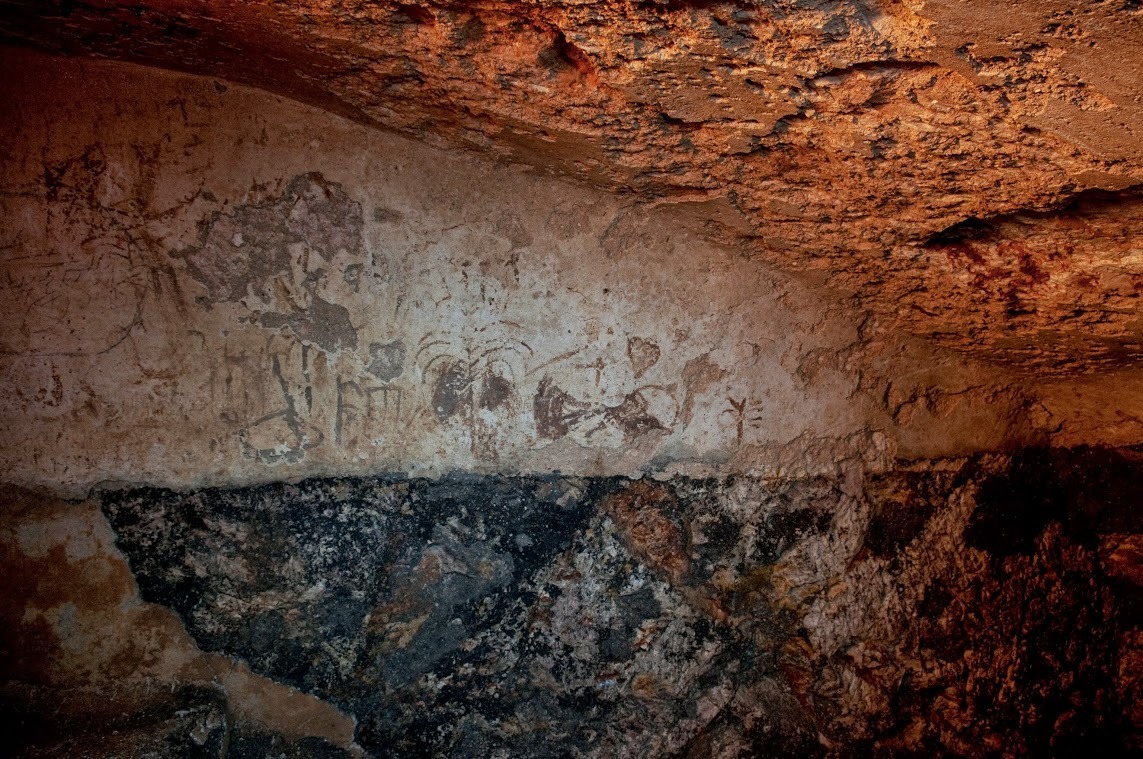
In the excavation an impressive ritual bath (miqwe) dating to the time
of the Second Temple (first century CE) was exposed inside an
underground cave. An anteroom, flanked by benches, led to the bath. A
winepress was excavated alongside the ritual bath.
The walls of the miqwe were treated with ancient plaster and were
adorned with numerous wall paintings and inscriptions, written in mud,
soot and incising. The inscriptions are Aramaic and written in cursive
Hebrew script, which was customary at the end of the Second Temple
period. Among the symbols that are drawn are a boat, palm trees and various plant species, and possibly even a menorah.
According to Royee Greenwald and Alexander Wiegmann, excavation
directors on behalf of the Israel Antiquities Authority, “There is no
doubt that this is a very significant discovery Such a concentration of
inscriptions and symbols from the Second Temple period at one
archaeological site, and in such a state of preservation, is rare and
unique and most intriguing”. At this point in the research the
inscriptions are a mystery. Some of the inscriptions might indicate
names. The symbols depicted on the walls are common elements in the
visual arts of the Second Temple period. In the meantime, the drawing
that might possibly be construed as a menorah is exceptional because in
those days they abstained from portraying this sacred object which was
located in the Temple. According to the excavators, “On the one hand the
symbols can be interpreted as secular, and on the other as symbols of
religious significance and deep spirituality”.
Moshe (Kinley) Tur-Paz, head of the Education Administration at the
Jerusalem Municipality said, “The large education system in Jerusalem is
always in need of additional school buildings. The unique find was
discovered in a compound where two nursery schools are slated to be
built and the Israel Antiquities Authority is currently carrying out the
conservation process there. The archaeological and historical site that
was exposed is of tremendous value to our identity as a Jewish people
which might shine more lighton the lives of our ancestors in the city of
Jerusalem. We will maintain contact with the Israel Antiquities
Authority and together we will examine how we can give educational and symbolic expression to the discovery that was found".
A number of issues and questions now face the researchers: What is the
relationship between the symbols and the inscriptions, and why, of all
places, were they drawn in the ritual bath? Who is responsible for
painting them? Was it one person or several people? Was it someone who
jokingly wanted to scribble graffiti, or perhaps what we have here is a
desire to convey a deeply spiritual and religious message, perhaps even a
cry for help as a result of a traumatic event (the destruction of the
Temple and the catastrophic war of 66-70 CE)?
The wall paintings are so sensitive that their exposure to the air
causes damage to them. As soon as the inscriptions were discovered the
Israel Antiquities Authority began implementing complex conservation
measures. They underwent initial treatment at the site, were removed in
their entirety from the ritual bath, and transferred to the conservation
laboratories of the Israel Antiquities Authority for further treatment
and stabilization. In the future the Israel Antiquities Authority will
display the spectacular inscriptions to the general public.
IMAGE: THIS IS A VIEW OF THE REMAINS OF THE IRON AGE CITY WALL OF PHILISTINE GATH. view more
CREDIT: PROF. AREN MAEIR, DIRECTOR, ACKERMAN FAMILY BAR-ILAN UNIVERSITY EXPEDITION TO GATH
The Ackerman Family Bar-Ilan University Expedition to Gath, headed by Prof. Aren Maeir, has discovered the fortifications and entrance gate of the biblical city of Gath of the Philistines, home of Goliath and the largest city in the land during the 10th-9th century BCE, about the time of the "United Kingdom" of Israel and King Ahab of Israel. The excavations are being conducted in the Tel Zafit National Park, located in the Judean Foothills, about halfway between Jerusalem and Ashkelon in central Israel.
Prof. Maeir, of the Martin (Szusz) Department of Land of Israel Studies and Archaeology, said that the city gate is among the largest ever found in Israel and is evidence of the status and influence of the city of Gath during this period. In addition to the monumental gate, an impressive fortification wall was discovered, as well as various building in its vicinity, such as a temple and an iron production facility. These features, and the city itself were destroyed by Hazael King of Aram Damascus, who besieged and destroyed the site at around 830 BCE.
The city gate of Philistine Gath is referred to in the Bible (in I Samuel 21) in the story of David's escape from King Saul to Achish, King of Gath.
Now in its 20th year, the Ackerman Family Bar-Ilan University Expedition to Gath, is a long-term investigation aimed at studying the archaeology and history of one of the most important sites in Israel. Tell es-Safi/Gath is one of the largest tells (ancient ruin mounds) in Israel and was settled almost continuously from the 5th millennium BCE until modern times.
The archaeological dig is led by Prof. Maeir, along with groups from the University of Melbourne, University of Manitoba, Brigham Young University, Yeshiva University, University of Kansas, Grand Valley State University of Michigan, several Korean universities and additional institutions throughout the world.
Among the most significant findings to date at the site: Philistine Temples dating to the 11th through 9th century BCE, evidence of an earthquake in the 8th century BCE possibly connected to the earthquake mentioned in the Book of Amos I:1, the earliest decipherable Philistine inscription ever to be discovered, which contains two names similar to the name Goliath; a large assortment of objects of various types linked to Philistine culture; remains relating to the earliest siege system in the world, constructed by Hazael, King of Aram Damascus around 830 BCE, along with extensive evidence of the subsequent capture and destruction of the city by Hazael, as mentioned in Second Kings 12:18; evidence of the first Philistine settlement in Canaan (around 1200 BCE); different levels of the earlier Canaanite city of Gath; and remains of the Crusader castle "Blanche Garde" at which Richard the Lion-Hearted is known to have been.