The exceptional findings are now published in the Israel Antiquities Authority’s ʼAtiqot journal Issue 117 * This discovery sheds light on Unexpected Cultural Links in the Negev 1,500 years ago
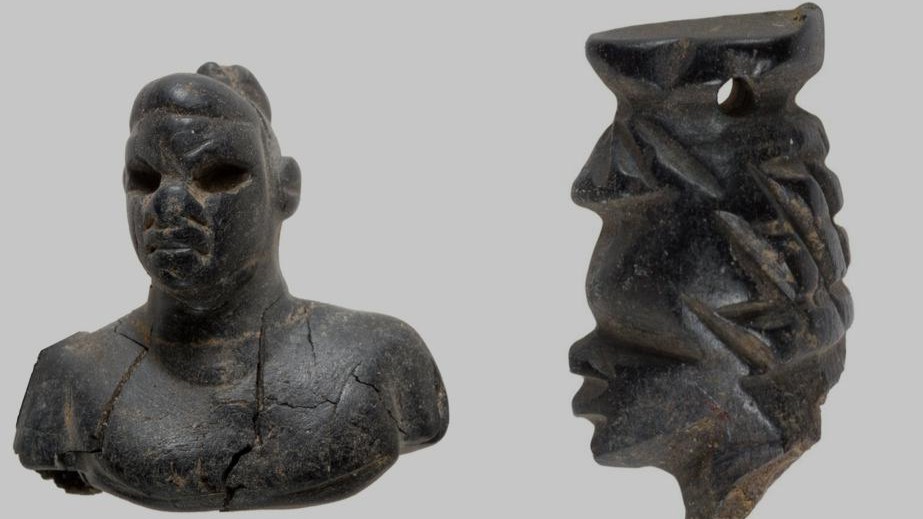
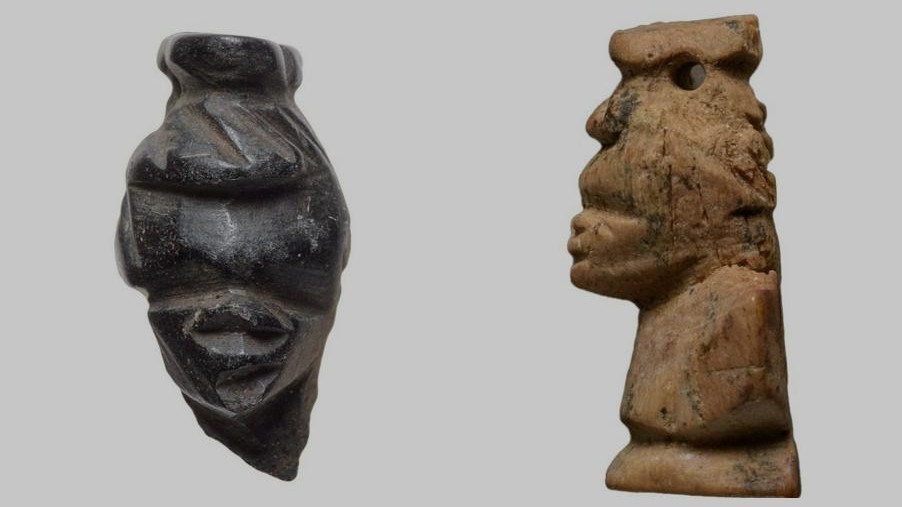
Two of the figurines placed as a burial offering. Photo: Dafna Gazit, Israel Antiquities Authority
Two of the figurines placed as a burial offering. Photo: Dafna Gazit, Israel Antiquities Authority
Ancient unique finds in the South: Five tiny figurines – including heads of African figures carved in black wood – were uncovered in 1500-year-old graves of women and children during an archaeological dig at Tel Malḥata in the Negev’s Arad Valley. The research on these findings, conducted by Dr. Noé D. Michael of the Israel Antiquities Authorityand the University of Cologne in Germany, along withSvetlana Tallis, Dr. Yossi Nagar and Emil Aladjem from the Israel Antiquities Authority, is now published in Issue 117 of the Israel Antiquities Authority’s ʼAtiqot journal.
"The figurines show that a Christian community lived in the south of the country about 1,500 years ago, possibly with some of its members coming from Africa”, say the researchers. “Carved from bone, and from ebony wood – a rare raw material originating from southern India and Sri Lanka –the figurines were designed in the form of women and men bearing prominent African facial features, and with a hole for the purpose of wearing them around the neck. It seems their purpose was not only decorative – but also as intimate personal items carrying with them a story of identity, tradition and memory.”
Carefully placed in the tomb alongside women and children, the figurines were exceptionally well-preserved. According to the researchers, “It is possible that the figures represent ancestors, and thus they reflect traditions passed down from generation to generation – even after the adoption of the Christian religion.”
During the Roman-Byzantine period, Tel Malḥata served as a major crossroads, where merchants from southern Arabia, India and Africa passed. finding African figurines in local Christian graves is a rare discovery, which deepens our understanding of the cultural diversity among the inhabitants of the country in this region about 1500 years ago.”
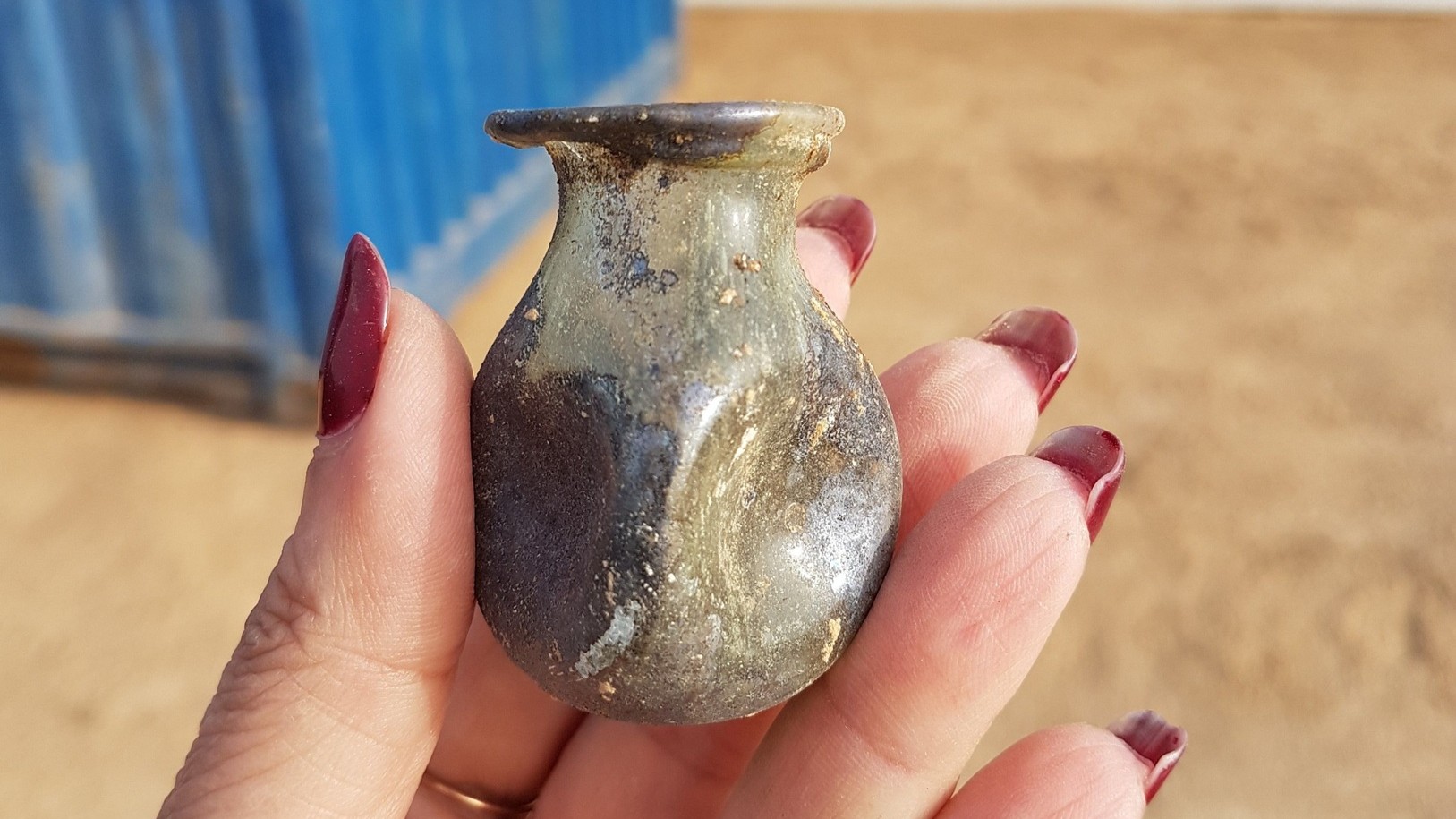
glassware, alabaster jewelry, and bronze bracelets were also found. Photo: Svetlana Talis, Israel Antiquities Authority
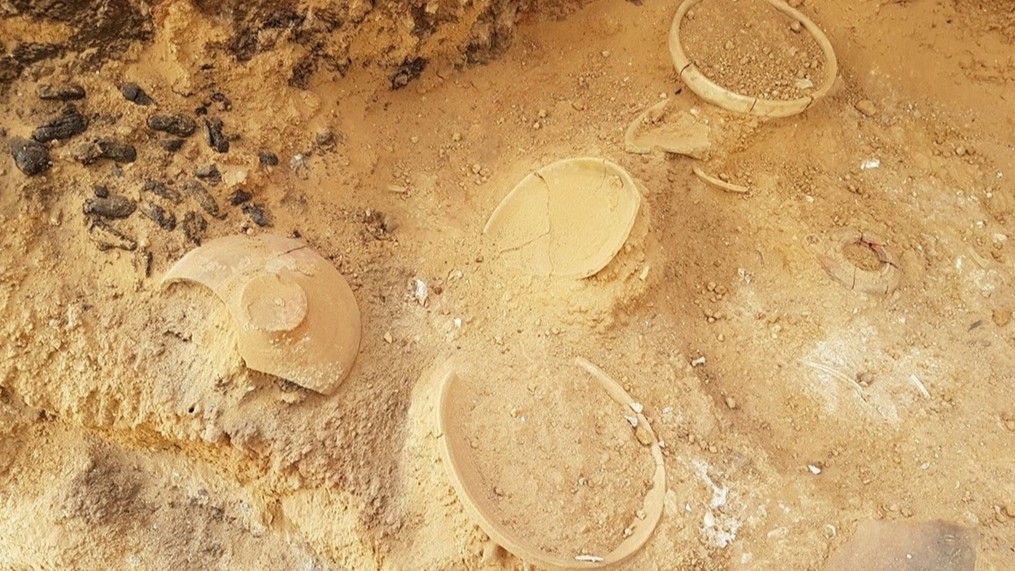
Pottery bowls related to the burial. Photo: Svetlana Talis, Israel Antiquities Authority
Among the figurines placed as burial offerings were also glassware, stone and alabaster jewelry, and bronze bracelets. The tombs themselves attest to a traditional Christian burial, from the 6th-7th centuries CE. “It is likely that a woman and a child who were buried side-by-side, and in whose graves two of the figurines were discovered, belonged to the same family – and perhaps they were even mother and son,” the researchers add.
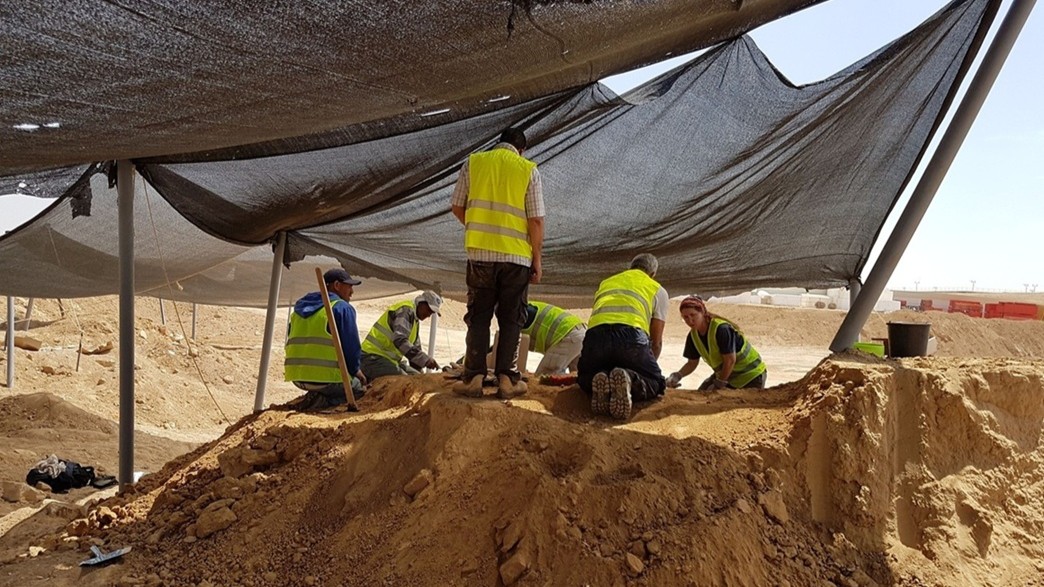
The excavation area. Photo: Svetlana Talis, Israel Antiquities Authority
According to Eli Escusido, Director of the Israel Antiquities Authority:
“The finds from Tel Malḥata are moving not only from an archaeological perspective, but also on a human level. They serve as a reminder that the Land of Israel has always been a crossroads of cultures and peoples—individuals arrived here, integrated into the local population, and yet still carried with them traditions and beliefs from distant lands.”
New research published in Communications Biology has uncovered the earliest known use of the medicinal and psychoactive plant Peganum harmala, commonly known as Syrian rue or harmal, in fumigation practices and inhaled as smoke. The findings offer unprecedented insight into early Arabian therapeutic and sensorial practices, revealing that native plants were already being deliberately used for their bioactive and psychoactive properties nearly 2,700 years ago.
Led by Dr. Barbara Huber (Max Planck Institute of Geoanthropology) and Professor Marta Luciani (University of Vienna), in collaboration with the Heritage Commission of the Saudi Ministry of Culture, the study applied advanced metabolic profiling techniques to analyze organic residues preserved inside Iron Age fumigation devices. The devices were excavated at the oasis settlement of Qurayyah in northwestern Saudi Arabia, a locale known in antiquity for its decorated ceramic vessels, today called Qurayyah Painted Ware.
“Our findings represent chemical evidence for the earliest known burning of harmal, not just in Arabia, but globally,” says Barbara Huber, lead author of the study. “Our discovery sheds light on how ancient communities drew on traditional plant knowledge and their local pharmacopeia to care for their health, purify spaces, and potentially trigger psychoactive effects.”
The study employed high-performance liquid chromatography-tandem mass spectrometry (HPLC-MS/MS), a powerful analytical technique that enables the detection of characteristic harmala alkaloids even in tiny, degraded samples.
“The integration of biomolecular analysis with archaeology has allowed us to identify not just what kind of plants people were using, but also where, how, and why,” says Prof. Marta Luciani, excavation director at Qurayyah and archaeologist at the University of Vienna. “We’re gaining access to plant-based practices that were central to daily life but are rarely preserved in the archaeological record.”
Known for its antibacterial, psychoactive, and therapeutic properties, Peganum harmala is still used in traditional medicine and household fumigation practices today in the region. The new findings underscore its long-standing cultural and medicinal significance.
“This discovery shows the deep historical roots of traditional healing and fumigation practices in Arabia,” adds Ahmed M. Abualhassan, Heritage Commission co-director of the Qurayyah project. “We’re preserving not only objects, but the intangible cultural heritage of ancient knowledge that still holds relevance in local communities today.”
The study’s implications stretch beyond archaeology into fields such as ethnobotany, medical anthropology, heritage studies, and pharmacognosy – all concerned with the long-term relationship between humans, medicinal plants and natural resources.
Two of the skeletons excavated by Mortimer Wheeler in the 1930s, dating from the 1st century AD. Both these individuals exhibit bladed weapon injuries, whilst one has a spear head lodged in his spine, previously interpreted (wrongly) as a Roman ballista bolt.
A new study by archaeologists at Bournemouth University has revealed that bodies recovered from a ‘war-cemetery’, previously attributed to the Roman Conquest of Britain at Maiden Castle Iron Age hillfort in Dorset, did not die in a single dramatic event.
A re-analysis of the burials, including a new programme of radiocarbon dating, has revealed that, rather than dying in a single, catastrophic event, individuals fell in periods of lethal violence spanning multiple generations, spread across the late first century BC to the early first century AD. This is suggestive of episodic periods of bloodshed, possibly the result of localised turmoil, executions or dynastic infighting during the decades leading up to the Roman Conquest of Britain.
BU’s Dr Martin Smith, Associate Professor in Forensic and Biological Anthropology, who analysed the bodies said: “The find of dozens of human skeletons displaying lethal weapon injuries was never in doubt, however, by undertaking a systematic programme of radiocarbon dating we have been able to establish that these individuals died over a period of decades, rather than a single terrible event”.
The ‘war-cemetery’ of Maiden Castle Iron Age hillfort in Dorset is one of Britain’s most famous archaeological discoveries. Discovered in 1936, many of the skeletons unearthed had clear evidence of trauma to the head and upper body. Dig director at the time, Sir Mortimer Wheeler suggested, were “the marks of battle”, caused during a furious but ultimately futile defence of the hillfort against an all-conquering Roman legion. Wheeler’s colourful account of an attack on the native hillfort and the massacre of its defenders by invading Romans, was accepted as fact, becoming an iconic event in popular narratives of Britain’s ‘Island Story’.
Principal Academic in Prehistoric and Roman Archaeology at BU, and the study’s Dig Director, Dr Miles Russell said: “Since the 1930s, the story of Britons fighting Romans at one of the largest hillforts in the country has become a fixture in historical literature. With the Second World War fast approaching, no one was really prepared to question the results. The tale of innocent men and women of the local Durotriges tribe being slaughtered by Rome is powerful and poignant. It features in countless articles, books and TV documentaries. It has become a defining moment in British history, marking the sudden and violent end of the Iron Age.”
Dr Russell added: “The trouble is it doesn’t appear to have actually happened. Unfortunately, the archaeological evidence now points to it being untrue. This was a case of Britons killing Britons, the dead being buried in a long-abandoned fortification. The Roman army committed many atrocities, but this does not appear to be one of them.”
The study has also raised further questions as to what may still lie undiscovered at Maiden Castle. BU’s Visiting Fellow, Paul Cheetham commented that “Here we interpret this as either a number of distinct cultures living and dying together, or we can understand this as burial rights that were determined by complex social rules or hierarchical divisions within this Iron Age society. Whilst Wheeler’s excavation was excellent, he was only able to investigate a fraction of the site. It is likely that a larger number of burials remain undiscovered around the immense ramparts.”
The work at Maiden Castle also brings into question how other archaeological cemeteries across the UK have been interpreted, as Paul Cheetham continued: “The intermingling of differing cultural burial practices contemporaneously shows that simplistic approaches to interpreting archaeological cemeteries must now be questioned."
WATCH VIDEO STORY: https://www.youtube.com/watch?v=Os9nS4jstXw
Archaeologist Greer Jarrett at Lund University in Sweden has been sailing in the footsteps of Vikings for three years. He can now show that the Vikings sailed farther away from Scandinavia, and took routes farther from land, than was previously believed to have been possible. In his latest study, he has found evidence of a decentralised network of ports, located on islands and peninsulas, which probably played a central role in trade and travel in the Viking era.
The sailing boat – an open, square-rigged clinker boat similar to the boats used during the Viking Age (800-1050 AD) – travelled from Trondheim up to the Arctic Circle and back in 2022. Since then, Greer Jarrett and his team have sailed over 5,000 kilometres along Viking trade routes (see map). His research shows that the likely routes of the Vikings took them farther from land than previously thought.
“I can show that this type of boat sails well on open water, in tough conditions. But navigating close to land and in the fjords sometimes presents challenges that are just as great, but not as obvious. Underwater currents and katabatic winds blowing down from mountain slopes, for example,” says Greer Jarrett, a doctoral student in archaeology at Lund University.
Jarrett's research trips have not been without risks. When the yard holding up the mainsail snapped off the coast of Norway, the crew were forced to improvise to save themselves from distress.
“The cold in the Lofoten Islands was a challenge. Our hands really suffered. At that point I realised just how crucial it is to have a good crew,” says Greer Jarrett.
Has interviewed Norwegian seafarers
Jarrett has also tested the boat's capabilities on the open sea, sailing both the Kattegat and the Baltic Sea. Despite the lack of a deep-draught keel, Jarrett says the boats are surprisingly stable.
In a previously published paper, Jarrett and his colleagues have shown that in the Middle Ages it was possible for Greenlanders to travel to remote parts of the Arctic in search of walrus tusks using this type of boat.
To identify specific Viking routes, Jarrett also interviewed sailors and fishermen about the routes traditionally used in the 19th and early 20th centuries, when sailing boats without engines were still common in Norway.
“I used the experience of my own journeys and the sailors’ traditional knowledge to reconstruct possible Viking Age sailing routes.”
Stories helped Vikings to navigate
The Vikings did not navigate by map, compass or sextant. Instead, they used “mental maps” where memories and experiences played a crucial role. They also used myths linked to various coastal landmarks.
“Examples include Viking stories about the islands Torghatten, Hestmona and Skrova off the Norwegian coast. The stories serve to remind sailors of the dangers surrounding these places, or of their importance as navigation marks.”
These preserved myths are the last remnants of what must once have been a landscape steeped in stories. Jarrett calls this a “Maritime Cultural Mindscape”. Small islets, skerries and reefs were all part of a web of stories that helped the Vikings navigate through the landscape; and that were passed down through generations of seafarers.
Possible Viking harbours identified
Through a combination of direct experience of the characteristics of the boats, and digital reconstruction of what the landscape looked like in the Viking Age, Jarrett has identified four possible Viking harbours along the Norwegian coast in his latest publication. (See image)
The locations of these ports (Jarret calls them “havens”) are farther out to sea than the major ports and hubs, known to date.
“With this type of boat, it has to be easy to get in and out of the harbour in all possible wind conditions. There must be several routes in and out. Shallow bays are not an issue because of the shallow draft of the boats. Getting far up the narrow fjords, however, is tricky. They are difficult to sail upwind with a square rig, and the boats are sensitive to katabatic winds.”
Jarrett's hypothesis is that during the Viking Age, such small, easily accessible harbours abounded. Places where sailors could pause, rest, and meet other seafarers.
“A lot of the time, we only know about the starting and ending points of the trade that took place during the Viking Age. Major ports, such as Bergen and Trondheim in Norway, Ribe in Denmark, and Dublin in Ireland. The thing I am interested in is what happened on the journeys between these major trading centres. My hypothesis is that this decentralised network of ports, located on small islands and peninsulas, was central to making trade efficient during the Viking Age.”
Mast fixed with oars
Jarrett's research trips have faced a few challenges. On their way back from Lofoten in May 2022, the yard (mast spar) holding up the mainsail broke as they sailed through the middle of Vestfjorden. The accident happened with the vessel 25 kilometres out to sea.
“We had to lash two oars together to hold the sail, and hope that it would hold. We made it back to the harbour safely, but then we had to spend several days repairing the boat before we could sail again.”
“On another trip, a minke whale suddenly surfaced and flapped its huge tail fin just metres from the boat.”
Jarret's adventures have also highlighted how important relationships must have been during the Viking voyages.
“You need a boat that can withstand all kinds of weather conditions. But if you don't have a crew that can cooperate and put up with each other for long periods, these journeys would probably be impossible,” Jarrett concludes.
Credit: Photo: Nelly Hercberg, Cultural Museum in Lund.
The skeleton of a man with a severe dislocated fracture of the knee, found in a cemetery in Lund, southern Sweden, is helping to unravel the complexities of social attitudes towards individuals with disabilities in the late medieval period. The research combines traditional osteological methods and 3D modelling - a cutting-edge technique for viewing and studying traumatic injury and related skeletal changes - with contextual information from historical texts and digitized excavation records to build a more nuanced understanding of disability and care in the past.
The study, conducted by Blair Nolan of Lund University, Sweden and colleagues, and published in De Gruyter Brill’s Open Archaeology, is the first to apply this approach to medieval remains in the Nordic region.
The skeleton, referred to as individual 2399, belonged to a man of about 30 years of age who lived in the late Middle Ages (1300–1536 CE). At some point in his twenties, his left femur (thigh bone) was badly broken at the knee joint, leaving him unable to walk unaided until his death. The injury could have been caused by a kick from a horse or a heavy object falling on the knee, such as stone while working on a building. For the remainder of his life, he required a mobility aid to get around, such as crutches or a leg stand.
Contextual analysis of his skeleton revealed that the man received considerable short- and long-term care. Following his injury, he was likely given forms of pain relief available at the time, such as ointments made of lavender oil, opium and alcohol, and would have required help to clean and dress the wound. He also required regular treatment for inflammation of the bone marrow - osteomyelitis - which probably included opening the wound to drain the pus.
When the researchers analyzed historical records to deduce the social impacts of individual 2399’s disability, they uncovered a very complex picture.
Religious views of physical disability at the time were complicated: it could be considered both a punishment from God and a divine test requiring penance. Nevertheless, the Church promoted and took part in collecting and distributing alms for the disabled, and monasteries were the main providers of institutionalized medical care.
Other cultural attitudes can be deduced from the legal codes of the time. For example, penal punishments could include removal of body parts such as hands, feet, eyes, nose or ears, leading to an association of disability with criminality in some cases. Also, the severity of a disability was defined not just by how much the individual was impaired but also by its visibility. An injury that could be concealed by hair or clothing was considered less severe.
Despite these negative cultural views of disability, individual 2399’s social status was still high enough to afford him both long-term medical care and a prominent burial place in the cemetery. Individuals of higher socioeconomic status, such as members of the burgher class, strove to be buried as close to the church as possible, and individual 2399 was buried on top of the foundation stones at the base of a church tower. Thus, his higher social status may have outweighed the fact that he had a disability.
Nolan said: “Deducing social norms regarding physical impairment and disability from religious and legal texts is difficult because it presents an idealized perspective. We can enrich our understanding of disability and identity through detailed osteological and archaeological analysis.”
The paper can be found here: https://doi.org/10.1515/opar-2025-0043