Sunday, March 13, 2022

Groundbreaking Exhibition Dedicated to Art of Mississippian Peoples

 Opens at Dallas Museum of Art in March 2022

Link to images

—The Spiro site in Oklahoma contained some of the most extraordinary ancient Native American works ever discovered in the United States—

Dallas, TX—February 17, 2022—Over 1,000 years ago, Mississippian peoples comprised an exceptional society that spanned eastern North America, distinguished by the construction of large earthen mounds. One of their most important cultural and ceremonial centers was Spiro, located in present-day Oklahoma. The Spiro mounds are one of the United States’ most important ancient Native American sites, as well as an archaeological find unmatched in modern times. Yet, despite creating a sophisticated ancient culture, the Spiro people are nearly forgotten in the pages of history books. Opening March 13, 2022, at the Dallas Museum of Art, Spirit Lodge: Mississippian Art from Spiro presents nearly 200 ancient and contemporary works created by the Mississippian peoples and their descendants. Organized by the National Cowboy & Western Heritage Museum, this groundbreaking exhibition marks the first and possibly last time these works of art and cultural significance will be reunited from various collections across the country. The exhibition was previously presented in Oklahoma and Alabama to national acclaim; the DMA is the third and final venue and the exhibition can be seen for free in the Museum’s Hoffman Galleries.

“We are thrilled to bring this revelatory exhibition to Dallas and illuminate for our visitors the extraordinary art and culture of this nearly forgotten ancient society,” said Dr. Agustín Arteaga, the DMA’s Eugene McDermott Director. “Exhibitions like Spirit Lodge not only honor the history of this country’s Native peoples but also recognize and celebrate their living descendants—resilient artists who carry on a cultural legacy.”

Spirit Lodge was organized in close consultation with the Caddo Nation and Wichita and Affiliated Tribes, the descendants of the Spiroan people, and with contributions by 17 humanities scholars from nearly a dozen universities and museums across the United States. Dr. Michelle Rich, The Ellen and Harry S. Parker III Assistant Curator of the Arts of the Americas at the DMA, has been a longtime advocate for the exhibition, the associated scholarly research, and the contemporary artists whose work is featured.

The Spiroan people, along with other Mississippian groups across the eastern half of North America, created a world equal to that of the Aztec, Maya, or Inca, consisting of trade networks and highly developed social, political, and religious centers. The exhibition explores the archaeology and history of Spiro and its relationship to other contemporaneous Indigenous communities in North and Central America, highlighting community development, religious and ceremonial activities, farming and hunting practices, and daily life. In about 1400 CE, during a climate change crisis, thousands of ritual objects from across the Mississippian world were amassed as offerings within a hollow chamber at Spiro called the Spirit Lodge. Bearing images of people, deities, culture heroes, animals, and symbolic creatures, these objects demonstrate the complexity and expanse of Mississippian society.

The exhibition includes approximately 200 objects. Looting in the early 1930s caused irreparable harm to Spiro, but subsequent archaeological investigations were conducted to excavate the remains of the Craig Mound, which housed the Spirit Lodge. In 1935 the public’s imagination was piqued when the Kansas City Star called the site’s discovery a “King Tut’s Tomb in the Arkansas Valley,” and identified it as the greatest source of Mississippian iconographic material ever found. Embossed copper plates, wooden sculptures, thousands of pearls and beads, large human effigy pipes, and engraved shell gorgets and cups were among the items found at Spiro. This exhibition reunites a range of items looted and archaeologically excavated at Spiro that have not been together since the early 1930s.

Spirit Lodge concludes with works by contemporary artists who are reviving and reimagining their ancestors’ artistic practices. The art found at Spiro was produced by the ancestors of Caddo, Wichita, Pawnee, Osage, Lakota, Chickasaw, Cherokee, Muscogee, Choctaw, Potawatomi, Quapaw, Cheyenne, Seminole, and countless other Indigenous peoples. The exhibition provides an opportunity to learn more about the legacy of Native peoples and connect that legacy to living Indigenous communities.

“Spirit Lodge celebrates the beauty of Indigenous Mississippian arts and cultures,” said Dr. Rich. “It highlights the complex history of North America and North Texas by exploring the experiences of ancestral inhabitants as they struggled to survive during a time of adverse climate change. The exhibition ends on a high note, showcasing the vibrant artistic practices of descendant peoples vital to the rich diversity of the United States.”

Spirit Lodge: Mississippian Art from Spiro is organized by the National Cowboy & Western Heritage Museum. This exhibition is supported in part by the Henry Luce Foundation, the Kirkpatrick Foundation, and the National Endowment for the Humanities. The Dallas Museum of Art is supported in part by the generosity of DMA Members and donors, the National Endowment for the Arts, the Texas Commission on the Arts, and the citizens of Dallas through the City of Dallas Office of Arts and Culture.

Wednesday, March 9, 2022

Ancient Mexican city endured for centuries without extremes in wealth and power

Monte Alban plaza 

IMAGE: THE MAIN PLAZA AT THE CENTER OF MONTE ALBÁN. view more 

CREDIT: LINDA NICHOLAS, FIELD MUSEUM

Location, location, location—it’s the first rule of real estate. For a long time, it’s been widely assumed that being close to resources drives settlement patterns, with cities generally founded near water and fertile land for growing crops. But a new paper by a husband-and-wife archaeological team questions that idea, using the example of an ancient city in what’s now southern Mexico. The researchers argue that Monte Albán, the largest city in its region for more than a thousand years, wasn’t situated near especially good farmland. But what it did have from the city’s foundation was a defendable hilltop location and a more collective form of government that attracted people both to the settlement and its surrounding area.

“We wanted to understand why Monte Albán was founded where it was,” says Linda Nicholas, the first author of the study in Frontiers in Political Science and an adjunct curator at the Field Museum.

Monte Albán lies in the Valley of Oaxaca in southern Mexico. It was founded in 500 BC, grew rapidly, and endured as the region’s main metropolis for 1,300 years, longer than most, if not all, other prehispanic Mesoamerican cities. “We’ve been working in the Oaxaca Valley for 40 years, and we and our colleagues have wondered what drew so many people to move to Monte Albán and its surrounding area, and what allowed the city to sustain itself for so long,” says Gary Feinman, the Field Museum’s MacArthur curator of anthropology and co-author of the study. “Over the years, a few competing ideas have been advanced.”

One hypothesis to explain the rapid growth at Monte Albán is coercion—the idea that powerful rulers forced people move there. Another possible explanation was that people went there because the land was good for farming. To examine the validity of these possible explanations, Nicholas and Feinman went back over decades of research covering both Monte Albán and the surrounding Valley of Oaxaca.

To evaluate the argument that Monte Albán attracted people because of the quality of its farmland, the researchers drew on studies of modern land use in the valley to map out different land classes based on the availability and permanence of water, the most important factor for crop yields in the valley. Good, well-watered land was patchily distributed across the valley, so that some areas had much higher potential yields than others. While pre-Monte Albán settlements were more heavily concentrated in the most productive parts of the valley, Monte Albán was not. Land quality was less a factor in settlement decisions at the time of Monte Albán’s foundation, both for the city and nearby settlements.

“Linda’s analysis of land use shows very clearly that Monte Albán wasn’t located near the richest land. Whether you just look at the land itself, or whether you figure in the labor to work it, agrarian productivity cannot explain the location of Monte Albán,” says Feinman.

So the hypothesis about fertile land doesn’t hold up for Monte Albán. Feinman and Nicholas also investigated the possibility that people were forced to come to the region. This part of the project relied on decades of archaeological survey work.

“In the 1960s, archaeologists started to ask different questions about ancient societies beyond just collecting and categorizing artifacts,” says Nicholas. “When you excavate a site, you only get a picture of a very small part, and also it’s both destructive and expensive.”

“If you’re trying to answer questions about how early cities formed and how long they lasted, excavation with its limited portal into the past doesn’t answer them,” says Feinman. “If you want to learn about the city of Chicago, excavating one house, a block, or even one neighborhood wouldn’t give you information about the growth of downtown in relationship to the Chicago River and Lake Michigan, or how it relates to a broader network of settlements in northern Illinois and beyond. It’s the same way with ancient cities—you need a more macro-level vantage to understand how their growth and decline compared to the areas around them.”

To get at this broader picture of where people lived and how their settlement patterns shifted over time, Feinman and Nicholas collaborated with Richard Blanton and Stephen Kowalewski in Oaxaca to survey one of the largest contiguous study regions in the world.

“For our systematic survey, we used aerial photographs and maps to guide us as we walked across the entire valley. When we found archaeological sites, we made notes of what we found and where and took collections to determine the periods of occupation,” says Nicholas. “We and our colleagues wound up covering thousands of square kilometers in the Oaxaca Valley and adjacent areas.” This research over the years has been supplemented with more in-depth excavations by many scholars at key sites.

This wider-ranging look at life in Monte Albán and its surrounding areas, drawn from both surveys and excavations, gave the researchers new insights over the years. “We learned that at Monte Albán and other settlements in prehispanic Oaxaca, the bulk of the residents lived on flattened terraces, which were constructed on the slopes of the hills. From the excavations that we and others conducted, we gained a perspective on terrace life, where people lived in individual houses with multiple rooms around a patio. Domestic units often shared a front retaining wall, and drains generally separated residences,” says Feinman. “People not only lived very close together, but they also must have been highly cooperative from one domestic unit to another, because if part of the retaining wall collapsed or the drain got clogged, they’d have to work together to fix it.”

The residents of Monte Albán also were economically interdependent, exchanging craft goods and food in the risky environment for agriculture where they lived. Although no large food storage facilities have been found, there are indications that the city’s residents participated in marketplace exchanges, which may have buffered the region’s unpredictable rainfall. Cooperative defense and economic opportunity drew people from afar to early Monte Albán.

The high degrees of cooperation between households at Monte Albán was echoed to some extent in the political organization of Monte Albán as a whole. “Compared to more autocratic societies, like the Classic-period Maya, Monte Albán seems to have had a more collective form of governance,” says Nicholas. Autocratic societies—ones ruled by despots, where a small group of people wielded all the power—tended to have architecture that reflected their form of rule, with big, fancy palaces and elaborate burial sites for the rich and powerful. Despotic rulers serve as the billboards for their regimes, often marked by aggrandizing and personalized monuments. Monte Albán, however, is characterized by non-residential public buildings, temples, and large, relatively open, shared plazas. Given the longevity of the site, the number of monuments that feature rulers is small.

Although defense was a key factor in the foundation and location of Monte Albán, there is no indication that the early occupants were coerced to move to this dense hilltop location where their agricultural prospects were somewhat risky, interpersonal efforts were needed to sustain their residences, and residential settlement was densely packed. Nevertheless, health measures indicate that the inhabitants of Monte Albán were generally better off than the residents of other prehispanic cities, and the institutions established at Monte Albán contributed to their well-being, drawing people from afar despite these challenges. 

Since people probably weren’t forced to come to Monte Albán, and they didn’t come for the productive farmland, that leaves the question: why did Monte Albán grow so quickly and stay large and important for so long? 

“We think we have a frame that draws more on cooperation,” says Nicholas. Based on the work of other scholars like Margaret Levi and Richard Blanton, Feinman hypothesizes that “it's a kind of mutual relationship between people who have power and people that don't. In this case, the powerful may have coordinated defense, helped organize marketplace exchange, and conducted ritual activities that enhanced community solidarity. On the other hand, the bulk of the city’s populace produced food and other goods that sustained the settlement and, through taxes, supported governance. It was a collaborative process that relied on compliance.”

Feinman notes that the architecture of the city might include clues about this cooperative relationship between the classes that led people to Monte Albán. “From the very founding of the site, there was a big main plaza where people could get together and express their voice, at least sometimes. People may have been encouraged to move there for defense and economic opportunity,” he says. “But on the other hand, in order to underpin and support these new institutions, farmers probably had to give over some of their surplus. So, it's kind of a give and take.”

While Feinman and Nicholas note that this study is just one case, about one city, it does have some lessons for us today. “Monte Albán was a city where a new social contract was written at its foundation. It was somewhat more equitable and less elite-centric than what had gone on before,” says Feinman. “And with its collective and relatively equitable government, it endured for more than a millennium. Yet when it collapsed, the city’s population declined drastically and many of its institutions dissolved, ushering in a period of more autocratic rule.”


###


Tuesday, March 8, 2022

Saffron crocus was first domesticated in Bronze Age Greece, suggest ancient artworks and genetics


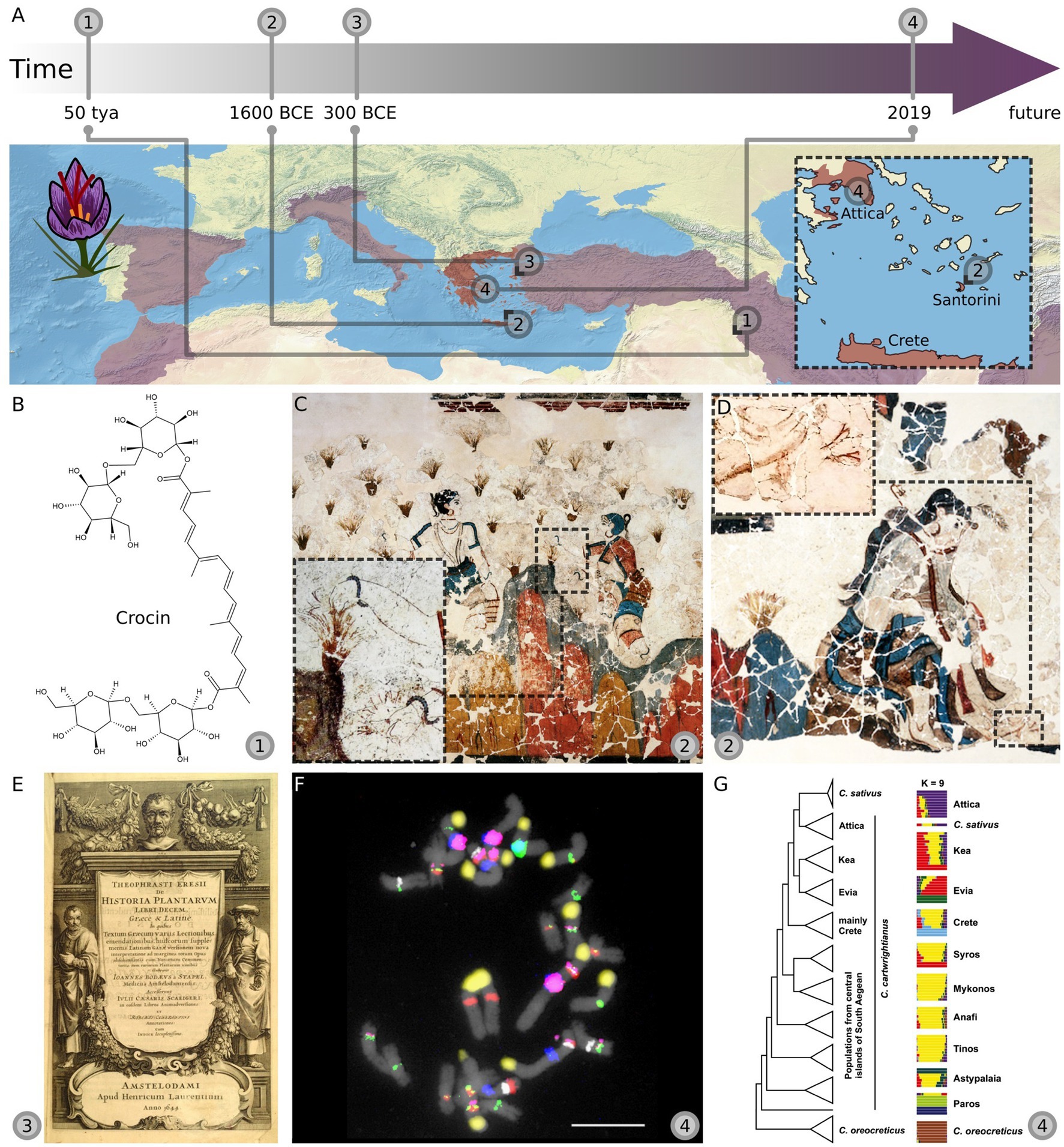
Saffron, the world’s most expensive spice, is extracted from the flowers of the saffron crocus, Crocus sativus. It has been grown for thousands of years in the Mediterranean region. But when and where was saffron first domesticated by our ancestors? In a review in Frontiers in Plant Science, researchers conclude that lines of evidence from ancient art and genetics converge on the same region.

“Both ancient artworks and genetics point to Bronze Age Greece, in approximately 1700 BCE or earlier, as the origin of saffron’s domestication,” said Ludwig Mann, one of the leading authors and a PhD student at Technische Universität Dresden, Germany.

The genus Crocus, with approximately 250 species, ranges from South and Central Europe and North Africa to Western China. Unlike domesticated saffron, these species reproduce sexually in the wild. The first known use by humans of wild crocuses was as pigment for cave paintings, approximately 50000 years ago in today’s Iraq. Ancient texts from Sumer, Assyria, and Babylonia also describe the use of wild crocuses in medicine and dye.

In contrast, domesticated saffron doesn’t grow in the wild, and can only be propagated asexually with human help, by dividing its underground ‘corms’ ̶ stem-like storage organs. The process was first described by the Greek philosopher Theophrastus in the fourth to third century BCE. Today, domesticated saffron is grown around the globe, for use in cooking and perfumes and as a yellow dye. Between 15000 and 16000 flowers, requiring between 370 and 470 person-hours to collect, yield a single kilo, worth between $1300 and $10000.

“Finding out where and when saffron was first domesticated isn’t straightforward: the species is difficult to study genetically, because it has three copies of every chromosome instead of the usual two, and a large genome containing a high percentage of difficult-to-sequence repetitive DNA,” said leading author Seyyedeh-Sanam Kazemi-Shahandashti, a PhD student at the Institute of Bio- and Geosciences of the Forschungszentrum Jülich, Germany.

“As there are no ancient crocus remains preserved from ancient times, we here revisit ancient artworks that depict saffron-like plants. We expected that these could point us to specific regions.”

The authors argue that artworks from the Minoan civilization of ancient Greece are likely the oldest to depict domesticated saffron. For example, the dense patches of crocus flowers on the fresco ‘The Saffron Gatherers’ from the island of Santorini (approximately 1600 BCE) suggest cultivation. Another fresco on the same island, ‘The Adorants’, shows flowers with long, dark-red stigmas which overtop dark violet petals, typical of domesticated saffron. Flowers with these traits are also depicted on ceramics and cloth from Bronze Age Greece, and symbolically rendered in the ideogram for saffron in the ancient Linear B script. In Egypt, tombs from the 15th and 14th centuries BCE depict how ambassadors from Crete brought tribute in the form of textiles dyed with saffron.

An origin in Bronze Age Greece agrees with results from genetic studies from 2019, which showed that C. cartwrightianus, which only occurs in mainland Greece and Crete, is saffron’s closest wild relative.

The authors believe that the modern saffron crocus with its three genomes arose naturally from the wild, either exclusively from C. cartwrightianus or from hybrids between C. cartwrightianus and another crocus species. The saffron crocus would then have been retained by the Bronze Age Greeks because of its superior qualities as a spice.

The authors will continue to trace saffron’s properties, said final author Dr Tony Heitkam, leader of the Plant Genomics group at Technische Universität Dresden: “Around the globe today, all saffron crocuses are effectively clones dating back to saffron’s emergence in ancient Greece. Nevertheless, despite sharing the same genome, saffron can have different properties depending on the region. We have started to investigate the molecular causes, in particular so-called ‘epigenetic’ differences, for this regional variation.”

Monday, March 7, 2022

Collectors in the prehistoric world recycled old stone tools to preserve the memory of their ancestors


Recycled patinated flint tools from Revadim. 

IMAGE: RECYCLED PATINATED FLINT TOOLS FROM REVADIM. view more 

CREDIT: TEL AVIV UNIVERSITY

  • The researchers: "Based on our findings we argue that prehistoric humans' practice of recycling old stone tools stemmed from the significance attributed by humans to artifacts produced by their predecessors."
  • In the prehistoric world, much like today, these artifacts carried emotional significance – the memory of ancestors who had produced the tool or connection to a specific location. Ancient humans realized that by using these tools every day they would preserve and even strengthen the memory.


A first-of-its-kind study at Tel Aviv University asks what drove prehistoric humans to collect and recycle flint tools that had been made, used, and discarded by their predecessors. After examining flint tools from one layer at the 500,000-year-old prehistoric site of Revadim in the south of Israel's Coastal Plain, the researchers propose a novel explanation: prehistoric humans, just like us, were collectors by nature and culture. The study suggests that they had an emotional urge to collect old human-made artefacts, mostly as a means for preserving the memory of their ancestors and maintaining their connectedness with place and time.


The study was led by PhD student Bar Efrati and Prof. Ran Barkai of the Jacob M. Alkow Department of Archaeology and Ancient Near Eastern Cultures at TAU's Entin Faculty of Humanities, in collaboration with Dr. Flavia Venditti from the University of Tubingen in Germany and Prof. Stella Nunziante Cesaro from the Sapienza University of Rome, Italy. The paper appeared in the prestigious scientific journal Scientific Reports, published by Nature.


Bar Efrati explains that stone tools with two lifecycles have been found at prehistoric sites all over the world, but the phenomenon has never been thoroughly investigated. In the current study the researchers focused on a specific layer at Revadim - a large, open-air, multi-layered site in the south of Israel's Coastal Plain, dated to about 500,000 years ago. The rich findings at Revadim suggest that this was a popular spot in the prehistoric landscape, revisited over and over again by early humans drawn by an abundance of wildlife, including elephants. Moreover, the area is rich with good-quality flint, and most tools found at Revadim were in fact made of fresh flint. 


Bar Efrati: "The big question is: Why did they do it? Why did prehistoric humans collect and recycle actual tools originally produced, used, and discarded by their predecessors, many years earlier? Scarcity of raw materials was clearly not the reason at Revadim, where good-quality flint is easy to come by.  Nor was the motivation merely functional, since the recycled tools were neither unusual in form nor uniquely suitable for any specific use."


The key to identifying the recycled tools and understanding their history is the patina – a chemical coating which forms on flint when it is exposed to the elements for a long period of time. Thus, a discarded flint tool that lay on the ground for decades or centuries accumulated an easily identifiable layer of patina, which is different in both color and texture from the scars of a second cycle of processing that exposed the original color and texture of flint.


In the current study, 49 flint tools with two lifecycles were examined. Produced and used in their first lifecycle, these tools were abandoned, and years later, after accumulating a layer of patina, they were collected, reworked, and used again. The individuals who recycled each tool removed the patina, exposing fresh flint, and shaped a new active edge. Both edges, the old and the new, were examined by the researchers under two kinds of microscopes, and via various chemical analyses, in search of use-wear marks and/or organic residues. In the case of 28 tools, use-wear marks were found on the old and/or new edges, and in 13 tools, organic residues were detected, evidence of contact with animal bones or fat.


Surprisingly, the tools had been used for very different purposes in their two lifecycles - the older edges primarily for cutting, and the newer edges for scraping (processing soft materials like leather and bone). Another baffling discovery: in their second lifecycle the tools were reshaped in a very specific and minimal manner, preserving the original form of the tool, including its patina, and only slightly modifying the active edge.


Prof. Ran Barkai: "Based on our findings, we propose that prehistoric humans collected and recycled old tools because they attached significance to items made by their predecessors. Imagine a prehistoric human walking through the landscape 500,000 years ago, when an old stone tool catches his eye. The tool means something to him – it carries the memory of his ancestors or evokes a connection to a certain place. He picks it up and weighs it in his hands. The artifact pleases him, so he decides to take it 'home'. Understanding that daily use can preserve and even enhance the memory, he retouches the edge for his own use, but takes care not to alter the overall shape – in honor of the first manufacturer. In a modern analogy, the prehistoric human may be likened to a young farmer still plowing his fields with his great-grandfather's rusty old tractor, replacing parts now and then, but preserving the good old machine as is, because it symbolizes his family's bond with the land. In fact, the more we study early humans, we learn to appreciate them, their intelligence, and their capabilities. Moreover, we discover that they were not so different from us. This study suggests that collectors and the urge to collect may be as old as humankind. Just like us, our early ancestors attached great importance to old artifacts, preserving them as significant memory objects - a bond with older worlds and important places in the landscape."

Thursday, March 3, 2022

Mummification in Europe may be older than previously known

 Mummification of the dead probably was more common in prehistory than previously known. This discovery is made at the hunter-gatherer burial sites in the Sado Valley in Portugal, dating to 8 000 years ago. A new study, headed by archaeologists at Uppsala University and Linnaeus University in Sweden and University of Lisbon in Portugal, presents new evidence for pre-burial treatments such as desiccation through mummification, which has not been suggested for the European Mesolithic before. The results are now published inEuropean Journal of Archaeology.

Until now, the oldest cases of intentional mummification were known from the Chinchorro hunter-gatherers living in the coastal region of the Atacama Desert in northern Chile with examples of mummified bodies buried in shell middens around 7 000 years ago still preserving soft tissue. However, most surviving mummies worldwide are more recent, dating between a few hundred years and 4 000 years old.

Mummification in prehistory is a challenging topic for researchers because it is difficult to detect if a body was preserved through mummification when soft tissue is no longer visible. An additional difficulty is the lack of written reports for these early periods. Unlike bone, finding soft tissue in archaeological sites is rare due to issues of preservation, and without it, it is difficult to recognize if the remains have been curated soon after death. This is particularly challenging in temperate and wetter climates, such as in most of Europe, where soft tissues and fabrics do not normally survive in archaeological sites.

Using recently discovered photographs of the skeletal remains of thirteen individuals excavated in the 1960s in the Sado Valley Mesolithic shell middens in Portugal, the researchers were able to reconstruct the positions in which the bodies were buried providing a unique opportunity to learn more about mortuary rituals taking place 8 000 years ago.

The study combined the approach of archaeothanatology with human decomposition experiments. Archaeothanatology is an approach used by archaeologists to document and analyse human remains in archaeological sites that combines observations of the spatial distribution of the bones in the grave with knowledge about how the human body decomposes after death. Archaeologists can then reconstruct how the dead body was handled after death and buried, even if several millennia have passed. In this study, the archaeothanatology was also informed by results from human decomposition experiments on mummification and burial at the Forensic Anthropology Research Facility at Texas State University.

Based on the results from the experiments, an observable signature for a mummy could be proposed that combines several observations: a hyperflexion of the limbs, an absence of disarticulation in significant parts of the skeleton, and a rapid infilling of sediment around the bones. These were all clearly present in at least one of the burials in this study. The analysis showed that some bodies were buried in extremely flexed positions with the legs flexed at the knees and placed in front of the chest.

During decomposition, the bones usually become disarticulated at weak joints, such as at the feet, but in these cases, the articulations were maintained. The researchers propose that this pattern of hyperflexion and lack of disarticulation could be explained if the body was not placed in the grave as a fresh cadaver, but in a desiccated state as a mummied corpse. Desiccation not only maintains some of these otherwise weak articulations, but also allows for a strong flexion of the body since the range of movement increases when the volume of soft tissue is smaller. Because the bodies were desiccated before burial, there is very little or no sediment present between the bones and the articulations are maintained by the continuous infilling of the surrounding soil supporting the bones and preventing the collapse of the articulations.

The researchers suggest that the observed patterns could be the product of a guided natural mummification process. The manipulation of the body during mummification would have taken place over an extended period of time, during which the body gradually would become desiccated to maintain its bodily integrity, and simultaneously contracted by trussing with rope or bandages to compress it into a desired position. When the process was finished, the body would have been easier to transport (being more contracted and significantly lighter than the fresh cadaver) while ensuring that it was buried while retaining its appearance and anatomical integrity. 

If mummification in Europe was older than previously known, a range of insights relating to the mortuary practices of Mesolithic communities arise, including a central concern for maintaining the integrity of the body and its physical transformation from a cadaver to a curated mummy. These practices would also underscore the significance of the burial places and the importance of bringing the dead to these locations in a manner that contained and protected the body, following principles that were culturally regulated, highlighting the significance of both the body and the burial place in Mesolithic Portugal 8 000 years ago. 

Rita Peyroteo-Stjerna, Liv Nilsson Stutz, et al.; Mummification in the Mesolithic. New Approaches to Old Photo Documentation Reveal Previously Unknown Mortuary Practices in the Sado Valley, Portugal; the European Journal of Archaeology, 3 March 2022; DOI:

What explains our lower back pain? Anthropologists turn to Neandertals for answers

New analysis considers backbone differences between humans and Neandertals — and the possible impact of industrialization

Spinal curvatures 

IMAGE: CONTRIBUTIONS TO CURVATURE OF THE MODERN HUMAN SPINE. WEDGING OF THE VERTEBRAL BODIES AND INTERVERTEBRAL DISCS RESULTS IN THORACIC KYPOHSIS AND LUMBAR LORDOSIS. view more 

CREDIT: IMAGE COURTESY OF SCOTT WILLIAMS, NYU’S DEPARTMENT OF ANTHROPOLOGY.

Examining the spines of Neandertals, an extinct human relative, may explain back-related ailments experienced by humans today, a team of anthropologists has concluded in a new comparative study. 

The analysis centers on the spine’s curvature, which is caused, in part, by a wedging, or angling, of vertebrae and the intervertebral discs—the softer material between the vertebrae.

“Neandertals are not distinct from modern humans in lumbar wedging and therefore likely possessed curved lower backs like we do,” explains Scott Williams, an associate professor in New York University’s Department of Anthropology and one of the authors of the paper, which appears in the journal PNAS Nexus. “However, over time, specifically after the onset of industrialization in the late 19th century, we see increased wedging in the lower back bones of today’s humans—a change that may relate to higher instances of back pain, and other afflictions, in postindustrial societies.”

An image and caption of the human spine, which illustrates how wedging contributes to its curvature, may be downloaded from Google Drive.

Neandertals have long been thought to have a different posture than modern humans. 

“A good part of this perspective derives from the wedging of Neandertals’ lumbar, or lower, vertebrae—their spines in this region curve less than those of modern humans studied in the U.S. or Europe,” explains Williams. 

However, much of this view was based on an analysis of modern humans beginning in the late 19th century—well after the onset of industrialization, which significantly altered our daily lives. Furniture, for instance, became more widely available and desk jobs more prevalent—both of which encouraged sitting and, with it, changes in posture. These changes were coupled with a reduction in high-activity occupations, such as agriculture. In addition, specific afflictions became associated with working conditions that elicit poor posture.

“Past research has shown that higher rates of low back pain are associated with urban areas and especially in ‘enclosed workshop’ settings where employees maintain tedious and painful work postures, such as constantly sitting on stools in a forward leaning position,” Williams observes.

In other words, by examining spines from humans who lived in the post-industrial era, past researchers may have mistakenly concluded that spine formation is due to evolutionary development rather than changed living and working conditions. 

To address this possibility, Williams and his colleagues examined both pre-industrial and post-industrial spines of male and female modern humans from around the world—a sample that included more than 300 spines, totaling more than 1,600 vertebrae—along with samples of Neandertal spines.

Overall, they found that spines in post-industrial people showed more lumbar wedging than did those in pre-industrial people. Moreover, Neandertals’ spines were significantly different from those in post-industrial people but not from pre-industrial people. Notably, the scientists found no differences linked to geography within samples from the same era. 

“A pre-industrial vs. post-industrial lifestyle is the important factor,” explains Williams, who acknowledges that because lower back curvature is made up of soft tissues (i.e., intervertebral discs), not just bones, it cannot be ascertained that Neandertals' lumbar lordosis differed from modern humans.

“The bones are often all that is preserved in fossils, so it’s all we have to work with,” he adds.

Nonetheless, the distinctions in spine formation between pre-industrial and post-industrial humans offer new insights into back conditions facing many today.

“Diminished physical activity levels, bad posture, and the use of furniture, among other changes in lifestyle that accompanied industrialization, resulted, over time, in inadequate soft tissue structures to support lumbar lordosis during development,” Williams says. “To compensate, our lower-back bones have taken on more wedging than our pre-industrial and Neandertal predecessors, potentially contributing to the frequency of lower back pain we find in post-industrial societies.” 

Stonehenge served as an ancient solar calendar - new analysis


New analysis has identified how the design of Stonehenge may have represented a calendar, helping people track a solar year of 365.25 days calibrated by the alignment of the solstices.

It had long been thought that the famous site of Stonehenge served as an ancient calendar, given its alignment with the solstices. Now, research has identified how it may have worked. 

New finds about the stone circle’s history, along with analysis of other ancient calendar systems, prompted Professor Timothy Darvill to take a fresh look at Stonehenge. His analysis, published in the journal Antiquity, concluded that the site was designed as a solar calendar. 

“The clear solstitial alignment of Stonehenge has prompted people to suggest that the site included some kind of calendar since the antiquarian William Stukeley,” said Professor Darvill, from Bournemouth University, “Now, discoveries brought the issue into sharper focus and indicate the site was a calendar based on a tropical solar year of 365.25 days.” 

Crucially, recent research had shown that Stonehenge’s sarsens were added during the same phase of construction around 2500 BC. They were sourced from the same area and subsequently remained in the same formation. This indicates they worked as a single unit. 

As such, Professor Darvill analysed these stones, examining their numerology and comparing them to other known calendars from this period. He identified a solar calendar in their layout, suggesting they served as a physical representation of the year that helped the ancient inhabitants of Wiltshire keep track of the days, weeks, and months. 

“The proposed calendar works in a very straightforward way. Each of the 30 stones in the sarsen circle represents a day within a month, itself divided into three weeks each of 10 days,” said Professor Darvill, noting that distinctive stones in the circle mark the start of each week. 

Additionally, an intercalary month of five days and a leap day every four years were needed to match the solar year. “The intercalary month, probably dedicated to the deities of the site, is represented by the five Trilithons in the centre of the site,” said Professor Darvill, “The four Station Stones outside the Sarsen Circle provide markers to notch-up until a leap day.” 

As such, the winter and summer solstices would be framed by the same pairs of stones every year. One of the trilithons also frames the winter solstice, indicating it may have been the new year. This solstitial alignment also helps calibrate the calendar – any errors in counting the days would be easily detectable as the sun would be in the wrong place on the solstices. 

Such a calendar, with 10 day weeks and extra months, may seem unusual today. However, calendars like this were adopted by many cultures during this period 

“Such a solar calendar was developed in the eastern Mediterranean in the centuries after 3000 BC and was adopted in Egypt as the Civil Calendar around 2700 and was widely used at the start of the Old Kingdom about 2600 BC,” said Professor Darvill. This raises the possibility that the calendar tracked by Stonehenge may stem from the influence of one of these other cultures. Nearby finds hint at such cultural connections - the nearby Amesbury archer, buried nearby around the same period, was born in the Alps and moved to Britain as a teenager. 

Professor Darvill hopes future research might shed light on these possibilities. Ancient DNA and archaeological artefacts could reveal connections between these cultures. Nevertheless, the identification of a solar calendar at Stonehenge should transform how we see it. 

“Finding a solar calendar represented in the architecture of Stonehenge opens up a whole new way of seeing the monument as a place for the living,” he said, “A place where the timing of ceremonies and festivals was connected to the very fabric of the universe and celestial movements in the heavens.”