Friday, August 28, 2020

How Neanderthals adjusted to climate change


German-Italian research project investigates different cutting tools from the Sesselfelsgrotte cave.
UNIVERSITY OF ERLANGEN-NUREMBERG
Climate change occurring shortly before their disappearance triggered a complex change in the behaviour of late Neanderthals in Europe: they developed more complex tools. This is the conclusion reached by a group of researchers from Friedrich-Alexander-Universität Erlangen-Nürnberg (FAU) and Università degli Studi die Ferrara (UNIFE) on the basis of finds in the Sesselfelsgrotte cave in Lower Bavaria.
Neanderthals lived approximately 400,000 to 40,000 years ago in large areas of Europe and the Middle East, even as far as the outer edges of Siberia. They produced tools using wood and glass-like rock material, which they also sometimes combined, for example to make a spear with a sharp and hard point made of stone.
From approximately 100,000 years ago, their universal cutting and scraping tool was a knife made of stone, the handle consisting of a blunt edge on the tool itself. These Keilmesser (backed, asymmetrical bifacially-shaped knives) were available in various shapes, leading researchers to wonder why the Neanderthals created such a variety of knives? Did they use different knives for different tasks or did the knives come from different sub-groups of Neanderthals? This was what the international research project hoped to find out.
Keilmesser are the answer
'Keilmesser are a reaction to the highly mobile lifestyle during the first half of the last ice age. As they could be sharpened again as and when necessary, they were able to be used for a long time - almost like a Swiss army knife today,' says Prof. Dr. Thorsten Uthmeier from the Institute of Prehistory and Early History at FAU. 'However, people often forget that bi-facially worked knives were not the only tools Neanderthals had. Backed knives from the Neanderthal period are surprisingly varied,' adds his Italian colleague Dr. Davide Delpiano from Sezione di Scienze Preistoriche e Antropologiche at UNIFE. 'Our research uses the possibilities offered by digital analysis of 3D models to discover similarities and differences between the various types of knives using statistical methods.'
The two researchers investigated artefacts from one of the most important Neanderthal sites in Central Europe, the Sesselfelsgrotte cave in Lower Bavaria. During excavations in the cave conducted by the Institute of Prehistory and Early History at FAU, more than 100,000 artefacts and innumerable hunting remains left behind by the Neanderthals have been found, even including evidence of a Neanderthal burial. The researchers have now analysed the most significant knife-like tools using 3D scans produced in collaboration with Prof. Dr. Marc Stamminger and Dr. Frank Bauer from the Chair of Visual Computing at the Department of Computer Science at FAU. They allow the form and properties of the tool to be recorded extremely precisely.
'The technical repertoire used to create Keilmesser is not only direct proof of the advanced planning skills of our extinct relatives, but also a strategical reaction to the restrictions imposed upon them by adverse natural conditions,' says Uthmeier, FAU professor for Early Prehistory and Archaeology of Prehistoric Hunters and Gatherers.
Other climate, other tools
What Uthmeier refers to as 'adverse natural conditions' are climate changes after the end of the last interglacial more than 100,000 years ago. Particularly severe cold phases during the following Weichsel glacial period began more than 60,000 years ago and led to a shortage of natural resources. In order to survive, the Neanderthals had to become more mobile than before, and adjust their tools accordingly.
The Neanderthals probably copied the functionality of unifacial backed knives, which are only shaped on one side, and used these as the starting point to develop bi-facially formed Keilmesser shaped on both sides. 'This is indicated in particular by similarities in the cutting edge, which consists in both instances of a flat bottom and a convex top, which was predominantly suited for cutting lengthwise, meaning that it is quite right to refer to the tool as a knife,' says Davide Delpiano from UNIFE.
Both types of knife - the simpler older version and the newer, significantly more complex version - obviously have the same function. The most important difference between the two tools investigated in this instance is the longer lifespan of bi-facial tools. Keilmesser therefore represent a high-tech concept for a long-life, multi-functional tool, which could be used without any additional accessories such as a wooden handle.
'Studies from other research groups seem to support our interpretation,' says Uthmeier. 'Unlike some people have claimed, the disappearance of the Neanderthals cannot have been a result of a lack of innovation or methodical thinking.'

Wednesday, August 26, 2020

Ancient mammoth ivory carving technology reconstructed by archeologists


SIBERIAN FEDERAL UNIVERSITY
IMAGE
IMAGE: A TEAM OF ARCHEOLOGISTS FROM SIBERIAN FEDERAL UNIVERSITY AND NOVOSIBIRSK STATE UNIVERSITY PROVIDED A DETAILED RECONSTRUCTION OF A TECHNOLOGY THAT WAS USED TO CARVE ORNAMENTS AND SCULPTURES FROM MAMMOTH IVORY.... view more 
CREDIT: LBOVA L. / 2020, ARCHAEOLOGICAL RESEARCH IN ASIA
A team of archeologists from Siberian Federal University and Novosibirsk State University provided a detailed reconstruction of a technology that was used to carve ornaments and sculptures from mammoth ivory. The team studied a string of beads and an ancient animal figurine found at the Paleolithic site of Ust-Kova in Krasnoyarsk Territory. Over 20 thousand years ago its residents used drills, cutters, and even levelling blades. The unusual features of some of the items showcased the mastery of the craftsmen. The new data obtained by the scientists will help study the relations between the residents of different Siberian sites. The article about the study was published in the highly respected journal Archaeological Research in Asia.
The Ust-Kova site is located in Kezhemsky District of Krasnoyarsk Territory at the mouth of the Kova river. Archaeologists from Krasnoyarsk have been working there since the middle of the 20th century, but the major part of the excavation work took place between 1980 and 2000. Based on the results of radiocarbon dating, the site is considered to be over 20 thousand years old. Of all findings from Ust-Kova, scientists consider animal figurines the most interesting. They also found various ornaments and tools made from mammoth ivory. However, until recently the technology of their manufacture has been unknown.
"We studied several mammoth ivory items found at Ust-Kova: a mammoth figurine, a seal sculpture, and bracelets and beads of different sizes that were created around 24 thousand years ago. Our group was supervised by Prof. L.V. Lbova, a PhD in History, from the Department of Archeology and Ethnography of Novosibirsk State University. We conducted detailed microscopic analysis of each object to identify the tools used in their manufacture by the markings they left," said Prof. Nikolay Drozdov, a PhD in History, representing Siberian Federal University.
After processing the microscopic images of the mammoth figurine with DStretch, the team was able to reconstruct the ancient technology in every detail. The image showed markings that were left by different tools. According to the scientists, at first a craftsman had to break a mammoth tusk down into segments. After that smaller plates were turned into beads: the master cut them into rectangles and made a hole in the center of each piece using a stone drill. Bigger parts were used to create animal sculptures. To depict a mammoth, the craftsman outlined a head and legs with a levelling blade and then removed the excess of the bone with a cutter. After the figurine was finished, it was decorated with a pattern to imitate eyes and hair.
The team also analyzed the chemical composition of the findings. The scientists were especially interested in the traces of dark-red pigment on the surface of the sculpture. It turned out that ancient craftsmen used to paint many of their items with manganese and magnesium (presumably, they were extracted from salt rocks situated not far from the site). The mammoth figurine was painted with a red pigment on one side and with a black one on the other. In the mythology of the Ust-Kuva people red was a symbol of life and black meant death. The researchers also found several layers of pigment on the beads. They assumed that the ornaments had been in use for many years and had to be regularly repaired.
The study can help better understand the relationships between different tribes and territories. Now scientists will be able to compare tools from different sites by various parameters. This will show whether distant tribes were in contact with each other and also help identify individual styles of ancient master carvers.

New neural network differentiates Middle and Late Stone Age toolkits


By analyzing the tool forms that frequently occur together, researchers have developed a neural network that reliably distinguishes between Middle and Later Stone Age assemblages
MAX PLANCK INSTITUTE FOR THE SCIENCE OF HUMAN HISTORY
IMAGE
IMAGE: MIDDLE AND LATER STONE AGE POPULATIONS INHABITED A VARIETY OF LANDSCAPES PRESENT IN EASTERN AFRICA, SUCH AS THE OPEN SAVANNAHS IN THE OMO BASIN OR TROPICAL COASTAL FORESTS AT PANGA... view more 
CREDIT: LEFT: M. GROVE; RIGHT: J. BLINKHORN
MSA toolkits first appear some 300 thousand years ago, at the same time as the earliest fossils of Homo sapiens, and are still in use 30 thousand years ago. However, from 67 thousand years ago, changes in stone tool production indicate a marked shift in behaviour; the new toolkits that emerge are labelled LSA and remained in use into the recent past. A growing body of evidence suggests that the transition from MSA to LSA was not a linear process, but occurred at different times in different places. Understanding this process is important to examine what drives cultural innovation and creativity, and what explains this critical behavioural change. Defining differences between the MSA and LSA is an important step towards this goal.
"Eastern Africa is a key region to examine this major cultural change, not only because it hosts some of the youngest MSA sites and some of the oldest LSA sites, but also because the large number of well excavated and dated sites make it ideal for research using quantitative methods," says Dr. Jimbob Blinkhorn, an archaeologist from the Pan African Evolution Research Group, Max Planck Institute for the Science of Human History and the Centre for Quaternary Research, Department of Geography, Royal Holloway. "This enabled us to pull together a substantial database of changing patterns of stone tool production and use, spanning 130 to 12 thousand years ago, to examine the MSA-LSA transition."
The study examines the presence or absence of 16 alternate tool types across 92 stone tool assemblages, but rather than focusing on them individually, emphasis is placed on the constellations of tool forms that frequently occur together.
"We've employed an Artificial Neural Network (ANN) approach to train and test models that differentiate LSA assemblages from MSA assemblages, as well as examining chronological differences between older (130-71 thousand years ago) and younger (71-28 thousand years ago) MSA assemblages with a 94% success rate," says Dr. Matt Grove, an archaeologist at the University of Liverpool.
Artificial Neural Networks (ANNs) are computer models intended to mimic the salient features of information processing in the brain. Like the brain, their considerable processing power arises not from the complexity of any single unit but from the action of many simple units acting in parallel. Despite the widespread use of ANNs today, applications in archaeological research remain limited.
"ANNs have sometimes been described as a 'black box' approach, as even when they are highly successful, it may not always be clear exactly why," says Grove. "We employed a simulation approach that breaks open this black box to understand which inputs have a significant impact on the results. This enabled us to identify how patterns of stone tool assemblage composition vary between the MSA and LSA, and we hope this demonstrates how such methods can be used more widely in archaeological research in the future."
"The results of our study show that MSA and LSA assemblages can be differentiated based on the constellation of artefact types found within an assemblage alone," Blinkhorn adds. "The combined occurrence of backed pieces, blade and bipolar technologies together with the combined absence of core tools, Levallois flake technology, point technology and scrapers robustly identifies LSA assemblages, with the opposite pattern identifying MSA assemblages. Significantly, this provides quantified support to qualitative differences noted by earlier researchers that key typological changes do occur with this cultural transition."
The team plans to expand the use of these methods to dig deeper into different regional trajectories of cultural change in the African Stone Age. "The approach we've employed offers a powerful toolkit to examine the categories we use to describe the archaeological record and to help us examine and explain cultural change amongst our ancestors," says Blinkhorn.

Vast stone monuments constructed in Arabia 7,000 years ago

FULL STORY

In a new study published in The Holocene, researchers from the Max Planck Society in Jena together with Saudi and international collaborators, present the first detailed study of 'mustatil' stone structures in the Arabian Desert. These are vast structures made of stone piled into rectangles, which are some of the oldest large-scale structures in the world. They give insights into how early pastoralists survived in the challenging landscapes of semi-arid Arabia.
The last decade has seen rapid development in the archaeology of Saudi Arabia. Recent discoveries range from early hominin sites hundreds of thousands of years old to sites just a few hundred years old. One enigmatic aspect of the archaeological record of western Arabia is the presence of millions of stone structures, where people have piled rocks to make different kinds of structures, ranging from burial tombs to hunting traps. One enigmatic form consists of vast rectangular shapes. Archaeologists working with the AlUla Royal Commission gave these the name 'mustatils,' which is Arabic for rectangle.
Mustatils only occur in northwest Saudi Arabia. They had been previously recognized from satellite imagery and as they were often covered by younger structures, it had been speculated that they might be ancient, perhaps extending back to the Neolithic.
In this new article led by Dr Huw Groucutt (group leader of the Extreme Events Research Group which is a Max Planck group spanning the Max Planck Institutes for Chemical Ecology, the Science of Human History, and Biogeochemistry) an international team of researchers under the auspices of the Green Arabia Project (a large project headed by Prof. Michael Petraglia from the Department of Archaeology at the Max Planck Institute for the Science of Human History and the Saudi Ministry for Tourism as well as collaborators from multiple Saudi and international institutions) conducted the first every detailed study of mustatils. Through a mixture of field survey and analyzing satellite imagery, the team have considerably extended knowledge on these enigmatic stone structures.
More than one hundred new mustatils have been identified around the southern margins of the Nefud Desert, between the cities of Ha'il and Tayma, joining the hundreds previously identified from studies of Google Earth imagery, particularly in the Khaybar area. The team found that these structures typically consist of two large platforms, connected by parallel long walls, sometimes extending over 600 meters in length. The long walls are very low, had no obvious openings and are located in diverse landscape settings. It is also interesting that little in the way of other archaeology -- such as stone tools -- was found around the mustatils. Together these factors suggest that the structures were not simply utilitarian entities for something like water or animal storage.
At one locality the team were able to date the construction of a mustatil to 7000 thousand years ago, by radiocarbon dating charcoal from inside one of the platforms. An assemblage of animal bones was also recovered, which included both wild animals and possibly domestic cattle, although it is possible that the latter are wild auroch. At another mustatil the team found a rock with a geometric pattern painted onto it.
"Our interpretation of mustatils is that they are ritual sites, where groups of people met to perform some kind of currently unknown social activities," says Groucutt. "Perhaps they were sites of animal sacrifices, or feasts."
The fact that sometimes several of the structures were built right next to each other may suggest that the very act of their construction was a kind of social bonding exercise. Northern Arabia 7,000 years ago was very different to today. Rainfall was higher, so much of the area was covered by grassland and there were scattered lakes. Pastoralist groups thrived in this environment, yet it would have been a challenging place to live, with droughts a constant risk.
The team's hypothesis is that mustatils were built as a social mechanism to live in this challenging landscape. They may not be the oldest buildings in the world, but they are on a uniquely large scale for this early period, more than two thousand years before pyramids began to be constructed in Egypt. Mustatils offer fascinating insights into how humans have lived in challenging environments and future studies promise to be extremely useful at understanding these ancient societies.

Tuesday, August 25, 2020

3,200-year-old fort, site of epic battles in biblical era, found in south Israel


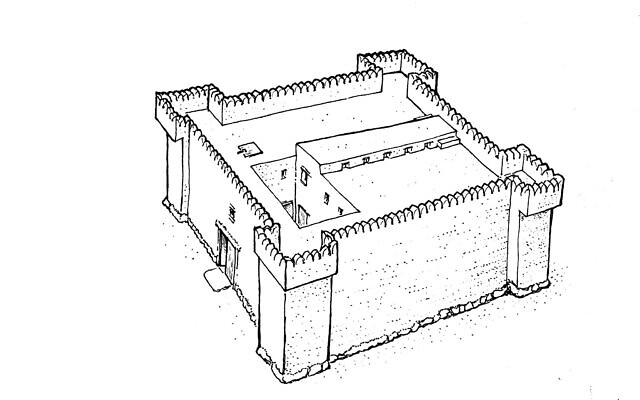
A 3,200-year-old citadel unearthed near Guvrin Stream and Kibbutz Gal On, August 2020. (Emil Aladjem/Israel Antiquities Authority)
A 3,200-year-old Canaanite citadel where epic battles were fought during biblical times has been unearthed near the southern Israeli city of Kiryat Gat, the Israel Antiquities Authority (IAA) announced Sunday.
The 12th century BCE fort next to Kibbutz Gal On and the Guvrin Stream, some 70 kilometers (40 miles) south of Jerusalem, was built by the Egyptians, who ruled the area at the time, as a defense against the Philistines, in an era corresponding to the period of the biblical Book of Judges, the IAA said in a statement.
The citadel was eventually abandoned by the Egyptians, leading to the destruction of many Canaanite cities, probably at the hands of the Philistines.
According to IAA archaeologists, Saar Ganor and Itamar Weissbein, the structure that was unearthed is 18 meters (59 feet) long and 18 meters wide, with towers in its four corners for a lookout.
They said a huge doorstep has been preserved that was carved out of a single rock weighing 3 tons.
Earthenware discovered in a 3,200-year-old citadel unearthed near Guvrin Stream and Kibbutz Gal On, August 2020. (Dafna Gazit/Israel Antiquities Authority)
Inside is a yard with brick paving and columns, flanked by rooms. Hundreds of pieces of earthenware were discovered in the rooms, some of them whole, including many bowls produced in an Egyptian style. One bowl and a mug were likely used for worship, the archaeologists said.
“The citadel we discovered offers a glimpse into the geopolitical reality described in the Book of Judges, where the Canaanites, Israelites and Philistines battle each other,” Ganor and Weissbein were quoted as saying in the statement.
“At the time, the Land of Canaan was ruled by the Egyptians, and its residents were their proteges,” they said. “But then, during the 12th century BCE, two central players appeared in the area: the Israelites and the Philistines. And thus began a series of bloody territorial struggles.
“The Israelites settled in unfortified communities on the central mountain ridge, while the Philistines gained power in the southern Mediterranean coast,” they added. “Trying to conquer more land, the Philistines battled the Egyptians and the Canaanites on the border, which likely passed along the Guvrin Stream between the Philistine kingdom of Gat and the Canaanite kingdom of Lachish.”
A sketch of a 3,200-year-old citadel unearthed near Guvrin Stream and Kibbutz Gal On, August 2020. (drawing by Itamar Weissbein/Israel Antiquities Authority)
“The Gal On Citadel was seemingly built as part of a Canaanite-Egyptian attempt to deal with the new geopolitical situation.
“The citadel was built in a strategic spot, overlooking the main road along Guvrin Stream — a road that linked the coast to the Judean lowlands.”
According to the statement, similar Egyptian fortresses from the same period have been discovered elsewhere in Israel.
The citadel was found in excavations carried out by schoolchildren from Beersheba, students of the Nahshon pre-military academy and many more volunteers.

Monday, August 24, 2020

Medieval texts reveal false Royal Navy origins


FLINDERS UNIVERSITY
Alfred the Great, King of Wessex from 871 and King of the Anglo-Saxons from 886 to 899, is widely touted as establishing England's first Royal fleet but research led by Flinders Medieval Studies PhD candidate Matt Firth has found evidence that the Anglo-Saxons' first recorded naval victory occurred 20 years before Alfred was crowned King of Wessex and 24 years before his first recorded naval victory.
The research - Kingship and Maritime Power in 10th?Century England, by Matthew Firth and Erin Sebo - has been published in the International Journal of Nautical Archaeology (DOI: 10.1111/1095-9270.1242).
"The nationalistic rhetoric that as grown up around the Royal Navy and its central role in British Empire identity since at least the 18th century has given rise to some questionable 'facts' around its origins," says Firth.
"The idea that Alfred founded the navy is widespread - and the claim has been uncritically reproduced by such reputable authorities as the National Museum of the Royal Navy, Encyclopædia Britannica and BBC's history webpage."
Firth and Dr Erin Sebo from Flinders University's College of Humanities, Arts and Social Sciences embarked on studies to identify how important naval power was to early medieval kings, and began finding evidence to question Alfred the Great's status as the founder of the Royal Navy.
Using a combination of tenth-century historical texts and the growing archaeological evidence for medieval ship design, the new research shows that Alfred was not the first English monarch to coordinate a fleet to defend the country against Viking attack.
The Anglo-Saxon Chronicles report an engagement in 851 involving an ealdorman Elchere and King Æthelstan of Kent (839-c.853), who reputedly defeated a Viking force near Sandwich - the first recorded instance of a victory for an English fleet. It implies that a tradition of defensive naval action existed from at least the reign of Alfred's father, Æthelwulf of Wessex (839-858).
The first recorded naval engagement of Alfred's reign is an attack on a fleet of seven ships in 875; the second being a skirmish with a flotilla of only four vessels in 882.
There is also evidence that the legend bestowed on Alfred the Great as a naval visionary has greatly elevated his capabilities and successes at sea.
"Alfred's ship designs, as described in the records, were impractical and failed as a maritime force in its first naval battle against more experienced Viking sailors," says Firth.
Maritime power was important to good kingship, but there is little evidence of continuity between the ad hoc fleets of the 10th-century and the emergence of a Royal Navy.
"Suggestions of vast patrol fleets maintained by his successors are both logistically and technologically impossible," says Firth.
The new research also sheds fresh light on the famous burial ships of medieval England and Scandinavia - a topical archaeological issue because of new discoveries in Iceland and Norway in the past 18 months.
Similarities in burial configuration and in ship design across these regions demonstrate ongoing cultural contact, resulting in comparable technological innovations in warship design between England and Scandinavia, and common cultural attitudes to the importance and prestige of sea-power

Thursday, August 20, 2020

Syphilis may have spread through Europe before Columbus

Syphilis is a sexually transmitted disease -- and while commonly dismissed due to the availability of modern treatments, it is in fact spreading at an alarming rate: Over the last decades, more than 10 million people around the world have been infected with the syphilis subspecies pallidum of the Treponema pallidum bacteria. Other treponematoses, such as yaws and bejel, are caused by other subspecies of Treponema pallidum. The origins of syphilis, which wreaked havoc in Europe from the late 15th to the 18th century, are still unclear. The most popular hypothesis so far holds Christopher Columbus and his sailors liable for bringing the disease to Europe from the New World.
Yaws already widespread in Europe
The new study indicates a fair possibility that Treponema pallidum already existed in Europe before Columbus ever set sails to America. The researchers found treponematoses in archaeological human remains from Finland, Estonia and the Netherlands. Both molecular dating of the ancient bacterial genomes and traditional radiocarbon dating of the samples were used to estimate the age of the pathogens causing these diseases. The results indicate that the genomes dated back to between the early 15th and 18th century.
In addition to the syphilis cases, the researchers found yaws in one of the individuals. Like syphilis, yaws is transmitted via skin contact, although rarely through sexual intercourse. Today, the disease is only found in tropical and subtropical regions. "Our data indicates that yaws was spread through all of Europe. It was not limited to the tropics, as it is today," says last author Verena Schünemann, professor of paleogenetics at the Institute of Evolutionary Medicine of the University of Zurich.
Genome of a previously unknown pathogen discovered
The research team also discovered something else: The skeleton found in the Netherlands contained a pathogen belonging to a new, unknown and basal treponemal lineage. This lineage evolved in parallel to syphilis and yaws but is no longer present as a modern-day disease. "This unforeseen discovery is particularly exciting for us, because this lineage is genetically similar to all present treponemal subspecies, but also has unique qualities that differ from them," says first author Kerttu Majander from UZH.
Because several closely related subspecies of Treponema pallidum existed throughout Europe, it is possible that the diseases persisted in overlapping regions, and sometimes infected the same patient. The spatial distribution in the northern periphery of Europe also suggests that endemic treponematoses had already spread widely in Europe in the early modern period.
Not just Columbus
"Using our ancient genomes, it is now possible for the first time to apply a more reliable dating to the treponema family tree," says Schünemann. The genetic analyses conducted in this study suggest that the predecessor of all modern Treponema pallidum subspecies likely evolved at least 2,500 years ago. For venereal syphilis in particular, the latest common ancestor existed between the 12th and 16th century.
According to the newly discovered diversity of treponematoses in early modern Europe, syphilis may have either originated or perhaps further developed in the Old World. "It seems that the first known syphilis breakout cannot be solely attributed to Columbus' voyages to America," concludes Schünemann. "The strains of treponematoses may have co-evolved and interchanged genetic material before and during the intercontinental contacts. We may yet have to revise our theories about the origins of syphilis and other treponemal diseases."