Tuesday, August 25, 2020

3,200-year-old fort, site of epic battles in biblical era, found in south Israel


A 3,200-year-old citadel unearthed near Guvrin Stream and Kibbutz Gal On, August 2020. (Emil Aladjem/Israel Antiquities Authority)
A 3,200-year-old Canaanite citadel where epic battles were fought during biblical times has been unearthed near the southern Israeli city of Kiryat Gat, the Israel Antiquities Authority (IAA) announced Sunday.
The 12th century BCE fort next to Kibbutz Gal On and the Guvrin Stream, some 70 kilometers (40 miles) south of Jerusalem, was built by the Egyptians, who ruled the area at the time, as a defense against the Philistines, in an era corresponding to the period of the biblical Book of Judges, the IAA said in a statement.
The citadel was eventually abandoned by the Egyptians, leading to the destruction of many Canaanite cities, probably at the hands of the Philistines.
According to IAA archaeologists, Saar Ganor and Itamar Weissbein, the structure that was unearthed is 18 meters (59 feet) long and 18 meters wide, with towers in its four corners for a lookout.
They said a huge doorstep has been preserved that was carved out of a single rock weighing 3 tons.
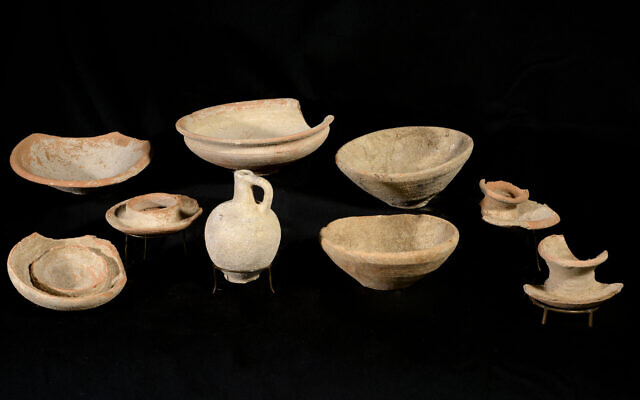
Earthenware discovered in a 3,200-year-old citadel unearthed near Guvrin Stream and Kibbutz Gal On, August 2020. (Dafna Gazit/Israel Antiquities Authority)
Inside is a yard with brick paving and columns, flanked by rooms. Hundreds of pieces of earthenware were discovered in the rooms, some of them whole, including many bowls produced in an Egyptian style. One bowl and a mug were likely used for worship, the archaeologists said.
“The citadel we discovered offers a glimpse into the geopolitical reality described in the Book of Judges, where the Canaanites, Israelites and Philistines battle each other,” Ganor and Weissbein were quoted as saying in the statement.
“At the time, the Land of Canaan was ruled by the Egyptians, and its residents were their proteges,” they said. “But then, during the 12th century BCE, two central players appeared in the area: the Israelites and the Philistines. And thus began a series of bloody territorial struggles.
“The Israelites settled in unfortified communities on the central mountain ridge, while the Philistines gained power in the southern Mediterranean coast,” they added. “Trying to conquer more land, the Philistines battled the Egyptians and the Canaanites on the border, which likely passed along the Guvrin Stream between the Philistine kingdom of Gat and the Canaanite kingdom of Lachish.”
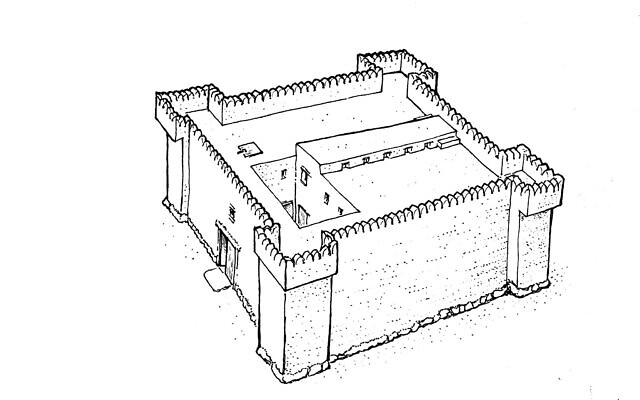
A sketch of a 3,200-year-old citadel unearthed near Guvrin Stream and Kibbutz Gal On, August 2020. (drawing by Itamar Weissbein/Israel Antiquities Authority)
“The Gal On Citadel was seemingly built as part of a Canaanite-Egyptian attempt to deal with the new geopolitical situation.
“The citadel was built in a strategic spot, overlooking the main road along Guvrin Stream — a road that linked the coast to the Judean lowlands.”
According to the statement, similar Egyptian fortresses from the same period have been discovered elsewhere in Israel.
The citadel was found in excavations carried out by schoolchildren from Beersheba, students of the Nahshon pre-military academy and many more volunteers.

Monday, August 24, 2020

Medieval texts reveal false Royal Navy origins


FLINDERS UNIVERSITY
Alfred the Great, King of Wessex from 871 and King of the Anglo-Saxons from 886 to 899, is widely touted as establishing England's first Royal fleet but research led by Flinders Medieval Studies PhD candidate Matt Firth has found evidence that the Anglo-Saxons' first recorded naval victory occurred 20 years before Alfred was crowned King of Wessex and 24 years before his first recorded naval victory.
The research - Kingship and Maritime Power in 10th?Century England, by Matthew Firth and Erin Sebo - has been published in the International Journal of Nautical Archaeology (DOI: 10.1111/1095-9270.1242).
"The nationalistic rhetoric that as grown up around the Royal Navy and its central role in British Empire identity since at least the 18th century has given rise to some questionable 'facts' around its origins," says Firth.
"The idea that Alfred founded the navy is widespread - and the claim has been uncritically reproduced by such reputable authorities as the National Museum of the Royal Navy, Encyclopædia Britannica and BBC's history webpage."
Firth and Dr Erin Sebo from Flinders University's College of Humanities, Arts and Social Sciences embarked on studies to identify how important naval power was to early medieval kings, and began finding evidence to question Alfred the Great's status as the founder of the Royal Navy.
Using a combination of tenth-century historical texts and the growing archaeological evidence for medieval ship design, the new research shows that Alfred was not the first English monarch to coordinate a fleet to defend the country against Viking attack.
The Anglo-Saxon Chronicles report an engagement in 851 involving an ealdorman Elchere and King Æthelstan of Kent (839-c.853), who reputedly defeated a Viking force near Sandwich - the first recorded instance of a victory for an English fleet. It implies that a tradition of defensive naval action existed from at least the reign of Alfred's father, Æthelwulf of Wessex (839-858).
The first recorded naval engagement of Alfred's reign is an attack on a fleet of seven ships in 875; the second being a skirmish with a flotilla of only four vessels in 882.
There is also evidence that the legend bestowed on Alfred the Great as a naval visionary has greatly elevated his capabilities and successes at sea.
"Alfred's ship designs, as described in the records, were impractical and failed as a maritime force in its first naval battle against more experienced Viking sailors," says Firth.
Maritime power was important to good kingship, but there is little evidence of continuity between the ad hoc fleets of the 10th-century and the emergence of a Royal Navy.
"Suggestions of vast patrol fleets maintained by his successors are both logistically and technologically impossible," says Firth.
The new research also sheds fresh light on the famous burial ships of medieval England and Scandinavia - a topical archaeological issue because of new discoveries in Iceland and Norway in the past 18 months.
Similarities in burial configuration and in ship design across these regions demonstrate ongoing cultural contact, resulting in comparable technological innovations in warship design between England and Scandinavia, and common cultural attitudes to the importance and prestige of sea-power

Thursday, August 20, 2020

Syphilis may have spread through Europe before Columbus

Syphilis is a sexually transmitted disease -- and while commonly dismissed due to the availability of modern treatments, it is in fact spreading at an alarming rate: Over the last decades, more than 10 million people around the world have been infected with the syphilis subspecies pallidum of the Treponema pallidum bacteria. Other treponematoses, such as yaws and bejel, are caused by other subspecies of Treponema pallidum. The origins of syphilis, which wreaked havoc in Europe from the late 15th to the 18th century, are still unclear. The most popular hypothesis so far holds Christopher Columbus and his sailors liable for bringing the disease to Europe from the New World.
Yaws already widespread in Europe
The new study indicates a fair possibility that Treponema pallidum already existed in Europe before Columbus ever set sails to America. The researchers found treponematoses in archaeological human remains from Finland, Estonia and the Netherlands. Both molecular dating of the ancient bacterial genomes and traditional radiocarbon dating of the samples were used to estimate the age of the pathogens causing these diseases. The results indicate that the genomes dated back to between the early 15th and 18th century.
In addition to the syphilis cases, the researchers found yaws in one of the individuals. Like syphilis, yaws is transmitted via skin contact, although rarely through sexual intercourse. Today, the disease is only found in tropical and subtropical regions. "Our data indicates that yaws was spread through all of Europe. It was not limited to the tropics, as it is today," says last author Verena Schünemann, professor of paleogenetics at the Institute of Evolutionary Medicine of the University of Zurich.
Genome of a previously unknown pathogen discovered
The research team also discovered something else: The skeleton found in the Netherlands contained a pathogen belonging to a new, unknown and basal treponemal lineage. This lineage evolved in parallel to syphilis and yaws but is no longer present as a modern-day disease. "This unforeseen discovery is particularly exciting for us, because this lineage is genetically similar to all present treponemal subspecies, but also has unique qualities that differ from them," says first author Kerttu Majander from UZH.
Because several closely related subspecies of Treponema pallidum existed throughout Europe, it is possible that the diseases persisted in overlapping regions, and sometimes infected the same patient. The spatial distribution in the northern periphery of Europe also suggests that endemic treponematoses had already spread widely in Europe in the early modern period.
Not just Columbus
"Using our ancient genomes, it is now possible for the first time to apply a more reliable dating to the treponema family tree," says Schünemann. The genetic analyses conducted in this study suggest that the predecessor of all modern Treponema pallidum subspecies likely evolved at least 2,500 years ago. For venereal syphilis in particular, the latest common ancestor existed between the 12th and 16th century.
According to the newly discovered diversity of treponematoses in early modern Europe, syphilis may have either originated or perhaps further developed in the Old World. "It seems that the first known syphilis breakout cannot be solely attributed to Columbus' voyages to America," concludes Schünemann. "The strains of treponematoses may have co-evolved and interchanged genetic material before and during the intercontinental contacts. We may yet have to revise our theories about the origins of syphilis and other treponemal diseases."

Wednesday, August 19, 2020

Analysis of ancient Mesoamerican sculptures supports universality of emotional expressions


Universal facial expressions uncovered in art of the ancient Americas: A computational approach
AMERICAN ASSOCIATION FOR THE ADVANCEMENT OF SCIENCE
An analysis of facial expressions in ancient Mesoamerican sculptures finds that some emotions expressed in these artworks match the emotions that modern U.S. participants would anticipate for each discernible context, including elation, sadness, pain, anger, and determination or strain. For instance, elation was predicted in the context of social touch while anger was predicted in the context of combat. The results support the hypothesis that some emotions conveyed through facial expressions are universal, reinforcing that feelings can be expressed nonverbally in ways that transcend culture. While previous studies have explored cross-cultural similarities and differences in how facial expressions convey emotions, these studies have typically asked people from Eastern or indigenous cultures to match depictions of Western expressions to situations or words in their native language. Such work may be perceived as biased since it treats Western emotional expression as the norm. To circumvent this bias, Alan Cowen and colleagues asked U.S. research subjects to label emotions expressed in ancient American art sculptures, which predated exposure to modern Western civilizations. The researchers combed through tens of thousands of images of Mesoamerican sculptures on museum websites, identifying 63 authentic sculptures that displayed facial expressions within clearly identifiable contexts, such as a smiling mother holding a baby. Next, Cowen et al. digitally separated each sculpture's expression from its context, producing, for example, one image of just the smile and one image of the mother holding the baby, with no expression visible. They asked the U.S. participants to label each image of a sculpture's facial expression with the emotion it depicted, and, separately, to label images of a sculpture's context with the emotion they would expect to see. Sculptures depicting some emotions passed the test of universality, with facial expression labels ("elated," for the mother's facial expression) matching the expectations of participants who only saw the context (an expressionless mother holding a baby). This suggests that emotional expressions can be inferred through universal human themes, such as a mother-child relationship, even without a common language. "We would eventually be interested in replicating this work in other cultures," says Cowen, noting examples of sculpture from ancient Egyptian, Indian, and Chinese cultures that could potentially be analyzed using similar study protocols. "For the time being, we are heavily focused on studying emotional expression in everyday life across many countries, aided by machine learning tools."

Friday, August 14, 2020

Remains of 17th century bishop support neolithic emergence of tuberculosis


Bishop Peder Winstrup of Lund, Sweden passed away in the winter of 1679 at the age of 74 and was interred in a crypt at Lund Cathedral; three centuries later, his astonishingly well-preserved remains provide insights to the origins of tuberculosis
MAX PLANCK INSTITUTE FOR THE SCIENCE OF HUMAN HISTORY
IMAGE
IMAGE: PORTRAIT OF BISHOP PEDER JENSEN WINSTRUP view more 
CREDIT: ORF3US / CC BY-SA (HTTPS://CREATIVECOMMONS.ORG/LICENSES/BY-SA/3.0)
When Anthropologist Caroline Arcini and her colleagues at the Swedish Natural Historical Museum discovered small calcifications in the extremely well preserved lungs of Bishop Peder Winstrup, they knew more investigation was needed. "We suspected these were remnants of a past lung infection," says Arcini, "and tuberculosis was at the top of our list of candidates. DNA analysis was the best way to prove it."
Up to one quarter of the world's population is suspected to have been exposed to bacteria of the Mycobacterium tuberculosis complex, which cause tuberculosis (TB). Bishop Winstrup would have been one of many to fall ill during the onset of the so-called "White Plague" TB pandemic that ravaged post-medieval Europe. Today, TB is among the most prevalent diseases, accounting for the highest worldwide mortality from a bacterial infection.
The global distribution of TB has led to the prevailing assumption that the pathogen evolved early in human history and reached its global distribution via the hallmark Out of Africa human migrations tens of thousands of years ago, but recent work on ancient TB genomes has stirred up controversy over when this host-pathogen relationship began. In 2014, a team led by scientists from the University of Tübingen and Arizona State University reconstructed three ancient TB genomes from pre-contact South America - not only were the ancient strains unexpectedly related to those circulating in present-day seals, but comparison against a large number of human strains suggested that TB emerged within the last 6000 years. Understandably, skepticism surrounded this new estimate since it was based entirely on ancient genomes that are not representative of the TB strains associated with humans today.
"Discovery of the Bishop's lung calcification gave us the opportunity to revisit the question of tuberculosis emergence with data from an ancient European," comments Kirsten Bos, group leader for Molecular Paleopathology at the Max Planck Institute for the Science of Human History (MPI-SHH), who co-led the study. "If we could reconstruct a TB genome from Bishop Winstrup, where we know his date of death to the day, it would give a secure and independent calibration for our estimates of how old TB, as we know it, actually is."
The highest quality ancient TB genome to date
In a new study published this week in Genome Biology, Susanna Sabin of MPI-SHH and colleagues reconstruct a tuberculosis genome from the calcified nodule discovered in Bishop Winstrup's remains.
"The genome is of incredible quality - preservation on this scale is extremely rare in ancient DNA," comments Bos.
Together with a handful of tuberculosis genomes from other work, the researchers revisit the question of the age of the Mycobacterium tuberculosis complex, with the year of the Bishop's death as a fine-tuned calibration point. Using multiple molecular dating models, all angles indeed point to a relatively young age of the Mycobacterium tuberculosis complex.
"A more recent emergence of the tuberculosis pathogen complex is now supported by genetic evidence from multiple geographic regions and time periods," comments Sabin, first author of the study. "It's the strongest evidence available to date for this emergence having been a Neolithic phenomenon."
This most recent shift in the narrative for when bacteria in the Mycobacterium tuberculosis complex became highly infectious to humans raises further questions about the context of its emergence, as it appears to have coincided with the rise of pastoralism and sedentary lifestyles.
"The Neolithic transition seems to have played an important role for the emergence of a number of human pathogens," comments Denise Kühnert, group leader for disease transmission research at MPI-SHH who co-led the investigation.
"For TB in particular, stronger evidence could only come from an older genome, though these deeper time periods are unlikely to yield preservation on the scale of what we've seen for Bishop Winstrup," adds Bos.
"Moving forward," Sabin further comments, "the hope is we will find adequately preserved DNA from time periods close to the emergence of the complex, or perhaps from its ancestor."

Humans prepared beds to sleep on right at the dawn of our species -- over 200 000 years ago


UNIVERSITY OF THE WITWATERSRAND
IMAGE
IMAGE: BORDER CAVE IN THE LEBOMBO MOUNTAINS. PANORAMA FROM DRONE IMAGES. A. KRUGER view more 
CREDIT: A. KRUGER
Researchers in South Africa's Border Cave, a well-known archaeological site perched on a cliff between eSwatini (Swaziland) and KwaZulu-Natal in South Africa, have found evidence that people have been using grass bedding to create comfortable areas for sleeping and working on at least 200 000 years ago.
These beds, consisting of sheaves of grass of the broad-leafed Panicoideae subfamily were placed near the back of the cave on ash layers. The layers of ash was used to protect the people against crawling insects while sleeping. Today, the bedding layers are visually ephemeral traces of silicified grass, but they can be identified using high magnification and chemical characterisation.
The Border Cave study was conducted by a multidisciplinary team from the University of the Witwatersrand, South Africa, the CNRS (University of Bordeaux), and Université Côte d'Azur, France, the Instituto Superior de Estudios Sociales, Tucumán, Argentina, and the Royal Institute for Cultural Heritage, Belgium. The research was published in the high impact journal Science.
"We speculate that laying grass bedding on ash was a deliberate strategy, not only to create a dirt-free, insulated base for the bedding, but also to repel crawling insects," says Professor Lyn Wadley, principal researcher and lead author.
"Sometimes the ashy foundation of the bedding was a remnant of older grass bedding that had been burned to clean the cave and destroy pests. On other occasions, wood ash from fireplaces was also used as the clean surface for a new bedding layer."
Several cultures have used ash as an insect repellent because insects cannot easily move through fine powder. Ash blocks insects' breathing and biting apparatus, and eventually dehydrates them. Tarchonanthus (camphor bush) remains were identified on the top of the grass from the oldest bedding in the cave. This plant is still used to deter insects in rural parts of East Africa.
"We know that people worked as well as slept on the grass surface because the debris from stone tool manufacture is mixed with the grass remains. Also, many tiny, rounded grains of red and orange ochre were found in the bedding where they may have rubbed off human skin or coloured objects," says Wadley.
Modern hunter-gatherer camps have fires as focal points; people regularly sleep alongside them and perform domestic tasks in social contexts. People at Border Cave also lit fires regularly, as seen by stacked fireplaces throughout the sequence dated between about 200 000 and 38 000 years ago.
"Our research shows that before 200 000 years ago, close to the origin of our species, people could produce fire at will, and they used fire, ash, and medicinal plants to maintain clean, pest-free camps. Such strategies would have had health benefits that advantaged these early communities."
Although hunter-gatherers tend to be mobile and seldom stay in one place for more than a few weeks, cleansing camps had the potential to extend potential occupancy.

Wednesday, August 12, 2020

Australian Indigenous banana cultivation found to go back over 2,000 years


Findings help dispel the view that Australia's first peoples were 'only hunter gatherers'
AUSTRALIAN NATIONAL UNIVERSITY
IMAGE
IMAGE: ANCIENT BANANA CULTIVATION SITE AT WAGADAGAM, MABUYAG ISLAN, TORRES STRAITview more 
CREDIT: ANU
Archaeologists at The Australian National University (ANU) have found the earliest evidence of Indigenous communities cultivating bananas in Australia.
The evidence of cultivation and plant management dates back 2,145 years and was found at Wagadagam on the tiny island of Mabuyag in the western Torres Strait.
The site comprised a series of retaining walls associated with gardening activities along with a network of stone arrangements, shell arrangements, rock art and a mound of dugong bones.
Soils from the site showed definitive evidence for intensive banana cultivation in the form of starch granules, banana plant microfossils and charcoal.
Lead researcher, Kambri-Ngunnawal scholar Robert Williams, says the findings help dispel the view that Australia's first peoples were "only hunter gatherers".
"The Torres Strait has historically been seen as a separating line between Indigenous groups who practiced agriculture in New Guinea but who in Australia were hunter gatherers," Mr Williams said.
"Our research shows the ancestors of the Goegmulgal people of Mabuyag were engaged in complex and diverse cultivation and horticultural practices in the western Torres Strait at least 2,000 years ago.
"So rather than being a barrier, the Torres Strait was more of a bridge or a filter of cultural and horticultural practices going both north and south.
"The type of banana we found on Mabuyag appeared much earlier on New Guinea, which was a centre of banana domestication."
The team also found stone flake tools with plant residues along their cutting surfaces.
"What we're seeing here is an Indo-Pacific horticultural tradition based primarily on things like yams, taro and banana and important fat and protein elements in the form of fish, dugong and turtle, these people had a very high-quality diet," Mr Williams said.
"Food is an important part of Indigenous culture and identity and this research shows the age and time depth of these practices. I hope it will spark interest in these food traditions and might move people back towards them."
Mr Williams said the charcoal found at the site indicated burning for gardening activities. Excavated charcoal provided dates for the finds through radiocarbon dating.
Co-researcher Dr Duncan Wright said the Torres Strait region was a place where local innovations took place.
"The age of the banana propagation is also very significant. It's not something we expect to see in continental Australia and this is the earliest well dated evidence for plant management in Torres Strait," Dr Wright said.
"At the time I thought it was odd to see cultivation in a landscape otherwise set aside for ritual activities. Now we know why, the retaining walls were part of a much older phase of activity at Wagadagam."
As a descendant of the Kambri Ngunnawal peoples, Mr Williams said he was mindful of how his research could affect a first nations' community.
"Historically, culture has been appropriated by non-Indigenous archaeologists and anthropologists, so it was really important for me to make a connection with the people in this community and ensure they understood the research really belongs to them.
"I hope this work is something the community can be really proud about. It demonstrates through clear evidence the diversity and complexity of early horticulture in the western Torres Strait."
Mr Williams is the lead author on the research published in Nature, Ecology and Evolution.
He did his Masters in Archaeology at ANU and is currently a third year PhD candidate in the Department of Archaeology at Sydney University.
"This paper is led by a First Australian author. It's another big achievement for Robert, whom I suspect will play an important role in the discipline of Archaeology," Dr Wright said.
"His work makes a statement that goes beyond academia, representing a much-needed shift for the discipline where research into First Nations' communities is led by First Nations' peoples."