Saturday, August 8, 2020

A significant administrative storage center from the days of Kings Hezekiah and Menashe uncovered in Jerusalem near the US Embassy


Over 120 seal impressions stamped on jars found in the Arnona neighborhood of Jerusalem provide a sneak-peek into tax collection in the period of the Judean monarchs.
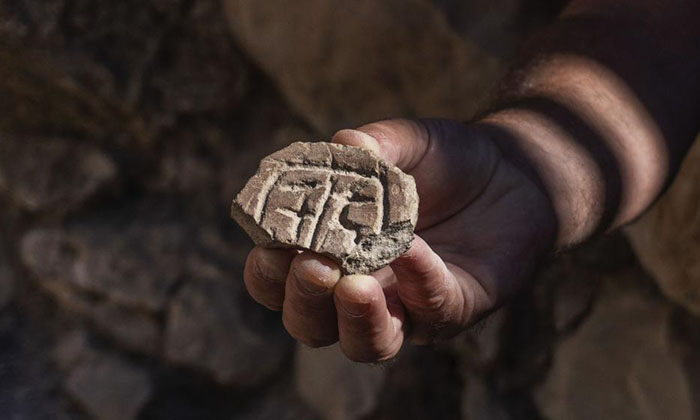
The excavations in Arnona, conducted by the Israel Antiquities Authority, were funded by the Israel Land Authority and administrated by the Moriah Jerusalem Development Corporation and revealed one of the largest and most important collections of seal impressions uncovered in Israel. The impressions were stamped with the letters "LMLK" (to the King) written in ancient Hebrew script and the name of an ancient city in the Kingdom of Judah. Other seals are associated with private individuals who bear the name of a senior official of the Kingdom of Judah or a wealthy individual.
What challenge was the Kingdom of Judah preparing for 2,700 years ago in today's Arnona neighborhood of Jerusalem, and can it be related to a dramatic historical event? A significant administrative storage center from the days of Kings Hezekiah and Menashe (8th century to the middle of the 7th century BCE) has recently been exposed to archeological excavations in the Arnona neighborhood of Jerusalem. The excavation conducted by the Israel Antiquities Authority US Embassy is funded by the Israel Land Authority and administrated by the Moriah Jerusalem Development Corporation for the development of a new neighborhood.
Excavation at the site revealed an unusually large structure built of concentric ashlars walls. Of particular interest, 120 jar handles were found bearing seal impressions containing ancient Hebrew script! Many of the handles bare the inscription "LMLK" - (belonging) to the King- with the name of an ancient city. In contrast, others feature the names of senior officials or wealthy individuals from the First Temple Period. This is one of the largest and most important collections of seal impressions ever uncovered in archaeological excavations in Israel.
According to Neria Sapir and Nathan Ben-Ari, directors of the excavations on behalf of the Israel Antiquities Authority, "This is one of the most significant discoveries from the period of the Kings in Jerusalem made in recent years. At the site we excavated, there are signs that governmental activity managed and distributed food supplies not only for a shortage but administered agricultural surplus amassing commodities and wealth. Evidence shows that at this site, taxes were collected in an orderly manner for agricultural products such as wine and olive oil. The site once dominated large agricultural plots and orchards of olive trees and grapevines, which included agricultural, industrial facilities such as wine presses for winemaking. The site is dated to a period documented in the Bible by upheavals such as that of the Assyrian conquest campaign - under the command of King Sennacherib in the days of King Hezekiah. It may be that the government economic provisions indicated by the stamp seals are related to these events; however, the excavation revealed that the site continued to be active after the Assyrian conquest. Moreover, the array of stamped seals indicated that the system of taxation remained uninterrupted during this period. It is interesting to note that some of the storage jar handles are inscribed with the names of senior officials and wealthy individuals from the Kingdom of Judah - Naham Abdi, Naham Hatzlihu, Meshalem Elnatan, Zafan Abmetz, Shaneah Azaria, Shalem Acha, and Shivna Shachar. These names appear on storage jar handles at various sites across the Kingdom of Judah and attest to the elite position of those whose names are impressed on the jars. It is estimated that these are senior officials who were in charge of specific economic areas, or perhaps wealthy individuals at that time - those who owned large agricultural lands, propelled the economy of their district and owned private seals."
The excavators also posit that a large number of seal impressions at the site indicate that during the latter part of the Kingdom of Judah, the governmental activity took place in the area south of the City of David. It is also possible that this governmental activity was related to the nearby site of Ramat Rachel, which may be identified with the palace of the Kings of Judah and/or as an administrative center.
The majority of the seal impressions uncovered contain the ancient Hebrew letters "LMLK." These impressions are characterized by a sun disk flanked with two wings. Above the sun disc appears the word 'to the King' and below one of four cities in the kingdom of Judah: Hebron, Ziph, Socho, or Mmst. According to Sapir and Ben-Ari, while the identification of Hebron, Ziph, and Socho can be identified with known ancient cities in Judea in the Hebron Hills area, however, the identification of Mmst is still controversial."
During the ancient period, for reasons not understood, the large building at the site was covered over with a massive pile of flint stones forming an artificial hill measuring 20 meters high and extending over seven dunams (!). Even today, this huge pile of stones stands out from the surrounding hills and is visible from a great distance. According to the researchers, "These artificial stone hills have been identified at several sites in Jerusalem and are a phenomenon to the end of the First Temple period and have aroused the curiosity and fascination of Jerusalem researchers since the beginning of archeological research in the area. Nevertheless, the reason for the huge effort made in stacking them over many acres remains an unresolved archaeological mystery."
Another finding that sheds light on the character of the period is a collection of figurines – clay statuettes. According to archaeologists Sapir and Ben-Ari, "Some of the figurines are designed in the form of women, horse riders or as animals. These figurines are usually interpreted as objects used in pagan worship and idolatry - a phenomenon which, according to the Bible, was prevalent in the Kingdom of Judah." The researchers added that "It seems that shortly after the site was abandoned, with the destruction of the Kingdom of Judah in 586 BCE and the Babylonian exile, the site was resettled and administrative activity resumed. During this time, governmental activity at the site was connected to the Judean province upon the Return to Zion in 538 BCE under the auspices of the Achaemenid Persian Empire, which then ruled over the entire ancient Near East and Central Asia."
According to Dr. Yuval Baruch, the Jerusalem District Archaeologist of the IAA, "The archeological discoveries at Arnona identify the site as a key site - the most important in the history of the final days of the Kingdom of Judah and of the return to Zion decades after the destruction of the kingdom. This site joins a number of other key sites uncovered in the area of Jerusalem, which were connected to the centralized administrative system of the Kingdom of Judah from its peak until its destruction. The Israel Antiquities Authority and the Israel Lands Authority recognize the importance of the site and its uniqueness and are working together to preserve and integrate these sites into the new neighborhood plan. This is part of the IAA's trend of sustainable development which views archeological excavations as a resource that must be preserved and presented to the public as part of local heritage, and not just as an academic field of study."

A 1,300-year old church, apparently part of a monastery, was uncovered in the village of Kfar Kama, near Mount Tabor


The church was discovered in Kfar Kama, in archaeological excavations carried out by the Israel Antiquities Authority, in collaboration with the Kinneret Academic College and local volunteers * The discovery in the Galilee excited the Head of the Greek Catholic Church in Israel, who personally came to visit the site * The excavation was conducted before the construction of a playground, at the initiative of the Kfar Kama Local Council and the Jewish National Fund.
A 1,300year-old church, with ornate mosaic floors, was recently revealed in an excavation in the Circassian village of Kfar Kama, near Kfar Tabor, carried out by the Israel Antiquities Authority, in collaboration with the Kinneret Academic College, and with assistance from local volunteers. The Catholic Archbishop Dr. Youssef Matta, Head of the Greek Catholic Church in Israel, personally visited the site and was inspired by the ancient remains.
The excavation directed led by archaeologist Nurit Feig on behalf of the Israel Antiquities Authority, and in collaboration with Prof. Moti Aviam of the Kinneret Academic College, took place before the building of a playground,  initiated by the Kfar Kama Local Council and the Jewish National Fund.

According to Feig, “The church, measuring 12 × 36 m, includes a large courtyard, a narthex foyer, and a central hall. Particular to this church is the existence of three apses (prayer niches), while most churches were characterized by a single apse. The nave and the aisles were paved with mosaics, which partially survived. Their colorful decoration stands out, incorporating geometric patterns, and blue, black, and red floral designs. An unusual discovery was the small reliquary, a stone box used to preserve sacred relics.
An additional series of rooms was partially uncovered adjacent to the church. According to a ground-penetrating radar inspection operated by Dr. Shani Libbi, there are other rooms at the site yet to be excavated. According to the researchers, “it is quite possible that this large complex was a monastery.”
In the early 1960s, a smaller church with two chapels was excavated inside the village of Kfar Kama and was dated by the finds to the first half of the sixth century CE. According to Prof. Moti Aviam, “this was probably the village church, while the church now discovered was probably part of a contemporary monastery on the outskirts of the village.”
The discovery hints at the apparent importance of the Christian village settled in the Byzantine period close to Mount Tabor, a site of primary religious significance for Christianity, identified as the site of the Transfiguration. In 1876, when the Circassian Shapsug tribe first settled in Kfar Kama, they used the stones of the ancient village to build their houses.

The discovery of the church in Kfar Kama will contribute to the extensive research project on the Christian settlement in the Galilee that is being carried out by Prof. Moti Aviam and Dr. Jacob Ashkenazi of the Kinneret Institute of Galilean Archaeology in the Kinneret Academic College.

Evidence of the path of modern humans leaving Africa 100,000 years ago, was discovered in Dimona


Local youths working with the Israel Antiquities Authority uncovered the Stone Age site during the summer * This is the first place in Israel where in situ evidence has been found of the particular stone knapping technology used by humans who left Africa * The discovery was revealed in an archeological excavation facilitating the construction of a solar energy field and was underwritten by the Israel Electric Company
Recent excavations conducted by the Israel Antiquities Authority together with local youths from  Dimona, in preparation for the construction of a solar energy field and funded by the Electric Company, discovered a  Middle Paleolithic flint knapping site that existed between 250,000 - 50,000 years ago. Those who helped uncover the unique prehistoric site were youths from the city, who worked in the excavation as a summer job during the economically challenging period of the COVID-19.
The newly discovered site near Dimona is small. Prehistoric humans seemingly arrived here to access the abundant natural flint, from which they made their tools.
The site here is unique because of the flint knapping technology, known as ‘Nubian Levallois,’ which originated in Africa. Researchers trace the path of this technology to understand the migration routes of modern humans from Africa to the rest of the world, about 100,000 years ago.
According to the excavation directors, the prehistory researchers Talia Abulafia and Maya Oron from the Israel Antiquities Authority, “This is the first evidence of a ‘Nubian’ flint industry in an archeological excavation in Israel. The knapped flint artifacts remained right in the first place where the humans sat and created the tools. This manufacturing is identified with modern human populations who lived in East Africa 150-100 thousand years ago and migrated from there around the world. In the last decade, quite a few Nubian sites have been discovered in the Arabian Peninsula. This has led many scholars to claim that modern humans left Africa through the Arabian Peninsula. The Dimona site appears to present the northernmost example of Nubian flint output found in situ, thus marking the migration route: from Africa to Saudi Arabia, and from there, perhaps, to the Negev.

The excavation took place while dealing with the challenges presented by COVID-19, which affect the health and economy of Israeli citizens in general, and the residents of Dimona in particular. According to Svetlana Talis, Northern Negev District Archaeologist at the Israel Antiquities Authority, “Dimona is one of the most severely affected towns in the second wave of the Corona outbreak and was even on the verge of lockdown. After wondering what to do about summer holidays, local youths from Dimona came to the excavation to work and help their families, and to uncover a site of particular importance. All of this is part of a project promoted and directed by the Israel Antiquities Authority in recent years, which seeks to bring our youth closer to their cultural heritage.”

Thursday, August 6, 2020

DNA from an ancient, unidentified ancestor was passed down to humans living today


New algorithm suggests that early humans and related species interbred early and often
PLOS
A new analysis of ancient genomes suggests that different branches of the human family tree interbred multiple times, and that some humans carry DNA from an archaic, unknown ancestor. Melissa Hubisz and Amy Williams of Cornell University and Adam Siepel of Cold Spring Harbor Laboratory report these findings in a study published 6th August in PLOS Genetics.
Roughly 50,000 years ago, a group of humans migrated out of Africa and interbred with Neanderthals in Eurasia. But that's not the only time that our ancient human ancestors and their relatives swapped DNA. The sequencing of genomes from Neanderthals and a less well-known ancient group, the Denisovans, has yielded many new insights into these interbreeding events and into the movement of ancient human populations. In the new paper, the researchers developed an algorithm for analyzing genomes that can identify segments of DNA that came from other species, even if that gene flow occurred thousands of years ago and came from an unknown source. They used the algorithm to look at genomes from two Neanderthals, a Denisovan and two African humans. The researchers found evidence that 3 percent of the Neanderthal genome came from ancient humans, and estimate that the interbreeding occurred between 200,000 and 300,000 years ago. Furthermore, 1 percent of the Denisovan genome likely came from an unknown and more distant relative, possibly Homo erectus, and about 15% of these "super-archaic" regions may have been passed down to modern humans who are alive today.
The new findings confirm previously reported cases of gene flow between ancient humans and their relatives, and also point to new instances of interbreeding. Given the number of these events, the researchers say that genetic exchange was likely whenever two groups overlapped in time and space. Their new algorithm solves the challenging problem of identifying tiny remnants of gene flow that occurred hundreds of thousands of years ago, when only a handful of ancient genomes are available. This algorithm may also be useful for studying gene flow in other species where interbreeding occurred, such as in wolves and dogs.
"What I think is exciting about this work is that it demonstrates what you can learn about deep human history by jointly reconstructing the full evolutionary history of a collection of sequences from both modern humans and archaic hominins," said author Adam Siepel. "This new algorithm that Melissa has developed, ARGweaver-D, is able to reach back further in time than any other computational method I've seen. It seems to be especially powerful for detecting ancient introgression."

Wednesday, August 5, 2020

Native American stone tool technology found in Arabia


CNRS


IMAGE
IMAGE: STONE FLUTED POINTS DATING BACK SOME 8,000 TO 7,000 YEARS AGO, WERE DISCOVERED ON ARCHAEOLOGICAL SITES IN MANAYZAH, YEMEN AND AD-DAHARIZ, OMAN. UNTIL NOW, THE PREHISTORIC TECHNIQUE OF FLUTING HAD... view more 
CREDIT: © JÉRÉMIE VOSGES / CNRS

Stone fluted points dating back some 8,000 to 7,000 years ago, were discovered on archaeological sites in Manayzah, Yemen and Ad-Dahariz, Oman. Spearheads and arrowheads were found among these distinctive and technologically advanced projectile points. Until now, the prehistoric technique of fluting had been uncovered only on 13,000 to 10,000-year-old Native American sites. According to a study led by an international team of archaeologists from the CNRS (1), Inrap, Ohio State University and the Max Planck Institute for the Science of Human History, the difference in age and geographic location implies there is no connection between the populations who made them. This is therefore an example of cultural convergence for an invention which required highly-skilled expertise. And yet, despite similar fluting techniques, the final aim appears to be different. Whereas in the Americas the points were used to facilitate hafting, or attaching the point to a shaft, fluting in Arabia was possibly a mere display of knapping skills.

 new study led by archaeologists from the CNRS, the Inrap, the Ohio State University and the Max Planck Institute for the Science of Human History, reports on fluted points from the archaeological sites of Manayzah in Yemen and Ad-Dahariz in Oman. Fluted stone tools are a distinctive, technologically advanced form of projectile points, including spearheads and arrowheads. Fluting is a specific technique that involves the extraction of an elongated flake along the length of a projectile point, leaving a distinctive groove or depression at the base of the spearhead or arrowhead.
Fluting is a distinct technological tradition invented by early human cultures that spread across the Americas. Fluted point technology is very well known in North America, evidenced by finds across the continent dating from 13,000 to 10,000 years ago. As lead author Dr. Rémy Crassard of the CNRS notes, "Until the early 2000s, these fluted points were unknown elsewhere on the planet. When the first isolated examples of these objects were recognized in Yemen, and more recently in Oman, we recognized that there could be huge implications."
The sites of Manayzah and Ad-Dahariz yielded dozens of fluted points. The Arabian examples date to the Neolithic period, about 8,000 to 7,000 years ago, at least two thousand years later than the American examples. As Professor Petraglia of the Max Planck explains, "Given their age and the fact that the fluted points from America and Arabia are separated by thousands of kilometers, there is no possible cultural connection between them. This is then a clear and excellent example of cultural convergence, or independent invention in human history."
The new PLOS ONE article carefully examines the fluted points found in south Arabia. Detailed technological analysis, backed up by stone tool experiments and replication by an expert modern flintknapper, illustrate the similarities between the American and Arabian fluting procedures.
In addition to the similarities, the authors of the new study also investigated the contrasts between the technologies of the two regions. Technological differences were apparent in the nature and location of the flute. The authors emphasize that the 'fluting method' was likely a mental conceptualization of stone tool manufacture, more than just a technical way to produce a projectile and hafting zone. Whereas the apparent function of fluting in the Americas is to facilitate hafting, or attaching the point to a shaft, most of the Arabian fluted points do not have hafting as a functional final aim. The fluting concept and the method itself are the same in both American and Arabia, yet the final aim of fluting appears to be different.
Arabian and American fluted point technologies were highly specialized stone tool production methods. The PLOS ONE study of Arabian fluting technology demonstrates that similar innovations and inventions were developed under different circumstances and that such highly-skilled and convergent production methods can have different anthropological implications. As discussed in the article, Professor McCorriston argues that "fluting in Arabia was used as a display of skill, rather than serving a purely functional purpose such as hafting, as is more widely accepted in the Americas."
In Arabian prehistory, southern Arabia experienced developments of local origin, with multiple examples of inventions and innovations not culturally transmitted by outside traditions. The fluting method is then a hallmark of this indigenous development in the south Arabian Neolithic.

Tuesday, August 4, 2020

Ancient shell llama offering found in lake Titicaca


PENN STATE
IMAGE
IMAGE: STONE BOX WITH CARVED SHELL LLAMA AND ROLLED GOLD FOIL view more 
CREDIT: TEDDY SEQUIN
A llama carved from a spondylus shell and a cylindrical laminated gold foil object were the contents of a carved stone box -- an offering -- found at the bottom of Lake Titicaca, according to researchers from Penn State and the Université libre de Bruxelles, Belgium. The offering, found near an island in the lake, was not located where others had found offerings in the past.
"We knew they (Inca) did some form of ritual offerings and that they did them in the lake," said Jose Capriles, assistant professor of anthropology, Penn State. "The 16th and 17th century chronicles indicate there were submerged offerings."
Lake Titicaca is located in the Andes between Bolivia and Peru. It is the largest lake in South America and was important to many cultures, including the Tiwanaku and the Inca.
Amateur divers in 1977 found other offerings, or artifacts that could be part of offering bundles near the Island of the Sun, but these were not intact offerings. Professional divers between 1988 and 1992 investigated the area of the Khoa reef and found pre-Inca and Inca artifacts including stone boxes with miniature figures. Recent excavations show that the Khoa reef was an important ceremonial site for the Inca and prior societies; however, this new group of artifacts was not found on the Khoa reef, but on the K'akaya reef.
Capriles and Christophe Delaere, junior research fellow, Université libre de Bruxelles, report their findings today (Aug. 4) in Antiquity.
"Since 2012, the Université libre de Bruxelles has implemented a research program with the goal of locating and inventorying the underwater heritage of Lake Titicaca," said Delaere. "Our team has systematically surveyed around the islands and reefs in the Bolivian side of Lake Titicaca."
The K'akaya Archipelago is west of Challapata Bay in the eastern shore of Lake Titicaca and is a series of a main island and three small ones. K'akaya reef is the last islet of the small chain and is covered in bird droppings.
The divers retrieved the box intact although currents had eroded one side. The box was tightly sealed, but not watertight. Resting in the box, beneath the silt that had filtered in, was the spondylus shell llama and the rolled gold foil.
One indication that these boxes contain artifacts valuable enough for offerings, beside the gold foil, is the spondylus shell llama. The closest location where the Inca could obtain this spiny oyster shell was in warm coastal ocean waters off the coast of Ecuador.
Finding this box in a new location suggests to the researchers that Lake Titicaca was a locus of ritual and ceremonial activity by the Inca. Similar offerings are found in other parts of what was the Inca Empire, some on land and some on water, but the researchers think that the lake was important in the consolidation of the empire.
According to Capriles, as the Inca radiated out from Cuzco in Peru, Lake Titicaca became a focal point. Prior archaeological evidence indicates that many of the islands, reefs and archipelagos contain ruins of temples and other monumental architecture.
"Most of what we know outside of archaeology is from the Spanish," said Capriles. "Indications were that Lake Titicaca was a pilgrimage center for the Inca, but also served as a focal point for alliances with other groups."
Spanish myths about the Inca dumping their gold into Lake Titicaca are apparently untrue, but the lake holds much more information still to be uncovered, said the researchers.
The artifacts reside with the Bolivian municipality of Escoma, which has jurisdiction over the area in which they were found.
"One of the goals of our underwater archaeological survey was to identify the existence of similar sites and to our surprise we found at least one," said Delaere. "It presents not only one of the rare intact discoveries of an Inca underwater offering, but also that it was found at another place in the lake, which has an important implication for understanding the relationship between the expanding Inca empire, the local communities who lived in the lake, and Lake Titicaca itself prior to European contact.
"The inland underwater world remains largely unexplored and offers outstanding opportunities to understand prehistoric societies," said Delaere. "The underwater heritage of Lake Titicaca still has many surprises to reveal."

Saturday, August 1, 2020

Latest Archaeology News

Europe

Most of Stonehenge's large boulders share origin in west woods, Wiltshire

Jonathan Kantrowitz at Archaeology News Report - 2 days ago
Origins of the sarsen megaliths at Stonehenge AMERICAN ASSOCIATION FOR THE ADVANCEMENT OF SCIENCE SHARE PRINT E-MAIL Most of the hulking sandstone boulders - called sarsens - that make up the United Kingdom's famous Stonehenge monument appear to share a common origin 25 kilometers away in West Woods, Wiltshire, according to an analysis of the stones' chemical composition. The findings support the theory that the stones were brought to Stonehenge at around the same time, contradicting a previous suggestion that one large sarsen, the Heel Stone, originated in the immediate vicini... more »

Bald's Eyesalve: Medieval medicine could provide new treatment for modern day infections

Jonathan Kantrowitz at Archaeology News Report - 3 days ago
FULL STORY ------------------------------ Antibiotic resistance is an increasing battle for scientists to overcome, as more antimicrobials are urgently needed to treat biofilm-associated infections. However scientists from the School of Life Sciences at the University of Warwick say research into natural antimicrobials could provide candidates to fill the antibiotic discovery gap. Bacteria can live in two ways, as individual planktonic cells or as a multicellular biofilm. Biofilm helps protect bacteria from antibiotics, making them much harder to treat, one such biofilm that is part... more »
 

Researchers find evidence of smallpox in the viking age

Jonathan Kantrowitz at Archaeology News Report - 1 week ago
UNIVERSITY OF COPENHAGEN THE FACULTY OF HEALTH AND MEDICAL SCIENCES SHARE PRINT E-MAIL The fatal disease smallpox is older and more widespread than scientists so far have proved. A new study by an international team of researchers from the University of Copenhagen and the University of Cambridge shows that the Vikings also suffered from smallpox. Through the ages, the highly infectious disease smallpox has killed hundreds of millions of people. But it is unclear exactly when the disease emerged. There has been found evidence of smallpox from individuals from the 17th century wh... more »

Breakthrough in studying ancient DNA from Doggerland that separates the UK from Europe

Jonathan Kantrowitz at Archaeology News Report - 2 weeks ago
UNIVERSITY OF WARWICK SHARE PRINT E-MAIL [image: IMAGE] IMAGE: THE SEDIMENT OF WHICH THE SEDADNA WAS STUDIED view more CREDIT: DR MARTIN BATES, UWTSD Thousands of years ago the UK was physically joined to the rest of Europe through an area known as Doggerland. However, a marine inundation took place during the mid-holocene, separating the British landmass from the rest of Europe, which is now covered by the North Sea. Scientists from the School of Life Sciences at the University of Warwick have studied sedimentary ancient DNA (sedaDNA) from sediment deposits in the southern Nor... more »
 

New chemical analyzes: What did Danes and Italians in the Middle Ages have in common?

Jonathan Kantrowitz at Archaeology News Report - 2 weeks ago
UNIVERSITY OF SOUTHERN DENMARK SHARE PRINT E-MAIL [image: IMAGE] IMAGE: THE MONTELLA CHAPEL NEAR NAPLES, SOUTHERN ITALY, WAS BUILT IN THE 1620S WHEN GIOVANNI BERNARDINO IANNELLI DONATED A LARGE SUM TO THE MONASTERY. IT HAS BEEN EXCAVATED SINCE 2007. view more CREDIT: UNIVERSITY OF SOUTHERN DENMARK In the 1600s, two private chapels were erected as family burial sites for two noble families. One in the town Svendborg in Denmark, the other in Montella, Italy. They were both attached to a Franciscan Friary, and only a few meters from the chapels, more common townspeople and friars ... more »29,000 years of Aboriginal history Uncovering new layers of River Murray occupation
Jonathan Kantrowitz at Archaeology News Report - 2 weeks ago
FLINDERS UNIVERSITY SHARE PRINT E-MAIL [image: IMAGE] IMAGE: MIDDEN SHELL EXPOSED ON THE PIKE CLIFF LINE ON THE RIVER MURRAY. view more CREDIT: FLINDERS UNIVERSITY The known timeline of the Aboriginal occupation of South Australia's Riverland region has been vastly extended by new research led by Flinders University in collaboration with the River Murray and Mallee Aboriginal Corporation (RMMAC). Radiocarbon dating of shell middens - remnants of meals eaten long ago - capture a record of Aboriginal occupation that extends to around 29,000 years, confirming the location as one ...more »
 

5,000 years of history of domestic cats in Central Europe

Jonathan Kantrowitz at Archaeology News Report - 2 weeks ago
Interdisciplinary studies in paleogenetics and archeozoology NICOLAUS COPERNICUS UNIVERSITY IN TORUN SHARE PRINT E-MAIL [image: IMAGE] IMAGE: PERSPEKTYWICZNA CAVE INSIDE VIEW DURING EXCAVATION. view more CREDIT: MAGDALENA KRAJCARZ A loner and a hunter with highly developed territorial instincts, a cruel carnivore, a disobedient individual: the cat. These features make the species averse to domestication. Even so, we did it. Nowadays, about 500 million cats live in households all around the world; it is also difficult to estimate the amount of the homeless and the feral ones Alth... more »
Jonathan Kantrowitz at Archaeology News Report - 3 weeks ago
Archaeologists from Cardiff University and the University of Sheffield have combined the latest scientific methods to offer new insights into life during the Norman Conquest of England. Until now, the story of the Conquest has primarily been told from evidence of the elite classes of the time. But little has been known about how it affected everyday people's lives. The research team, which also included academics from the University of Bristol, used a range of bioarchaeological techniques to compare human and animal bones recovered from sites across Oxford, along with ceramics used ... more »
 
Americas

Lead white pigments on Andean drinking vessels provide new historical context

Jonathan Kantrowitz at Archaeology News Report - 4 days ago
Isotope analysis suggest clues to the manufacture and distribution of qeros DICKINSON COLLEGE SHARE PRINT E-MAIL [image: IMAGE] IMAGE: LEAD RESEARCHER ALLISON CURLEY WITH QEROS FROM THE COLLECTION OF THE SMITHSONIAN NATIONAL MUSEUM OF THE AMERICAN INDIAN. view more CREDIT: ALYSON THIBODEAU (Carlisle, Pa.) - Researchers studying lead white pigments on Andean ceremonial drinking vessels known as qeros have found new similarities among these artifacts that could help museums, conservators, historians and scholars better understand the timeline and production of these culturally si... more »

Stone tools move back the arrival of humans in America thousands of years

Jonathan Kantrowitz at Archaeology News Report - 1 week ago
UNIVERSITY OF COPENHAGEN THE FACULTY OF HEALTH AND MEDICAL SCIENCES SHARE PRINT E-MAIL Stone tools move back the arrival of humans in America thousands of years Findings of stone tools move back the first immigration of humans to America at least 15,000 years. This is revealed in a new international study from the University of Copenhagen, where researchers have analysed ancient material from a Mexican mountain cave. The first humans arrived in America at least 30,000 years ago, approximately 15,000 before science was hitherto able to render it probable. This is the conclusion i... more »
 

Earliest humans stayed at the Americas 'oldest hotel' in Mexican cave

Jonathan Kantrowitz at Archaeology News Report - 1 week ago
A cave in a remote part of Mexico was visited by humans around 30,000 years ago -- 15,000 years earlier than people were previously thought to have reached the Americas. Painstaking excavations of Chiquihuite Cave, located in a mountainous area in northern Mexico controlled by drugs cartels, uncovered nearly 2000 stone tools from a small section of the high-altitude cave. Archaeological analysis of the tools and DNA analysis of the sediment in the cave uncovered a new story of the colonisation of the Americas which now traces evidence of the first Americans back to 25,000-30,000 years... more »

Archaeologists use tooth enamel protein to show sex of human remains

Jonathan Kantrowitz at Archaeology News Report - 1 week ago
New method used in Bay Area excavation A new method for estimating the biological sex of human remains based on reading protein sequences rather than DNA has been used to study an archaeological site in Northern California. The protein-based technique gave superior results to DNA analysis in studying 55 sets of human remains between 300 and 2,300 years old. The work is published July 17 in *Scientific Reports*. The method targets amelogenin, a protein found in tooth enamel, said first author Tammy Buonasera, postdoctoral researcher working with Glendon Parker, adjunct associate profe... more »

New evidence challenges Euro-centric narrative of early colonization

Jonathan Kantrowitz at Archaeology News Report - 2 weeks ago
In American history, we learn that the arrival of Spanish explorers led by Hernando de Soto in the 1500s was a watershed moment resulting in the collapse of Indigenous tribes and traditions across the southeastern United States. While these expeditions unquestionably resulted in the deaths of countless Indigenous people and the relocation of remaining tribes, new research from Washington University in St. Louis provides evidence that Indigenous people in Oconee Valley -- present-day central Georgia -- continued to live and actively resist European influence for nearly 150 years. The... more »

How Native Americans sustained oyster harvests for thousands of year

Jonathan Kantrowitz at Archaeology News Report - 2 weeks ago
An interdisciplinary team of scientists studying thousands of oyster shells along the Georgia coast, some as old as 4,500 years, has published new insights into how Native Americans sustained oyster harvests for thousands of years, observations that may lead to better management practices of oyster reefs today. Their study, led by University of Georgia archaeologist Victor Thompson, was published July 10 in the journal *Science Advances*. The new research argues that understanding the long-term stability of coastal ecosystems requires documenting past and present conditions of such ... more »

Polynesians, Native Americans made contact before European arrival, genetic study finds

Jonathan Kantrowitz at Archaeology News Report - 3 weeks ago
STANFORD MEDICINE SHARE PRINT E-MAIL Through deep genetic analyses, Stanford Medicine scientists and their collaborators have found conclusive scientific evidence of contact between ancient Polynesians and Native Americans from the region that is now Colombia -- something that's been hotly contested in the historic and archaeological world for decades. "Genomics is at a stage where it can really make useful contributions to answering some of these open questions," said Alexander Ioannidis, PhD, a postdoctoral scholar at Stanford. "I think it's really exciting that we, as data ... more »


Neandertals
 

Neandertals may have had a lower threshold for pain

Jonathan Kantrowitz at Archaeology News Report - 1 week ago
People who inherited a special ion channel from Neandertals experience more pain MAX PLANCK INSTITUTE FOR EVOLUTIONARY ANTHROPOLOGY SHARE PRINT E-MAIL [image: IMAGE] IMAGE: NEANDERTALS AND MODERN MAN HAVE MIXED AND EXCHANGED GENES SEVERAL TIMES OVER THE MILLENNIA. RESEARCHERS HAVE DISCOVERED THAT PEOPLE WHO HAVE INHERITED A GENE VARIANT FOR AN ION CHANNEL FROM...view more CREDIT: © SCIENCE PHOTO LIBRARY / DAYNES, ELISABETH As several Neandertal genomes of high quality are now available researchers can identify genetic changes that were present in many or all Neandertals, invest... more »


Neanderthals of Western Mediterranean did not become extinct because of changes in climate

Jonathan Kantrowitz at Archaeology News Report - 1 week ago
UNIVERSITÀ DI BOLOGNA SHARE PRINT E-MAIL [image: IMAGE] IMAGE: RESEARCHERS SAMPLED THIS 50-CM LONG STALAGMITE IN THE POZZO CUCÙ CAVE, IN THE CASTELLANA GROTTE AREA (BARI) AND THEY CARRIED OUT 27 HIGH-PRECISION DATINGS AND 2,700 ANALYSES OF CARBON AND... view more CREDIT: PHOTO: O. LACARBONARA Homo Neanderthaliensis did not become extinct because of changes in climate. At least, this did not happen to the several Neanderthals groups that lived in the western Mediterranean 42,000 years ago. A research group of the University of Bologna came to this conclusion after a detailed pa... more »
 
Israel/Egypt

Hyksos, 15th Dynasty rulers of Ancient Egypt, were an internal takeover

Jonathan Kantrowitz at Archaeology News Report - 2 weeks ago
Chemical analysis reveals Egypt was a multi-cultural hub for centuries PLOS SHARE PRINT E-MAIL [image: IMAGE] IMAGE: SEAL AMULET WITH THE NAME OF THE HYKSOS PHAROAH APOPHIS. view more CREDIT: THE METROPOLITAN MUSEUM OF ART (CC0) The Hyksos, who ruled during the 15th Dynasty of ancient Egypt, were not foreign invaders, but a group who rose to power from within, according to a study published July 8, 2020 in the open-access journal PLOS ONE by Chris Stantis of Bournemouth University, UK and colleagues. The Hyksos were a foreign dynasty that ruled parts of Egypt between approximate... more »

Grape pips reveal collapse of ancient economy in the grip of plague and climate change

Jonathan Kantrowitz at Archaeology News Report - 4 days ago
While we all try to understand the new reality imposed by the COVID-19 pandemic, many look to the past for historical precedents such as the Spanish flu of 1918 and the Black Plague of the 14th century. The first historically attested wave of what later became known as the Black Plague (caused by the bacterium Yersinia pestis) spread throughout the Byzantine Empire and beyond, in 541 CE. Known as Justinianic Plague, after the emperor Justinian who contracted the disease but survived, it caused high mortality and had a range of socio-economic effects. Around the same time, an enormo... more »

Ancient rock art in northern Israel

Jonathan Kantrowitz at Archaeology News Report - 3 weeks ago
The culture responsible for building the dolmens -- enormous stone graves -- scattered throughout Israel remains largely unknown, but the discovery of rock art may give archaeologists new understanding of the people who lived here 4,000 years ago. Cave carvings discovered unexpectedly at the Yehudiya Forest Nature Reserve on the Golan Heights are the subject of new research from the Israel Antiquities Authority and the Tel Hai Academic College. The carvings were identified on ancient graves constructed from boulders, known as dolmens, that date back some 4,200 years, and appear to ... more »

Naturally perforated shells one of the earliest adornments in the Middle Paleolithic

Jonathan Kantrowitz at Archaeology News Report - 3 weeks ago
Simulations and microscopic analysis confirm that ancient shells were hung on strings and painted with ochre PLOS CAPTION Shells from Qafzeh Cave on which use-wear was studied. CREDIT Bar-Yosef Mayer et al, 2020 Ancient humans deliberately collected perforated shells in order to string them together as beads, according to a study published July 8, 2020 in the open-access journal *PLOS ONE* by Daniella Bar-Yosef Mayer (Tel Aviv University, Israel), Iris Groman-Yaroslavski (University of Haifa, Israel), and colleagues. Shells are one of the oldest ways humans have adorned and expresse... more »
Image: A seal made out of a piece of clay from the Persian Period /Credit: Shai Halevy, Israel Antiquities Authority /via CBN News. How did Jerusalem deal with the tremendous destruction wrought upon her by the Babylonian army in the 6th century BC? A double stamp impression on a bulla and a seal made of re-used pottery shards, dated with high probability to the Persian period, may provide an answer to this question. The findings were discovered in the course of archaeological excavations undertaken by the Israel Antiquities Authority [IAA] and Tel Aviv University in the Givati p... more »
 
Asia

Care for cats? So did people along the Silk Road more than 1,000 years ago

Jonathan Kantrowitz at Archaeology News Report - 3 weeks ago
Common domestic cats, as we know them today, might have accompanied Kazakh pastoralists as pets more than 1,000 years ago. This has been indicated by new analyses done on an almost complete cat skeleton found during an excavation along the former Silk Road in southern Kazakhstan. An international research team led by Martin Luther University Halle-Wittenberg (MLU), Korkyt-Ata Kyzylorda State University in Kazakhstan, the University of Tübingen and the Higher School of Economics in Russia has reconstructed the cat's life, revealing astonishing insights into the relationship between ... more »