Several passages on the Rök stone - the world's most famous Viking
Age runic monument - suggest that the inscription is about battles and
for over a hundred years, researchers have been trying to connect the
inscription with heroic deeds in war. Now, thanks to an
interdisciplinary research project, a new interpretation of the
inscription is being presented. The study shows that the inscription
deals with an entirely different kind of battle: the conflict between
light and darkness, warmth and cold, life and death.
The Rök runestone, erected in Östergötland around 800 CE, is the
world's most famous runestone from the Viking Age, but has also proven
to be one of the most difficult to interpret. This new interpretation is
based on a collaboration between researchers from several disciplines
and universities.
"The key to unlocking the inscription was the interdisciplinary
approach. Without these collaborations between textual analysis,
archaeology, history of religions and runology, it would have been
impossible to solve the riddles of the Rök runestone," says Per
Holmberg, professor in Swedish at the University of Gothenburg, who led
the study. A previous climate catastrophe
The study is based on new archaeological research describing how
badly Scandinavia suffered from a previous climate catastrophe with
lower average temperatures, crop failures, hunger and mass extinctions.
Bo Gräslund, professor in Archaeology at Uppsala University, points to
several reasons why people may have feared a new catastrophe of this
kind:
"Before the Rök runestone was erected, a number of events occurred
which must have seemed extremely ominous: a powerful solar storm
coloured the sky in dramatic shades of red, crop yields suffered from an
extremely cold summer, and later a solar eclipse occurred just after
sunrise. Even one of these events would have been enough to raise fears
of another Fimbulwinter," says Bo Gräslund. Nine riddles
According to the researchers' new interpretation now being
published, the inscription consists of nine riddles. The answer to five
of these riddles is "the Sun". One is a riddle asking who was dead but
now lives again. The remaining four riddles are about Odin and his
warriors.
Olof Sundqvist, professor in History of Religions at Stockholm University, explains the connection:
"The powerful elite of the Viking Age saw themselves as guarantors
for good harvests. They were the leaders of the cult that held together
the fragile balance between light and darkness. And finally at Ragnarök,
they would fight alongside Odin in the final battle for the light." Parallels with other Old Norse texts
According to the researchers, several points in the inscription have
clear parallels with other Old Norse texts that no one has previously
noted.
"For me, it's been almost like discovering a new literary source
from the Viking Age. Sweden's answer to the Icelandic Poetic Edda!" says
Henrik Williams, professor in Scandinavian Languages with a specialty
in Runology at Uppsala University.
The magnitude of the Great Lisbon Earthquake
event, a historic and devastating earthquake and tsunami that struck
Portugal on All Saints' Day in 1755, may not be as high as previously
estimated.
In his study published in the Bulletin of the Seismological Society of America,
Joao F. B. D. Fonseca at the Universidade de Lisboa used macroseismic
data -- contemporaneous reports of shaking and damage -- from Portugal,
Spain and Morocco to calculate the earthquake's magnitude at 7.7.
Previous estimates placed the earthquake at magnitude 8.5 to 9.0.
Fonseca's analysis also locates the epicenter of the 1755 earthquake
offshore of the southwestern Iberian Peninsula, and suggests the rupture
was a complicated one that may have involved faulting onshore as well.
This re-evaluation could have implications for the seismic hazard map of
the region, he said.
The current maps are based on the assumption that most of the
region's crustal deformation is contained in large offshore earthquakes,
without a significant onshore component. "While the current official
map assigns the highest level of hazard to the south of Portugal,
gradually diminishing toward the north, the interpretation now put
forward concentrates the hazard in the Greater Lisbon area," said
Fonseca.
The 1755 Lisbon earthquake and tsunami event, along with the fires it
caused that burned for hours in the city, is considered one of the
deadliest earthquake events in history, leading to the deaths of about
12,000 people. The devastation had a significant impact on Portugal's
economy and its political power within Europe, and its philosophical and
theological implications were widely discussed by Enlightenment
scholars from Voltaire to Immanuel Kant.
Early Stone Age populations living between 1.8 - 1.2 million years
ago engineered their stone tools in complex ways to make optimised
cutting tools, according to a new study by University of Kent and UCL.
The research, published in the Journal of Royal Society Interface,
shows that Palaeolithic hominins selected different raw materials for
different stone tools based on how sharp, durable and efficient those
materials were. They made these decisions in conjunction with
information about the length of time the tools would be used for and the
force with which they could be applied. This reveals previously unseen
complexity in the design and production of stone tools during this
period.
The research was led by Dr Alastair Key, from Kent's School of
Anthropology and Conservation, and is based on evidence from mechanical
testing of the raw materials and artefacts found at Olduvai Gorge in
Tanzania -- one of the world's most important sites for human origins
research.
Dr Key collaborated with Dr Tomos Proffitt, from UCL Institute of
Archaeology, and Professor Ignacio de la Torre of the CSIC-Centro de
Ciencias Humanas y Sociales in Madrid, for the study.
Their research, which employed experimental methods more commonly
used in modern engineering research, shows that hominins preferentially
selected quartzite, the sharpest but least durable stone type at Olduvai
for flake tools; a technology thought to have been used for expedient,
short-lived cutting activities.
Chert, which was identified as being highly durable and nearly as
sharp as quartzite, was only available to hominins for a short 200,000
year period. Whenever it was available, chert was favoured for a variety
of stone tool types due to its ability to maximise cutting performance
over extended tool-use durations. Other stone types, including highly
durable lavas, were available at Olduvai, however their use varied
according to factors such as how long a tool was intended to be used
for, a tools potential to create high cutting forces, and the distance
hominins had to travel to raw material sources.
The study reveals a level of complexity and flexibility in stone
tool production previously unseen at this time. Earlier research had
demonstrated Early Stone Age populations in Kenya to select highly
durable stone types for tools, but this is the first time cutting edge
sharpness has been able to be considered. By selecting the material best
suited to specific functional needs, hominins optimised the performance
of their tools and ensured a tools efficiency and 'ease-of-use' was
maximised.
Dr Key said: 'Why Olduvai populations preferentially chose one raw
material over another has puzzled archaeologists for more than 60 years.
This has been made all the more intriguing given that some stone types,
including lavas and quartzite, were always available.
'What we've been able to demonstrate is that our ancestors were
making quite complex decisions about which raw materials to use, and
were doing so in a way that produced tools optimised for specific
circumstances. Although we knew that later hominin species, including
our own, were capable of such decisions, it's amazing to think that
populations 1.8 - 1.2 million years ago were also doing so.'
Dr Proffitt added: 'Early hominins during the Oldowan were probably
using stone flakes for a variety of tasks. Mostly for butchering animals
whilst scavenging, but also probably for cutting various plants and
possibly even shaping wood. A durable cutting edge would have been an
important factor when using these tools.
'There are many modern analytical techniques used in material
sciences and engineering that can be used to interrogate the
archaeological record, and may provide new insights into the mechanical
properties of such tools and artefacts. By understanding the way that
these tools work and their functional limits it allows archaeologists to
build up a greater understanding of the capabilities of our earliest
ancestors at the dawn of technology.'
The team now hopes that researchers at other archaeological sites
will want to apply similar mechanical tests and techniques to help
understand the behaviour of Stone Age populations.
IMAGE: Church ruins from Norse Greenland's Eastern Settlement.
view more
Credit: James H. Barrett
The mysterious disappearance of Greenland's Norse colonies sometime
in the 15th century may have been down to the overexploitation of walrus
populations for their tusks, according to a study of medieval artefacts
from across Europe.
Founded by Erik the Red around 985AD after his exile from Iceland
(or so the Sagas tell us), Norse communities in Greenland thrived for
centuries - even gaining a bishop - before vanishing in the 1400s,
leaving only ruins.
Latest research from the universities of Cambridge, Oslo and
Trondheim has found that, for hundreds of years, almost all ivory traded
across Europe came from walruses hunted in seas only accessible via
Norse settlements in south-western Greenland.
Walrus ivory was a valuable medieval commodity, used to carve luxury
items such as ornate crucifixes or pieces for games like chess and
Viking favourite hnefatafl. The famous Lewis chessmen are made of walrus
tusk.
However, the study also indicates that, as time wore on, the ivory
came from smaller animals, often female; with genetic and archaeological
evidence suggesting they were sourced from ever farther north - meaning
longer and more treacherous hunting voyages for less reward.
Increasingly globalised trade saw elephant ivory flood European
markets in the 13th century, and fashions changed. There is little
evidence of walrus ivory imports to mainland Europe after 1400.
Dr James H. Barrett, from the University of Cambridge's Department
of Archaeology, argues that the Norse abandonment of Greenland may have
been precipitated by a "perfect storm" of depleted resources and
volatile prices, exacerbated by climate change.
"Norse Greenlanders needed to trade with Europe for iron and timber,
and had mainly walrus products to export in exchange," said Barrett,
lead author of the study published in Quaternary Science Reviews.
"We suspect that decreasing values of walrus ivory in Europe meant
more and more tusks were harvested to keep the Greenland colonies
economically viable."
"Mass hunting can end the use of traditional haul-out sites by
walruses. Our findings suggest that Norse hunters were forced to venture
deeper into the Arctic Circle for increasingly meagre ivory harvests.
This would have exacerbated the decline of walrus populations, and
consequently those sustained by the walrus trade."
Other theories for collapse of the colonies have included climate
change - the "Little Ice Age", a sustained period of lower temperatures,
began in the 14th century - as well as unsustainable farming methods
and even the Black Death.
"An overreliance on walrus ivory was not the only factor in Norse
Greenland's demise. However, if both the population and price of walrus
started to tumble, it must have badly undermined the resilience of the
settlements," says co-author Bastiaan Star of the University of Oslo.
"Our study suggests the writing was on the wall."
Analysis using carved artefacts would risk damage, so researchers
examined pieces of "rostrum": the walrus skull and snout to which tusks
remained attached during shipment, creating a protective "package" that
got broken up in the ivory workshops of medieval trading centres such as
Dublin, Trondheim and Bergen.
In total, the team studied 67 rostra taken from sites across Europe,
dating between the 11th and 15th century. Ancient DNA (25 samples) and
stable isotopes (31 samples) extracted from samples of bone, as well as
tusk socket size, provided clues to the animals' sex and origins.
The stable isotope analysis was conducted by Cambridge's Dorothy
Garrod Laboratory for Isotopic Analysis, and the DNA analysis by Oslo's
Department of Biosciences.
The researchers also studied traces of "manufacturing techniques" -
changing styles of butchery and skull preparation - to help place the
walrus remains in history.
While impossible to determine exact provenance, the researchers
detected a shift in European walrus finds around the 13th century to
walruses from an evolutionary branch most prevalent in the waters around
Baffin Bay.
These animals must have been hunted by sailing northwest up the
Greenland coast, and more recent specimens were smaller and often
female. "If the original hunting grounds of the Greenland Norse, around
Disko Bay, were overexploited, they may have journeyed as far north as
Smith Sound to find sufficient herds of walrus," said Barrett.
Norse artefacts have previously been found among the remains of 13th
and 14th century Inuit settlements in this most northern of regions.
One former Inuit camp on an islet off Ellesmere Island contained the
rivets of a Norse boat - quite possibly a hunting trip that never
returned.
"Ancestors of the Inuit occupied northern Greenland during the time
of the Norse colonies. They probably encountered and traded with the
Norse," said Barrett. "That pieces of a Norse boat were found so far
north hints of the risks these hunters might have ended up taking in
their quest for ivory."
Barrett points out that the Inuit of the region favoured female
walruses when hunting, so the prevalence of females in Greenland's later
exports could imply a growing Norse reliance on Inuit supply.
He says that hunting season for the Norse would have been short, as
seas were choked with ice for much of the year. "The brief window of
summer would have barely been sufficient for rowing the many hundreds of
miles north and back."
The legend of Erik the Red itself may mask what Barrett calls
"ecological globalisation": the chasing of natural resources as supply
dwindles. Recent research revealed that Greenland might have been
settled only after Icelandic walruses were hunted to exhaustion.
Ultimately, having been highly prized for centuries, the marbled
appearance of walrus ivory fell out of favour as West African trade
routes opened up, and the homogenous finish of elephant ivory became de
rigueur in the 13th century.
One account suggest that in the 1120s, Norse Greenlanders used
walrus ivory to secure their own bishopric from the King of Norway. By
1282, however, the Pope requests his Greenland tithes be converted from
walrus tusk into silver or gold.
"Despite a significant drop in value, the rostra evidence implies
that exploitation of walruses may have even increased during the
thirteen and fourteenth centuries," said Barrett.
"As the Greenlanders chased depleted walrus populations ever
northwards for less and less return in trade, there must have come a
point where it was unsustainable. We believe this 'resource curse'
undermined the resilience of the Greenland colonies."
1,200 year old hoard of gold coins found in Israel Antiquities Authority excavations at Yavneh
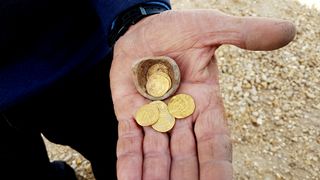
“Hanukka Gelt” was found last week during archaeological excavations in Yavneh during excavations conducted by the Israel Antiquities Authority (IAA) prior to the development of a new neighborhood at the behest of the Israel Lands Authority. The archaeologists were surprised to discover a broken clay juglet containing gold coins dating to the Early Islamic period. The excavations revealed an ancient industrial area which was active for several hundred years, and the archaeologists suggest that the shiny treasure may have been a potter’s personal “piggy bank”.
“I was in the middle of cataloging a large number of artifacts we found during the excavations when all of a sudden I heard shouts of joy” said Liat Nadav-Ziv, co-director alongside Dr. Elie Haddad of the excavation on behalf of the IAA. “I ran towards the shouting and saw Marc Molkondov, a veteran archaeologist of the IAA approaching me excitedly. We quickly followed him to the field where we were surprised at the sight of the treasure. This is without a doubt a unique and exciting find especially during the Hanukkah holiday”.
Liat Nadav-Ziv and Marc Molkondov with the hoard. Photo: Amihai Tamir, courtesy of the Israel Antiquities Authority
Inspection of the Yavneh gold coins conducted by Dr. Robert Kool, an expert on ancient coins at the IAA, dates the coins to the early Abbasid Period (9th century CE). Among the coins, is a gold Dinar from the reign of the Caliph Haroun A-Rashid (786-809 CE), on whom the popular story “Arabian Nights” also known as “One Thousand and One Nights” was based. “The hoard also includes coins that are rarely found in Israel” says Dr. Kool. “These are gold dinars issued by the Aghlabid dynasty that ruled in North Africa, in the region of modern Tunisia, on behalf of the Abbasid Caliphate centered in Bagdad…Without a doubt this is a wonderful Hanukkah present for us” concludes Dr. Kool.
The Hoard. Photo: Liat Nadav-Ziv, Courtesy of the Israel Antiquities Authority.
The large-scale excavation, carried out southeast of Tell Yavneh, revealed an unusually large amount of pottery kilns that was active at the end of the Byzantine and beginning of the Early Islamic period (7th– 9th centuries CE). The kilns were for commercial production of store-jars, cooking pots and bowls. The gold hoard was found inside a small juglet, near the entrance to one of the kilns and according to the archaeologists could have been the potter’s personal savings.
In a different area of the site, the remains of a large industrial installation were revealed dating to the Persian period (4th– 5th centuries BCE) and used for the production of wine. According to Dr. Haddad of the IAA “initial analysis of the contents of the installation revealed ancient grape pips (seeds). The size and number of vats found at the site indicated that wine was produced on a commercial scale, well beyond the local needs of Yavneh’s ancient inhabitants.”
The 7 gold coins were found in a small broken jar near a pottery kiln, and may have been a potter's personal piggy bank.
As Hanukkah ended last week, archaeologists in central Israel
discovered a hidden trove of 1,200-year-old coins near an ancient
pottery studio in the city of Yavne, between Jerusalem and the
Mediterranean Sea. In a news release,
researchers from the Israeli Antiquities Authority (IAA) likened the
stash of seven gold pieces to "Hanukkah gelt" (those foil-covered
chocolate coins that bless Jewish parents with eight nights of stains to
clean up), though the coins date to the ninth century, when Israel was under Islamic rule.
According
to Robert Kool, a coin expert with the IAA, one of the pieces
reportedly dates to the reign of Caliph Haroun A-Rashid (A.D. 786-809),
who later became a central character in the folk story collection "One
Thousand and One Nights."
"The
hoard also includes coins that are rarely found in Israel," Kool said
in a statement. These include gold coins issued by Islamic rulers in
North Africa (in modern-day Tunisia), Kool said.
Photo Credit: Liat Nadav-Ziv, Israel Antiquities Authority
A closer look at the coins. (Image credit: Liat Nadav-Ziv, Israel Antiquities Authority)Archaeologists
found the coins in a small broken jug near the entrance to one of many
ancient pottery kilns in Yavne, which appears to have been a hub of
commercial pottery production from the seventh to the ninth centuries.
Ceramic pots were versatile vessels used for storage, food preparation
and dining, but the broken pot that contained the coins may have been a
potter's personal "piggy bank," the team said.
The kiln was
uncovered during a large-scale excavation of Yavne, prior to the
construction of a new neighborhood there. Other sections of the dig have
revealed significantly older buildings, including a wine-making
facility dating to the Persian period (fourth to fifth century B.C.).
The facility included way more wine vats than would have been needed to
satisfy the local population, the archaeologists wrote, which means
Yavne was likely a booming center of wine production — and therefore
would have probably been a fun place to celebrate Hanukkah, after all.
Helene Machline, Israel Antiquities Authority Archaeologist, with the table portion.
The
top of a rare 2000-year-old measuring table used for liquid items such
as wine and olive oil has been discovered in what appears to have been a
major town square along the Pilgrimage Road in Jerusalem. The discovery
was made during excavations conducted by the Israel Antiquities
Authority in the City of David National Park.
The top part of the measuring table / Ari Levi, Israel Antiquities AuthoritiesIn
addition to the measuring table, tens of stone measuring weights were
also discovered in the same vicinity. These all support the theory that
this was the location of the main city square and market on route to the
Temple during the Second Temple Period, in what was historically known
as Jerusalem’s lower city. It appears that the market served as the
focal point of trade and commerce. Researchers suggest that this area
housed the offices of the Agoranomos, the official in the cities of
ancient Greece and Byzantine Empire that controlled the order of the
marketplace (agora).
Advertisement
According
to Prof. Ronny Reich, who is currently researching the recent
discovery, “we see two of the deep cavities that remained in a portion
of the ‘standard of volumes’ table uncovered in the City of David, each
with a drain at its bottom. The drain at the bottom could be plugged
with a finger, filled with a liquid of some type, and once the finger
was removed, the liquid could be drained into a container, using the
measurement table as a uniform guideline to determining the volume of
the container. This way, traders could calibrate their measuring
instruments using a uniform standard.”
The bottom part of the measuring table / Ari Levi, Israel Antiquities AuthoritiesReich
adds that “this is a rare find. Other stone artifacts were very popular
in Jerusalem during the Second Temple, however, so far, excavations in
Jerusalem have only uncovered two similar tables that were used for
measuring volume – one in the 1970s excavations in the Jewish Quarter,
and another in the Shu’afat excavations, in northern Jerusalem.”
According
to archaeologist Ari Levi of the IAA, one of the directors of the
excavations of the Pilgrimage Road, “the Pilgrimage Road excavations in
the City of David have also revealed a great number of stone
scale-weights measuring different values. These weights are of the type
which was commonly used in Jerusalem. The fact that there were
city-specific weights at the site indicates the unique features of the
economy and trade in Jerusalem during the Second Temple period, possibly
due to the influence of the Temple itself.”
The Stone
scale-weights have a flat, round shape, and they are made in different
sizes, representing different masses. According to Reich, more than 90%
of all stone weights of this type, totaling several hundreds, were found
in archaeological excavations in early Jerusalem, dating back to the
Second Temple period, and they represent a unique Jerusalem phenomenon.
The Pilgrimage Road at the City of David / Kobi Harati, City of David archiveIAA
researchers Nahshon Szanton, Moran Hagbi and Meidad Shor, who directed
the excavations along the Pilgrimage Road, uncovered a large, open,
paved area dating back some 2000 years, along the street leading up to
the Second Temple. They suggest that it served as the main square of the
lower city, where trade activity would have taken place in this part of
the city.
According to Ari Levi, “the volume standard table we’ve
found, as well as the stone weights discovered nearby, support the
theory that this was the site of vast trade activity, and perhaps this
may indicate the existence of a market.”
The discovery also points to food being shared and the use of wooden digging sticks to extract the plants from the ground
University of the Witwatersrand
IMAGE: Hypoxis angustifolia growth habit.
view more
Credit: Prof. Lyn Wadley/Wits University
"The inhabitants of the Border Cave in the Lebombo Mountains on the
Kwazulu-Natal/eSwatini border were cooking starchy plants 170 thousand
years ago," says Professor Lyn Wadley, a scientist from the Wits
Evolutionary Studies Institute at the University of the Witwatersrand,
South Africa (Wits ESI). "This discovery is much older than earlier
reports for cooking similar plants and it provides a fascinating insight
into the behavioural practices of early modern humans in southern
Africa. It also implies that they shared food and used wooden sticks to
extract plants from the ground."
"It is extraordinary that such fragile plant remains have survived
for so long," says Dr Christine Sievers, a scientist from the University
of the Witwatersrand, who completed the archaeobotanical work with
Wadley. The underground food plants were uncovered during excavations at
Border Cave in the Lebombo Mountains (on the border of KwaZulu-Natal
Province, South Africa, and eSwatini [formerly Swaziland]), where the
team has been digging since 2015. During the excavation, Wadley and
Sievers recognised the small, charred cylinders as rhizomes. All appear
to belong to the same species, and 55 charred, whole rhizomes were
identified as Hypoxis, commonly called the Yellow Star flower. "The most
likely of the species growing in KwaZulu-Natal today is the
slender-leafed Hypoxis angustifolia that is favoured as food,"
adds Sievers. "It has small rhizomes with white flesh that is more
palatable than the bitter, orange flesh of rhizomes from the better
known medicinal Hypoxis species (incorrectly called African Potato)."
The Border Cave plant identifications were made on the size and
shape of the rhizomes and on the vascular structure examined under a
scanning electron microscope. Modern Hypoxis rhizomes and their ancient
counterparts have similar cellular structures and the same inclusions of
microscopic crystal bundles, called raphides. The features are still
recognisable even in the charred specimens. Over a four-year period,
Wadley and Sievers made a collection of modern rhizomes and geophytes
from the Lebombo area. "We compared the botanical features of the modern
geophytes and the ancient charred specimens, in order to identify
them," explains Sievers.
Hypoxis rhizomes are nutritious and carbohydrate-rich with an energy
value of approximately 500 KJ/100g. While they are edible raw, the
rhizomes are fibrous and have high fracture toughness until they are
cooked. The rhizomes are rich in starch and would have been an ideal
staple plant food. "Cooking the fibre-rich rhizomes would have made them
easier to peel and to digest so more of them could be consumed and the
nutritional benefits would be greater," says Wadley. Wooden digging sticks used to extract the plants from the ground
"The discovery also implies the use of wooden digging sticks to
extract the rhizomes from the ground. One of these tools was found at
Border Cave and is directly dated at circa 40,000 years ago," says
co-author of the paper and co-director of the excavation, Professor
Francesco d'Errico, (Centre National de la Recherche Scientifique
(CNRS), Université de Bordeaux, France and University of Bergen,
Norway). Dr Lucinda Backwell (Instituto Superior de Estudios Sociales,
ISES-CONICET, Tucumán, Argentina) also co-authored the paper and was a
co-director of the excavation. The plants were cooked and shared
The Hypoxis rhizomes were mostly recovered from fireplaces and ash
dumps rather than from surrounding sediment. "The Border Cave
inhabitants would have dug Hypoxis rhizomes from the hillside near the
cave, and carried them back to the cave to cook them in the ashes of
fireplaces," says Wadley. "The fact that they were brought back to the
cave rather than cooked in the field suggests that food was shared at
the home base. This suggests that the rhizomes were roasted in ashes and
that, in the process, some were lost. While the evidence for cooking is
circumstantial, it is nonetheless compelling." Discoveries at Border Cave
This new discovery adds to the long list of important finds at
Border Cave. The site has been repeatedly excavated since Raymond Dart
first worked there in 1934. Amongst earlier discoveries were the burial
of a baby with a Conus seashell at 74,000 years ago, a variety
of bone tools, an ancient counting device, ostrich eggshell beads,
resin, and poison that may once have been used on hunting weapons. The Border Cave Heritage Site
Border Cave is a heritage site with a small site museum. The cave
and museum are open to the public, though bookings are essential [Olga
Vilane (+27) (0) 72 180 4332]. Wadley and her colleagues hope that the
Border Cave discovery will emphasise the importance of the site as an
irreplaceable cultural resource for South Africa and the rest of the
world. About Hypoxis angustifolia Hypoxis angustifolia is evergreen, so it has visibility
year-round, unlike the more common deciduous Hypoxis species. It thrives
in a variety of modern habitats and is thus likely to have had wide
distribution in the past as it does today. It occurs in sub-Saharan
Africa, south Sudan, some Indian Ocean islands, and as far afield as
Yemen. Its presence in Yemen may imply even wider distribution of this
Hypoxis plant during previous humid conditions. Hypoxis angustifolia
rhizomes grow in clumps so many can be harvested at once. "All of the
rhizome's attributes imply that it could have provided a reliable,
familiar food source for early humans trekking within Africa, or even
out of Africa," said Lyn Wadley. Hunter-gatherers tend to be highly
mobile so the wide distribution of a potential staple plant food would
have ensured food security.