Archaeologists have uncovered the earliest evidence of high-altitude
prehistoric living in the form of a rock shelter in Ethiopia, though
whether the site was inhabited permanently is unclear. According to the
report - based on archeological, biogeochemical, glacial chronological
and other analyses - more than 30,000 years ago, the Fincha Habera rock
shelter, a site situated more than 11,000 feet above sea level in the
Bale Mountains of Ethiopia, was home to Middle Stone Age foragers who
made use of nearby resources and feasted upon plentiful giant mole-rats.
Life at high-altitude imposes a number of limitations and stresses on
the human body. Because of this, it has long been assumed that the
peopling of high-elevation environments - those more than 2,500 meters
above sea level (masl) - has only recently occurred in human history.
However, from the Andean altiplano to the Tibetan Plateau, a growing
number of new archaeological finds in high places across the globe has
begun to show otherwise. Still, these sites are rare, and much remains
to be discovered about the nature of human high-altitude settlements.
Following excavations at Fincha Habera, which the team approached on
foot or by pack horse , as well as based on archaeological surveys and
paleoenvironmental analyses, Götz Ossendorf and colleagues present
results that push back the antiquity of a human presence at high
elevation. They report thousands of Middle Stone Age (MSA) artifacts,
including locally collected stones, burnt animal bones, and the hearths
of former fires. Radiocarbon dates from the site's earliest contexts
suggest that occupation began during the Late Pleistocene, sometime
between 47,000 and 31,000 years ago. While the environment enabled
long-term stays at Fincha Habera repeatedly over several thousand years,
the authors say, the permanence of these occupations cannot be proven
nor refuted. In a related Perspective, Mark Aldenderfer discusses
Ossendorf et al.'s findings in the context of recent high-altitude
studies, some of which present conclusions largely unsupported by
underlying data. "Words matter, and it's time for archaeologists working
on the world's high plateaus to be more deliberate about the terms they
use to describe and frame their findings," writes Aldenderfer. To that
end, he describes the restraint applied in descriptions in the report by
Ossendorf's team as "admirable."
Evidence of extreme warfare from Classic period disputes role of violence in civilization's decline
University of California - Berkeley
IMAGE: UC Berkeley's David Wahl and Lysanna
Anderson of USGS with a local assistant taking a sediment sample from
the center of Lake Ek'Naab from an inflatable platform. All the
equipment...
view more
Credit: Francisco Estrada-Belli, Tulane
The Maya of Central America are thought to have been a kinder,
gentler civilization, especially compared to the Aztecs of Mexico. At
the peak of Mayan culture some 1,500 years ago, warfare seemed
ritualistic, designed to extort ransom for captive royalty or to
subjugate rival dynasties, with limited impact on the surrounding
population.
Only later, archeologists thought, did increasing drought and
climate change lead to total warfare -- cities and dynasties were wiped
off the map in so-called termination events -- and the collapse of the
lowland Maya civilization around 1,000 A.D. (or C.E., current era).
New evidence unearthed by a researcher from the University of
California, Berkeley, and the U.S. Geological Survey calls all this into
question, suggesting that the Maya engaged in scorched-earth military
campaigns -- a strategy that aims to destroy anything of use, including
cropland -- even at the height of their civilization, a time of
prosperity and artistic sophistication.
The finding also indicates that this increase in warfare, possibly
associated with climate change and resource scarcity, was not the cause
of the disintegration of the lowland Maya civilization.
"These data really challenge one of the dominant theories of the
collapse of the Maya," said David Wahl, a UC Berkeley adjunct assistant
professor of geography and a researcher at the USGS in Menlo Park,
California. "The findings overturn this idea that warfare really got
intense only very late in the game."
"The revolutionary part of this is that we see how similar Mayan
warfare was from early on," said archaeologist Francisco Estrada-Belli
of Tulane University, Wahl's colleague. "It wasn't primarily the
nobility challenging one another, taking and sacrificing captives to
enhance the charisma of the captors. For the first time, we are seeing
that this warfare had an impact on the general population." Total warfare
The evidence, reported today in the journal Nature Human Behaviour,
is an inch-thick layer of charcoal at the bottom of a lake, Laguna
Ek'Naab, in Northern Guatemala: a sign of extensive burning of a nearby
city, Witzna, and its surroundings that was unlike any other natural
fire recorded in the lake's sediment.
The charcoal layer dates from between 690 and 700 A.D., right in the
middle of the classic period of Mayan civilization, 250-950 A.D. The
date for the layer coincides exactly with the date -- May 21, 697 A.D.
-- of a "burning" campaign recorded on a stone stela, or pillar, in a
rival city, Naranjo.
"This is really the first time the written record has been linked to
an event in the paleo data sets in the New World," Wahl said. "In the
New World, there is so little writing, and what's preserved is mostly on
stone monuments. This is unique in that we were able to identify this
event in the sedimentary record and point to the written record,
particularly these Mayan hieroglyphs, and make the inference that this
is the same event."
Wahl, a geologist who studies past climate and is first author of
the study, worked with USGS colleague Lysanna Anderson and Estrada-Belli
to extract 7 meters of sediment cores from the lake. Laguna Ek'Naab,
which is about 100 meters across, is located at the base of the plateau
where Witzna once flourished and has collected thousands of years of
sediment from the city and its surrounding agricultural fields. After
seeing the charcoal layer, the archaeologists examined many of Witzna's
ruined monuments still standing in the jungle and found evidence of
burning in all of them.
"What we see here is, it looks like they torched the entire city
and, indeed, the entire watershed," Wahl said. "Then, we see this really
big decrease in human activity afterwards, which suggests at least that
there was a big hit to the population. We can't know if everyone was
killed or they moved or if they simply migrated away, but what we can
say is that human activity decreased very dramatically immediately after
that event."
This one instance does not prove that the Maya engaged in total
warfare throughout the 650-year classic period, Estrada-Belli said, but
it does fit with increasing evidence of warlike behavior throughout that
period: mass burials, fortified cities and large standing armies.
"We see destroyed cities and resettled people similar to what Rome did to Carthage or Mycenae to Troy," Estrada-Belli said.
And if total warfare was already common at the peak of Mayan lowland
civilization, then it is unlikely to have been the cause of the
civilization's collapse, the researchers argue.
"I think, based on this evidence, the theory that a presumed shift
to total warfare was a major factor in the collapse of Classic Maya
society is no longer viable," said Estrada-Belli. "We have to rethink
the cause of the collapse, because we're not on the right path with
warfare and climate change." 'Bahlam Jol burned for the second time'
Though Mayan civilization originated more than 4,000 years ago, the
Classic period is characterized by widespread monumental architecture
and urbanization exemplified by Tikal in Guatemala and Dzibanché in
Mexico's Yucatan. City-states -- independent states made up of cities
and their surrounding territories -- were ruled by dynasties that,
archaeologists thought, established alliances and waged wars much like
the city-states of Renaissance Italy, which affected the nobility
without major impacts on the population.
In fact, most archaeologists believe that the incessant warfare that
arose in the terminal Classic period (800-950 A.D.), presumably because
of climate change, was the major cause of the decline of Mayan cities
throughout present day El Salvador, Honduras, Guatemala, Belize and
Southern Mexico.
So when Wahl, Anderson and Estrada-Belli discovered the charcoal
layer in 2013 in Laguna Ek'Naab -- a layer unlike anything Wahl had seen
before -- they were puzzled. The scientists had obtained the lake core
in order to document the changing climate in Central America, hoping to
correlate these with changes in human occupation and food cultivation.
The puzzle lingered until 2016, when Estrada-Belli and co-author
Alexandre Tokovinine, a Mayan epigrapher at the University of Alabama,
discovered a key piece of evidence in the ruins of Witzna: an emblem
glyph, or city seal, identifying Witzna as the ancient Mayan city Bahlam
Jol. Searching through a database of names mentioned in Mayan
hieroglyphs, Tokovinine found that very name in a "war statement" on a
stela in the neighboring city-state of Naranjo, about 32 kilometers
south of Bahlam Jol/Witzna.
The statement said that on the day "... 3 Ben, 16 Kasew ('Sek'),
Bahlam Jol 'burned' for the second time." According to Tokovinine, the
connotation of the word "burned," or puluuy in Mayan, has always been
unclear, but the date 3 Ben, 16 Kasew on the Mayan calendar, or May 21,
697, clearly associates this word with total warfare and the scorched
earth destruction of Bahlam Jol/Witzna.
"The implications of this discovery extend beyond mere
reinterpretation of references to burning in ancient Maya inscriptions,"
Tokovinine said. "We need to go back to the drawing board on the very
paradigm of ancient Maya warfare as centered on taking captives and
extracting tribute."
Three other references to puluuy or "burning" are mentioned in the
same war statement, referencing the cities of Komkom, known today as
Buenavista del Cayo; K'an Witznal, now Ucanal; and K'inchil, location
unknown. These cities may also have been decimated, if the word puluuy
describes the same extreme warfare in all references. The earlier
burning of Bahlam Jol/Witzna mentioned on the stela may also have left
evidence in the lake cores -- there are three other prominent charcoal
layers in addition to the one from 697 A.D. -- but the date of the
earlier burning is unknown.
Mayan archaeologists have reconstructed some of the local history,
and it's known that the conquest of Bahlam Jol/Witzna was set in motion
by a queen of Naranjo, Lady 6 Sky, who was trying to reestablish her
dynasty after the city-state had declined and lost all its possessions.
She set her seven-year-old son, Kahk Tilew, on the throne and then began
military campaigns to wipe out all the rival cities that had rebelled,
Estrada-Belli said.
"The punitive campaign was recorded as being waged by her son, the king, but we know it's really her," he said.
That was not the end of Bahlam Jol/Witzna, however. The city
revived, to some extent, with a reduced population, as seen in the lake
cores. And the emblem glyph was found on a stela erected around 800 A.D,
100 years after the city's destruction. The city was abandoned around
1,000 A.D.
"The ability to tie geologic evidence of a devastating fire to an
event noted in the epigraphic record, made possible by the relatively
uncommon discovery of an ancient Maya city's emblem glyph, reflects a
confluence of findings nearly unheard of in the field of
geoarchaeology," Wahl said.
The site of Khirbet Al-Rai has been excavated by researchers who are with the Israel Antiquities Authority. These researchers have said that they believe that the settlement they’ve discovered is perhaps the remnants of Ziklag.
The Bible tells the tale of how King David escaped Israel and King Saul by fleeing to Ziklag. In Ziklag, King David lived among the Philistines. The Philistines are believed to originate from the Mediterranean.
The team isn’t the first group of researchers who happened to look for the settlement. Many archaeologists out there have gone on several many excavations to find out more about the settlement. However, the team is certain that the settlement they’ve found is the real deal. Hebrew University’s
Head of the Institute of Archaeology, Yosef Garfinkel, has said that the name Ziklag is quite unusual in the vocabulary of names in Israel. Ziklag isn’t local Canaanite-Semitic. He went on to say that the name is actually a Philistine name. The name was given to the town by a foreign population of immigrants who came from the Aegean.
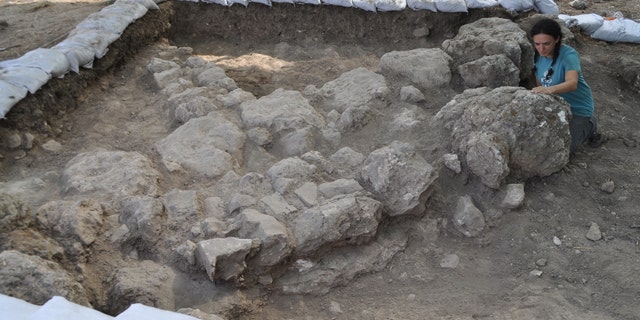
Large stone structures, as well as vessels, were found at Khirbet Al-Rai. These stone structures and vessels have been dated back to between the 11th and 12th centuries BC. Rooms with pottery vessels were found.
Researchers believe that these rooms were destroyed in a large fire.
Archeologists May Have
Found the Biblical City Where King David Sought Refuge
Tweet This
The site of Khirbet Al-Rai has been excavated by researchers who are
with the Israel Antiquities Authority. These researchers have said that
they believe that the settlement they’ve discovered is perhaps the
remnants of Ziklag.
The Bible tells the tale of how King David escaped Israel and King Saul
by fleeing to Ziklag. In Ziklag, King David lived among the Philistines.
The Philistines are believed to originate from the Mediterranean.
The team isn’t the first group of researchers who happened to look for
the settlement. Many archaeologists out there have gone on several many
excavations to find out more about the settlement. However, the team is
certain that the settlement they’ve found is the real deal.
Hebrew University’s Head of the Institute of Archaeology, Yosef
Garfinkel, has said that the name Ziklag is quite unusual in the
vocabulary of names in Israel. Ziklag isn’t local Canaanite-Semitic. He
went on to say that the name is actually a Philistine name. The name was
given to the town by a foreign population of immigrants who came from
the Aegean.
Large stone structures, as well as vessels, were found at Khirbet
Al-Rai. These stone structures and vessels have been dated back to
between the 11th and 12th centuries BC. Rooms with pottery vessels were
found. Researchers believe that these rooms were destroyed in a large
fire.
The
Apidima 1 partial cranium (right) and its reconstruction from posterior
view (middle) and side view (left). The rounded shape of the Apidima 1
cranium a unique feature of modern humans and contrasts sharply with
Neanderthals and their ancestors.
PARIS(AFP).-
A 210,000-year-old skull has been identified as the earliest modern
human remains found outside Africa, putting the clock back on mankind's
arrival in Europe by more than 150,000 years, researchers said
Wednesday.
In a startling discovery that changes our understanding of how
modern man populated Eurasia, the findings support the idea that Homo
sapiens made several, sometimes unsuccessful migrations from Africa over
tens of thousands of years.
ADVERTISING
Southeast
Europe has long been considered a major transport corridor for modern
humans from Africa. But until now the earliest evidence of Homo sapiens
on the continent dated back only around 50,000 years.
There has however been a number of discoveries indicating the
ancient presence of Neanderthals -- an early human cousin -- across the
continent.
Two fossilised but badly damaged skulls unearthed in a Greek cave in the 1970s were identified as Neanderthal at the time.
In findings presented in the journal Nature, an international team
of researchers used state-of-the art computer modelling and uranium
dating to re-examine the two skulls.
One of them, named Apidima 2 after the cave in which the pair were
found, proved to be 170,000 years old and did indeed belong to a
Neanderthal.
But, to the shock of scientists, the skull named Apidima 1 pre-dated
Apidima 2 by as much as 40,000 years, and was determined to be that of a
Homo sapiens.
That makes the skull by far the oldest modern human remains ever
discovered on the continent, and older than any known Homo sapiens
specimen outside of Africa.
"It shows that the early dispersal of Homo sapiens out of Africa not
only occurred earlier, before 200,000 years ago, but also reached
further geographically, all the way to Europe," Katerina Harvati, a
palaeoanthropologist at the Eberhard Karls University of Tuebingen,
Germany, told AFP.
"This is something that we did not suspect before, and which has
implications for the population movements of these ancient groups."
Apidima 1 lacked classic features associated with Neanderthal
skulls, including the distinctive bulge at the back of the head, shaped
like hair tied in a bun.
A cache of copper artifacts made some 6,300 years
ago may contain a secret code used by ancient Levantine metal workers,
which would make this one of the earliest forms of primitive writing in
the world. That’s the new and controversial theory of an Israeli
researcher who believes he has deciphered the meaning of the exquisite
but as-yet-enigmatic artifacts that were uncovered decades ago in a
remote desert cave in Israel.
More than 400 copper objects were found in 1961, wrapped in a tattered mat in a cavern on the nearly inaccessible slopes of Nahal Mishmar, a seasonal stream that flows into the Dead Sea.
The so-called Nahal Mishmar
hoard was one of the greatest prehistoric finds in Israel and in the
world. It revealed a previously unsuspected sophistication and advanced knowledge of metallurgy among the people who inhabited the Levant during the Chalcolithic, or Copper Age.
The treasure belonged to a
culture that modern archaeologists have named Ghassulian – not because
we have any idea what these people called themselves, but because it was
first identified at a site in Jordan called Teleilat Ghassul.
Carbon 14 dating of the mat
that held the Nahal Mishmar artifacts has shown that the hoard goes back
to around 4300 B.C.E. and many of the myriad objects, shaped as bowls,
maces, crowns and scepters, display a level of craftsmanship that was
thought unthinkable for that period.
Most of the artifacts were
produced using the lost-wax technique, a complex and time-consuming
process. Even more surprisingly, analyses have shown they were made of
then-unique alloys of copper with arsenic, antimony and other metals,
which would have had to be sourced as far as Anatolia or the Caucasus.
Though most researchers
agree the objects had some kind of ritualistic purpose, the hoard has
remained somewhat of a mystery for archaeologists, who are hard pressed
to explain what was the exact use of the artifacts, or what meaning can
be ascribed to the motifs that decorate them.
Part of the enigma stems from the fact that the Ghassulians lived before recorded history and have left us no writings to tell us about themselves.
Or did they?
The depictions of horned
animals, birds, human noses and other motifs found on the artifacts are
not just random decorations or symbolic images, claims Nissim Amzallag, a
researcher from the Department of Bible studies, Archeology and the
Ancient Near East at Ben Gurion University.
Amzallag,
who focuses on the cultural origins of ancient metallurgy, theorizes
that these representations form a rudimentary three-dimensional code, in
which each image symbolizes a word or phrase and communicates a certain
concept.
In other terms, the Nahal
Mishmar hoard should be seen as a precursor to the early writing systems
that would emerge centuries later in Egypt and Mesopotamia, Amzallag
says.
The researcher recently published his study of the hoard in Antiguo Oriente,
a peer-reviewed publication of the Center of Studies of Ancient Near
Eastern History at the Pontifical Catholic University of Argentina.
Artifacts found at Nahal Mishmar, made over 6,000 years agoClara Amit, IAA
Not as easy as A-B-C
In his work, Amzallag
analyzes several key pieces in the hoard and speculates on the possible
semantics of the iconography. Many of the depictions can be interpreted
as logograms, that is, graphic symbols that represent a particular w
[image:
IMAGE] *IMAGE: *This earpiece, perhaps of Egyptian manufacture, is
apparent loot from the First Crusade sack of Jerusalem in July, 1099.
view more Credit: Virginia Withers The University of North Carolina at
Charlotte-led archaeological dig on Jerusalem's Mount Zion has been
going on for over a decade, looking at an area where there were no known
ruins of major temples, churches or palaces, but nonetheless sacred
land where three millennia of struggle and culture has long lain buried,
evidence in layer upon layer of significant historical events.
Virtually every dig season,... more »
Complete
article Archaeologists have known about this location, called the Motza
site, for decades. However, now that the government plans to build a
new highway entrance and new roundabouts there, the Israel Antiquities
Authority sent a team to do a full-scale excavation of the Neolithic
settlement, Vardi told Live Science. This effort quickly became the
largest excavation of a Neolithic site in the country, he said. During
the Neolithic, hunter-gatherer groups began farming and making permanent
settlements. So, it came as no surprise when they found large buildings
with rooms wh... more »
[image:
IMAGE] *IMAGE: *A zebu-shaped weight from Tel Beth-Shemesh. view more
Credit: A. Hay, courtesy of the Tel Beth-Shemesh Excavations exhibition.
The keeping of livestock began in the Ancient Near East and underpinned
the emergence of complex economies and then cities. Subsequently, it is
there that the world's first empires rose and fell. Now, ancient DNA
has revealed how the prehistory of the region's largest domestic animal,
the cow, chimes with these events. An international team of
geneticists, led by those from Trinity College Dublin, have deciphered
early bovine prehistor... more »
Archaeologists
in southern Israel have discovered an ancient biblical city from the
time of King David. The site was discovered near the modern city of
Kiryat Gat by researchers from the Hebrew University in Jerusalem,
Macquarie University in Australia and the Israel Antiquities Authority.
The Philistine ancient city of Ziklag is mentioned multiple times in the
Bible in relation to David, the researchers note, citing 1 Samuel and 2
Samuel. “According to the Biblical narrative, Achish, King of Gat,
allowed David to find refuge in Ziklag while fleeing King Saul and from
there David al... more »
home
page Complete article Carbon 14 dating supports the archaeologists'
identification For decades scholars sought the elusive site of Ziklag,
where the Bible says David was given shelter by Philistine King Achish
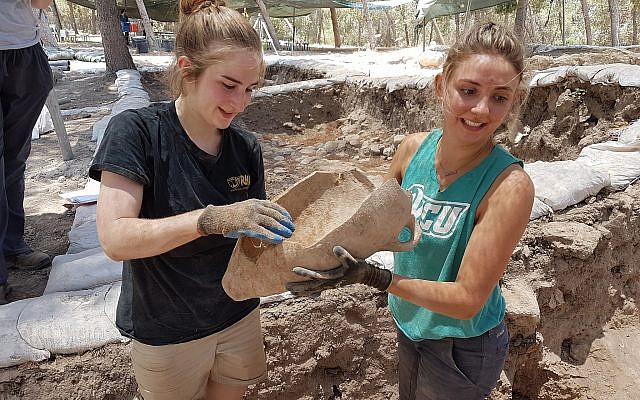
[image: Volunteers excavate pottery from Khirbet a-Ra'i, which
archaeologists have identified as biblical Ziklag. (Excavation
expedition to Khirbet a-Ra‘i)] Volunteers excavate pottery from Khirbet
a-Ra'i, which archaeologists have identified as biblical Ziklag.
(Excavation expedition to Khirbet a-Ra‘i) In a finding sure to inflame
the debate about the historicity of th... more »
Complete
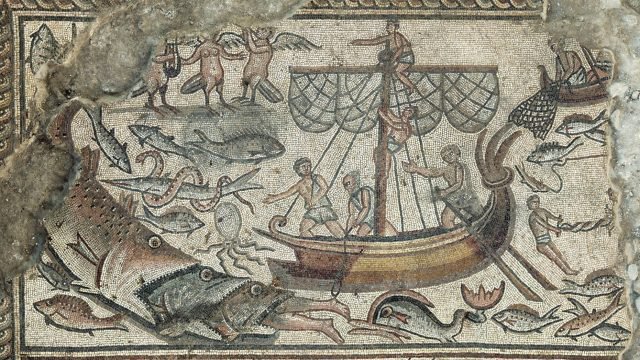
article *Full mosaic depicting Jonah being swallowed by a giant fish in
the ancient Huqoq synagogue. * In an excavation led by Professor Jodi
Magness of the University of North Carolina at Chapel Hill, a
1,600-year-old biblical triptych of mosaics made of small stone cubes
(or tesserae) was found in a synagogue in the ancient Galilean village
of Huqoq in Israel. “We’ve uncovered the first depiction of the episode
of Elim ever found in ancient Jewish art,” said Dr. Magness. This comes
on the heels of earlier mosaic discoveries at this site which include
depictions of The To... more »
An
international team, led by scientists from the Max Planck Institute for
the Science of Human History and the Leon Levy Expedition, retrieved
and analyzed, for the first time, genome-wide data from people who lived
during the Bronze and Iron Age (~3,600-2,800 years ago) in the ancient
port city of Ashkelon, one of the core Philistine cities during the Iron
Age. The team found that a European derived ancestry was introduced in
Ashkelon around the time of the Philistines' estimated arrival,
suggesting that ancestors of the Philistines migrated across the
Mediterranean, reaching Ash... more »
Elim
mosaic detail, Huqoq Excavation Project. Copyright Jim Haberman. All
rights reserved. Courtesy: UNC-Chapel Hill. Copyright Jim Haberman *For
nine years running, Carolina professor Jodi Magness has led a team of
research specialists and students to the ancient village of Huqoq in
Israel's Lower Galilee, where they bring to light the remains of a Late
Roman synagogue. For weeks during the summer, they unearth history in
the form of art. With each excavation season, the students and
researchers build on what little is known about the fifth century CE
Jewish community of H... more »
New study explores genetic roots of 26 populations from diverse regions and cultures of western South America and Mexico, revealing long-distance connections between speakers of the same language, and new traces of genetic diversity within Amazonia Max Planck Institute for the Science of Human History [image: IMAGE] *IMAGE: *The vast cultural and linguistic diversity of Latin American countries is still far from being fully represented by genetic surveys. A new study explores the genetic roots of 26 populations... view more Credit: Chiara Barbieri and Rodrigo Barquera The vast cult... more »
Smithsonian Tropical Research Institute [image: IMAGE] *IMAGE: *After analyzing white-deer remains from a site in Panama occupied between 2,200 and 500 years ago, María Fernanda Martínez-Polanco found some evidence of feasting signs.... view more Credit: Smithsonian Tropical Research Institute In pre-Columbian times, the white-tailed deer was among the most abundant and frequently consumed mammals in Panama. It was also an icon, represented on thousands of clay vessels. Through an analysis of deer remains in refuse piles at the Sitio Sierra archaeological site, researchers from the ... more »
University of New Mexico [image: IMAGE] *IMAGE: *UNM graduate student Paige Lynch conducting excavations at Mayahak Cab Pek in May 2019, part of ongoing UNM research into the earliest humans in the New World tropics. view more Credit: University of New Mexico From the perspective of Central and South America, the peopling of the New World was a complex process lasting thousands of years and involving multiple waves of Pleistocene and early Holocene period immigrants entering into the Neotropics. Paleoindian colonists arrived in waves of immigrants entering the Neotropics, a region ... more »
Chaco Canyon, a site that was once central to the lives of pre-colonial peoples called Anasazi, may not have been able to produce enough food to sustain thousands of residents, according to new research. The results could shed doubt on estimates of how many people were able to live in the region year-round. Located in Chaco Culture National Historic Park in New Mexico, Chaco Canyon hosts numerous small dwellings and a handful of multi-story buildings known as great houses. Based on these structures, researchers think that it was once a bustling metropolis that was home to as many a... more »
The question of how to best adapt to extreme climate is a critical issue facing modern societies worldwide. In "The Role of Diet in Resilience and Vulnerability to Climate Change among Early Agricultural Communities in the Maya Lowlands," published in *Current Anthropology*, authors Claire Ebert, Julie Hoggarth, Jaime Awe, Brendan Culleton, and Douglas Kennett examine the role of diet in the ability of the ancient Maya to withstand periods of severe climatic stress. The authors found that an increase in the elite Maya's preference for a maize-based diet may have made the population... more »
[image: IMAGE] *IMAGE: *Reconstruction of a Mesolithic camp-site with a hunter in the front ready to fire an arrow mounted with stone microliths. view more Credit: Ulco Glimmerveen The development of new hunting projectiles by European hunter-gatherers during the Mesolithic may have been linked to territoriality in a rapidly-changing climate, according to a study published July 17, 2019 in the open-access journal *PLOS ONE* by Philippe Crombé from Ghent University, Belgium. As a result of warming occurring at a rate of ca. 1.5 to 2°C per century, hunter-gatherers in Europe during t... more »
Researchers successfully reconstructed anthropic influences on sedimentation, including dredging and canal gates use, in the ancient harbour of Portus - a complex of harbour basins and canals that formed the hub of commerce in the capital of the Roman Empire. The findings suggest that the Romans were proactively managing their river systems from earlier than previously thought - as early as the 2nd century AD. The history was reconstructed using a range of high-resolution sediment analysis including piston coring, x-ray scanning, radiocarbon dating, magnetic and physical properties... more »
[image: IMAGE] *IMAGE: *Right lateral view of the *Cioclovina calvaria* exhibiting a large depressed fracture. view more Credit: Kranoti *et al*, 2019 New analysis of the fossilized skull of an Upper Paleolithic man suggests that he died a violent death, according to a study published July 3, 2019 in the open-access journal *PLOS ONE* by an international team from Greece, Romania and Germany led by the Eberhard Karls Universität Tübingen, Germany The fossilized skull of a Paleolithic adult man, known as the Cioclovina calvaria, was originally uncovered in a cave in South Transylvania... more »
Monash University [image: IMAGE] *IMAGE: *Australopithecus africanus impression by Jose Garcia and Renaud Joannes-Boyau, Southern Cross University. view more Credit: Jose Garcia and Renaud Joannes-Boyau, Southern Cross University. - New research brings to light for the first time the evolution of maternal roles and parenting responsibilities in one of our oldest evolutionary ancestors - *Australopithecus africanus* mothers breastfed their infants for the first 12 months after birth, and continued to supplement their diets with breastmilk during periods of food... more »
Genetic analysis has revealed that the ancestors of modern humans interbred with at least five different archaic human groups as they moved out of Africa and across Eurasia. While two of the archaic groups are currently known - the Neandertals and their sister group the Denisovans from Asia ¬- the others remain unnamed and have only been detected as traces of DNA surviving in different modern populations. Island Southeast Asia appears to have been a particular hotbed of diversity. Published in the *Proceedings of the National Academy of Sciences (PNAS)*, researchers from the Univers... more »
[image: IMAGE] *IMAGE: *The three-rooted lower molar anomaly in a recent Asian individual. Left: tooth sockets showing position of accessory root; right: three-rooted lower first molar tooth. view more Credit: Christine Lee An analysis of a 160,000-year-old archaic human molar fossil discovered in China offers the first morphological evidence of interbreeding between archaic humans and *Homo sapiens* in Asia. The study, which appears in the journal *Proceedings of the National Academy of Sciences*, centers on a three-rooted lower molar--a rare trait primarily found in modern Asians-... more »
------------------------------ Archaeologists working in two Italian caves have discovered some of the earliest known examples of ancient humans using an adhesive on their stone tools -- an important technological advance called "hafting." The new study, which included CU Boulder's Paola Villa, shows that Neanderthals living in Europe from about 55 to 40 thousand years ago traveled away from their caves to collect resin from pine trees. They then used that sticky substance to glue stone tools to handles made out of wood or bone. The findings add to a growing body of evidence that sug... more »
[image: IMAGE] *IMAGE: *The three-rooted lower molar anomaly in a recent Asian individual. Left: tooth sockets showing position of accessory root; right: three-rooted lower first molar tooth. view more Credit: Christine Lee An analysis of a 160,000-year-old archaic human molar fossil discovered in China offers the first morphological evidence of interbreeding between archaic humans and *Homo sapiens* in Asia. The study, which appears in the journal *Proceedings of the National Academy of Sciences*, centers on a three-rooted lower molar--a rare trait primarily found in modern Asians-... more »
The permanent human occupation on the Tibetan Plateau was facilitated by the introduction of cold-tolerant barley around 3600 years before present (BP), however, how barley agriculture spread onto the Tibetan Plateau remains unknown. Now by using both genetics and archaeological data, researchers from Kunming Institute of Zoology, CAS and Lanzhou University revealed that the barley agriculture was mainly brought onto the plateau by the millet farmers from northern China. Moreover, the genetic contribution from millet farmers largely promoted the formation of genetic landscape of th... more »
New study explores genetic roots of
26 populations from diverse regions and cultures of western South
America and Mexico, revealing long-distance connections between speakers
of the same language, and new traces of genetic diversity within
Amazonia
Max Planck Institute for the Science of Human History
IMAGE: The vast cultural and linguistic diversity
of Latin American countries is still far from being fully represented by
genetic surveys. A new study explores the genetic roots of 26
populations...
view more
Credit: Chiara Barbieri and Rodrigo Barquera
The vast cultural and linguistic diversity of Latin American
countries is still far from being fully represented by genetic surveys.
Western South America in particular holds a key role in the history of
the continent due to the presence of three major ecogeographic domains
(the Andes, the Amazonia, and the Pacific Coast), and for hosting the
earliest and largest complex societies. A new study in Molecular Biology and Evolution
by an international team lead by scholars from the Max Planck Institute
for the Science of Human History and from the University of Zurich
reveals signatures of history, ecology and cultural diversity in the
genetic makeup of living rural populations.
A thorough study, a collaboration between scientists and institutes
from Europe, the USA, Mexico, Ecuador, Colombia and Peru, including
geneticists, linguists and anthropologists, has shed new light on the
population history of South America. The study, which involved working
closely with local populations in numerous regions, was published in Molecular Biology and Evolution.
The results confirmed the impact of large, complex societies already
known from archaeological evidence, but also revealed previously unknown
migrations and connections across vast distances, including in
Amazonia, an area that has not been as deeply studied archaeologically.
Genetic studies have played a fundamental role in understanding the
population history of the American continent. By reconciling genetic
evidence with the archaeological record and with paleoclimatic data,
scientists have been able to pinpoint the time and scale of the earliest
migrations, possible routes through the continent, the subsequent
formation of population structure, and preferential routes of population
migration and contact. Yet the picture is necessarily superficial
because of the lack of representative data from all the diverse regions
of the continent. One recurrent simplification relies on the contrast
between the Andes, site of the famous large complex societies of the
Wari, Tiahuanaco and Inca who built a vast network of roads, and
Amazonia, where people apparently have been living in small isolated
groups. The Pacific Coast, key player in the earliest migration routes
and theatre of other large-scale societies (like the Moche and Chimú,
among others) is not properly incorporated in this traditional model.
"We wanted to bring attention to the fine-grained, complex events
taking place during the pre-colonial and post-European contact times. We
therefore visited diverse regions of South America, collecting new
samples from rural populations with different cultural backgrounds. In
our analysis, we focused on signals of contact and shared ancestry,
trying to find exceptions to the current paradigm on the diversity of
the continent," explains Chiara Barbieri, a geneticist from the Max
Planck Institute for the Science of Human History in Jena now working at
the University of Zurich, and lead author of the study.
"On a continental scale, one of the major findings is the presence
of a distinct ancestry component in Amazonia, present at high frequency
in populations from Ecuador and Colombia, near the Eastern Andes slope.
This genetic component, previously undetected, might have started to
differentiate from other ancestry components (for example the one
frequently found in Amazonia and the one found in the Coast and Andes)
more than 4,000 years ago. This has implications for understanding the
early migrations and structure of the continent, and suggests that human
diversity in Amazonia is larger than we thought," adds Barbieri.
On a local scale, the high-resolution genomic data generated for
this study was able to distinguish fine-grained cases of genetic
exchange that correspond to population contact. These exchanges connect
populations separated by hundreds of kilometers and who live in
different ecogeographic domains. "Connections have been found between
speakers of Quechua (a widely-spoken Andean language) through the Andes
and part of Amazonia. Also, some populations of Loreto and San Martín
(Amazonian regions) of Peru are genetically very close to the Cocama
speakers (an Amazonian language) of Colombia. These genetic signatures
suggest that here languages are diffused by movement of actual people
instead of by cultural diffusion alone," explain José Sandoval and
Ricardo Fujita of the University of San Martín de Porres in Lima, Peru,
who coauthored the study.
Finally, the genetic analyses show demographic traces of a large
population that correspond to ancient complex societies both in the
Andes and on the North Coast of Peru. Signatures of relatively large
populations are also found in a few populations of Amazonia, suggesting
the possibility of complex interactions in this region. Here
archaeological excavations are less numerous, making the chances of
uncovering relevant archaeological findings less likely. Lars
Fehren-Schmitz, a biological anthropologist from the University of
California, Santa Cruz, who contributed to the study, concludes, "Taken
all together, these findings bring attention to the diversity and
complexity of people from Amazonia and their interactions with
neighboring regions of the Andes. The genetic inheritance of South
American people still bears traces of the important events that took
place before the historical record in colonial times."