Wednesday, January 23, 2019

Careful Conservation of the Tomb of Tutankhamen Wraps After a Decade of Work


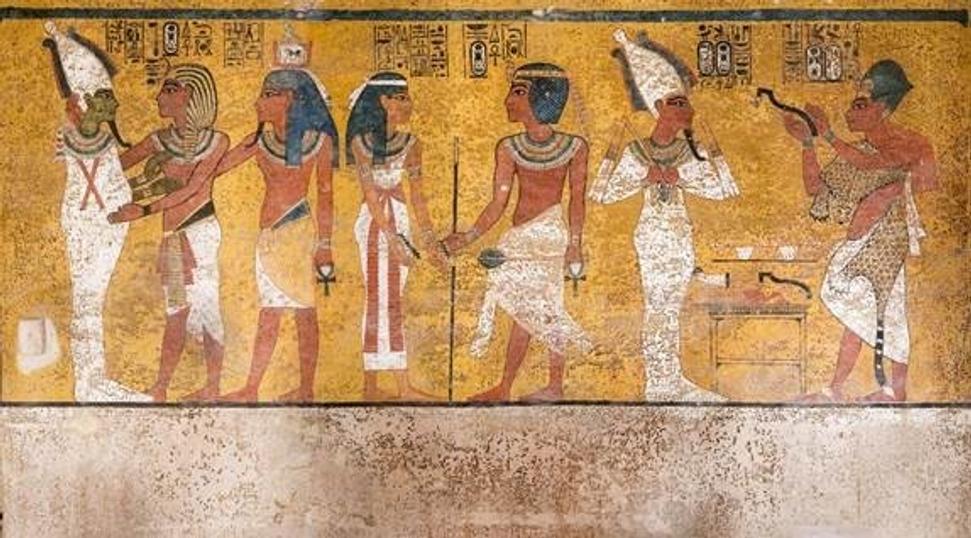
The north wall of the burial chamber depicts three separate scenes, ordered from right to left.  In the first, Ay, Tutankhamen’s successor, performs the “opening of the mouth” ceremony on Tutankhamen, who is depicted as Osiris, lord of the underworld.  In the middle scene, Tutankhamen, dressed in the costume of the living king, is welcomed into the realm of the gods by the goddess Nut.  On the left, Tutankhamen, followed by his ka (spirit twin), is embraced by Osiris.
 
The north wall of the burial chamber depicts three separate scenes, ordered from right to left. In the first, Ay, Tutankhamen’s successor, performs the “opening of the mouth” ceremony on Tutankhamen, who is depicted as Osiris, lord of the underworld. In the middle scene, Tutankhamen, dressed in the costume of the living king, is welcomed into the realm of the gods by the goddess Nut. On the left, Tutankhamen, followed by his ka (spirit twin), is embraced by Osiris. (Credit: Carleton Immersive Media Studio; Carleton University © J. Paul Getty Trust)

The Getty Conservation Institute (GCI) announced the completion of almost a decade of research, conservation efforts, and infrastructure improvements at the Tomb of Tutankhamen in Egypt, one of the best known cultural heritage sites in the world. The project—a multi-year collaboration between the GCI and Egypt’s Ministry of Antiquities—focused on conservation and the creation of a sustainable plan for continued management of the tomb.


“This project has greatly expanded our under­standing of one of antiquity’s most storied places,” says Tim Whalen, John E. and Louise Bryson Director of the Getty Conservation Institute. “It’s also representative of the collaborative partnership that the GCI undertakes with colleagues to create a model of practice that can be shared with professionals, and at other sites, around the world. We are grateful to our Egyptian colleagues for this remarkable opportunity.”

On January 31, 2019 a symposium will take place in which the collaborative Tutankhamen project will be presented together with colleagues from the Egyptian Ministry of Antiquities.

"Conservation and preservation is important for the future and for this heritage and this great civilization to live forever,” says Zahi Hawass, Egyptologist and former minister of State for Antiquities in Egypt, who also initiated the project with the GCI.

When the tomb was discovered in 1922 by archaelogist Howard Carter, under the patronage of Lord Carnarvon, the media frenzy that followed was unprecedented, and in many ways continues to this day. Carter and his team took 10 years to clear the tomb of its treasure because of the multitude of objects found within it. While the objects Carter’s team catalogued and stabilized were housed and secured, the tomb itself became a “must-see” attraction, open to the public and heavily visited by tourists from around the world. The tomb still houses a handful of original objects, including the mummy of Tutankhamen himself (on display in an oxygen-free case), the quartzite sarcophagus with its granite lid on the floor beside it, the gilded wooden outermost coffin, and the wall paintings of the burial chamber that depict Tut’s life and death.

The great demand for entry to the small tomb gave rise to concerns among Egyptian authorities about the condition of its wall paintings. Humidity and carbon dioxide generated by visitors promotes microbiological growth and can physically stress the wall paintings when the amount of water vapor in the air fluctuates. It was thought that brown spots—microbiological growths on the burial chamber’s painted walls—might be growing.

Another problem in the tomb was physical damage to the wall paintings. This included scratches and abrasion in areas close to where visitors have access, and inadvertent damage likely caused by film crews with equipment operating in the chamber’s tight spaces. Dust carried by the shoes and clothing of the tomb’s many visitors had also settled throughout, creating a gray veil on the uneven surfaces of the walls. This obscured the brightness of the paintings and increased the need for cleaning and the subsequent risk of additional paint loss.

In addition, high levels of humidity, excessive carbon dioxide, crowding, poor lighting and ventilation, lack of signage, and other factors combined to create a poor experience for visitors to the tomb.

Prompted by these concerns, the GCI and Egyptian authorities developed a multi-year collaboration focused on the conservation and management of the tomb and its wall paintings. The GCI already had considerable experience working in Egypt at the Tomb of Queen Nefertari in the Valley of the Queens and on a plan for the overall conservation and management of the Valley of the Queens.

The GCI-Egyptian project went on to carry out the most thorough study of the tomb’s condition since Carter’s time. The team of experts included an Egyptologist to conduct background research; environmental engineers to investigate the tomb’s microclimatic conditions; microbiologists to study the brown spots; documentation specialists, architects, and designers to upgrade the tomb’s infrastructure; scientists to study the original materials of the wall paintings; and conservators to carry out condition recording and treatment.

“As in all of our collaborative projects, the GCI has taken the long view, with the intent to provide sustainable conservation and site management outcomes,” says Neville Agnew, senior principal project specialist at the Getty Conservation Institute. “This involves systematic planning, documentation, scientific investigation, personnel training and a sensitive approach to treatment.”

The project team found the wall paintings to be in relatively stable condition, apart from localized flaking and loss of paint that was caused by both inconsistencies in the materials used and their application, as well as damage caused by visitors. Newly designed barriers now restrict visitor access in these areas to reduce the risk of future damage. The paintings were stabilized through dust removal and reduction of coatings from previous treatments, and condition monitoring was also established to better evaluate future changes.

Also addressed were the mysterious brown spots on the wall paintings. They were already present when Carter first entered the tomb, and a comparison of the spots with historic photographs from the mid-1920s showed no new growth. To confirm this finding, DNA and chemical analysis were undertaken and confirmed the spots to be microbiological in origin but dead and thus no longer a threat. Because the spots have penetrated into the paint layer, they have not been removed since this would harm the wall paintings.

In addition to the wall paintings conservation, the GCI also facilitated upgrades to the protection and presentation of the site, including infrastructure (walkways, viewing platform, signage, lighting, and an air filtration and ventilation system to mitigate humidity, carbon dioxide, and dust), a bilingual maintenance manual for the installations in the tomb, training for local personnel, and recommendations for visitor numbers and management that include guidelines for filming inside the tomb. The tomb was open for most of the project, and visitors were able to observe and ask questions as the conservators worked. The tomb is currently open to visitors.

Tuesday, January 15, 2019

11,500-year-old animal bones in Jordan suggest early dogs helped humans hunt


11,500 years ago in what is now northeast Jordan, people began to live alongside dogs and may also have used them for hunting, a new study from the University of Copenhagen shows. The archaeologists suggest that the introduction of dogs as hunting aids may explain the dramatic increase of hares and other small prey in the archaeological remains at the site.
Dogs were domesticated by humans as early as 14,000 years ago in the Near East, but whether this was accidental or on purpose is so far not clear. New research published in the Journal of Anthropological Archaeology by a team of archaeologists from the University of Copenhagen and University College London may suggest that humans valued the tracking and hunting abilities of early dogs more than previously known.
A study of animal bones from the 11,500 year old settlement Shubayqa 6 in northeast Jordan not only suggests that dogs were present in this region at the start of the Neolithic period, but that humans and dogs likely hunted animals together:
"The study of the large assemblage of animal bones from Shubayqa 6 revealed a large proportion of bones with unmistakable signs of having passed through the digestive tract of another animal; these bones are so large that they cannot have been swallowed by humans, but must have been digested by dogs," explained zooarchaeologist and the study's lead author Lisa Yeomans.
Lisa Yeomans and her colleagues have been able to show that Shubayqa 6 was occupied year round, which suggests that the dogs were living together with the humans rather than visiting the site when there were no inhabitants:
"The dogs were not kept at the fringes of the settlement, but must have been closely integrated into all aspects of day-to-day life and allowed to freely roam around the settlement, feeding on discarded bones and defecating in and around the site."
Can new hunting techniques account for the increase in small prey? When Yeomans and her co-authors sifted through the analysed data, they also noted a curious increase in the number of hares at the time that dogs appeared at Shubayqa 6. Hares were hunted for their meat, but Shubayqa 6's inhabitants also used the hare bones to make beads. The team think that it is likely that the appearance of dogs and the increase in hares are related.
"The use of dogs for hunting smaller, fast prey such as hares and foxes, perhaps driving them into enclosures, could provide an explanation that is in line with the evidence we have gathered. The long history of dog use, to hunt both small as well as larger prey, in the region is well known, and it would be strange not to consider hunting aided by dogs as a likely explanation for the sudden abundance of smaller prey in the archaeological record," said Lisa Yeomans.
"The shift may also be associated with a change in hunting technique from a method, such as netting, that saw an unselective portion of the hare population captured, to a selective method of hunting in which individual animals were targeted. This could have been achieved by dogs."

Monday, January 14, 2019

On the steppes of Genghis Khan – Mongolia’s nomads

The new international special exhibition at Moesgaard Museum tells the fascinating story of Genghis Khan and the nomads of the Mongolian steppes. For more than a millennium, Mongolian nomads made their mark on contacts between East and West, through belligerent expansion and by controlling trade routes across steppe and desert.
The story of Genghis Khan and his ravaging horsemen, who, by brilliant military strategies, created the foundations for the greatest empire the world has ever seen, is well known. Through his enormous conquests in the early 13th century, this commander from the Mongolian steppes forged an empire that stretched from China in the east, westward to what is now Eastern Europe.
The special exhibition On the steppes of Genghis Khan – Mongolia’s nomads takes visitors on a journey in the company of Mongolian nomads and their animal herds. It reveals a life on the move, where Genghis Khan is ever-present, both as a historical hero and as the personification of the dream of a united people. In this arid belt of steppe, desert and mountain, Mongolian nomads have found a way to survive, binding the world together across vast landscapes with few roads, exposed to burning sun or intense cold.
The exhibition includes fantastic exhibits on international loan, some of them actually from the time of Genghis Khan, as well as many wonderful artefacts brought back by Danish expeditions over the years, not least those led by Henning Haslund-Christensen in the 1930s. Danish nomad research represents a major initiative in international anthropology, and the many expeditions have resulted in rich collections being amassed at both Moesgaard Museum and the National Museum of Denmark.
The nomadic way of life has survived in Mongolia to the present day, with a third of the population still living as nomads on the steppes with their sheep, goats, horses, camels and cattle. Mongolian nomads have a common awareness of their history, and they cultivate the rich culture that revolves around being on the move with large herds of livestock, connections and contacts, trade across enormous distances and the shaman’s spiritual journeys between worlds and times. A way of life that has also brought great material wealth, as can be seen in their ornaments, costumes, tents, furniture, household items, tools, weapons and equipment – all of the finest craftsmanship. The exhibition at Moesgaard Museum shows visitors how the nomadic way of life, right up to the present day, constitutes an intriguing alternative to our own settled and sedentary existence, characterised by a completely different view of the world.
The exhibition On the steppes of Genghis Khan – Mongolia’s nomads has been developed by Moesgaard Museum in collaboration with the National Museum of Denmark and will show at Moesgaard until April 2019, after which it will be shown in the National Museum of Denmark’s Egmont Hall.

Comprehensive Study of Folklore


Folklore is the collection of traditional beliefs, customs, and stories of a community, passed through the generations by word of mouth. This vast expressive body, studied by the corresponding discipline of folklore, has evaded the attention of economists. In this study we do four things that reveal the tremendous potential of this corpus for understanding comparative development and culture. First, we introduce and describe a unique catalogue of folklore that codes the presence of thousands of motifs for roughly 1,000 pre-industrial societies. Second, we use a dictionary-based approach to elicit group-specific measures of various traits related to the natural environment, institutional framework, and mode of subsistence. We establish that these proxies are in accordance with the ethnographic record, and illustrate how to use a group’s oral tradition to quantify non-extant characteristics of preindustrial societies. Third, we use folklore to uncover the historical cultural! values of a group. Doing so allows us to test various influential conjectures among social scientists including the original affluent society, the culture of honor among pastoralists, the role of family in extended kinship systems and the intensity of trade and rule-following norms in politically centralized group. Finally, we explore how cultural norms inferred via text analysis of oral traditions predict contemporary attitudes and beliefs.

Thursday, January 10, 2019

Solving the ancient mysteries of Easter Island


The ancient people of Rapa Nui (Easter Island, Chile) built their famous ahu monuments near coastal freshwater sources, according to a team of researchers including faculty at Binghamton University, State University of New York.

The island of Rapa Nui is well-known for its elaborate ritual architecture, particularly its numerous statues (moai) and the monumental platforms that supported them (ahu.) Researchers have long wondered why ancient people built these monuments in their respective locations around the island, considering how much time and energy was required to construct them. A team of researchers including Binghamton University anthropologist Carl Lipo used quantitative spatial modeling to explore the potential relations between ahu construction locations and subsistence resources, namely, rock mulch agricultural gardens, marine resources, and freshwater sources--the three most critical resources on Rapa Nui. Their results suggest that ahu locations are explained by their proximity to the island's limited freshwater sources.

"The issue of water availability (or the lack of it) has often been mentioned by researchers who work on Rapa Nui/Easter Island," said Lipo. "When we started to examine the details of the hydrology, we began to notice that freshwater access and statue location were tightly linked together. It wasn't obvious when walking around--with the water emerging at the coast during low tide, one doesn't necessarily see obvious indications of water. But as we started to look at areas around ahu, we found that those locations were exactly tied to spots where the fresh groundwater emerges -- largely as a diffuse layer that flows out at the water's edge. The more we looked, the more consistently we saw this pattern. Places without ahu/moai showed no freshwater. The pattern was striking and surprising in how consistent it was. Even when we find ahu/moai in the interior of the island, we find nearby sources of drinking water. This paper reflects our work to demonstrate that this pattern is statistically sound and not just our perception."

"Many researchers, ourselves included, have long speculated associations between ahu/moai and different kinds of resources, e.g., water, agricultural land, areas with good marine resources, etc.," said lead author Robert DiNapoli of the University of Oregon. "However, these associations had never been quantitatively tested or shown to be statistically significant. Our study presents quantitative spatial modeling clearly showing that ahu are associated with freshwater sources in a way that they aren't associated with other resources."

According to Terry Hunt of the University of Arizona, the proximity of the monuments to freshwater tells us a great deal about the ancient island society.

"The monuments and statues are located in places with access to a resource critical to islanders on a daily basis--fresh water. In this way, the monuments and statues of the islanders' deified ancestors reflect generations of sharing, perhaps on a daily basis--centered on water, but also food, family and social ties, as well as cultural lore that reinforced knowledge of the island's precarious sustainability. And the sharing points to a critical part of explaining the island's paradox: despite limited resources, the islanders succeeded by sharing in activities, knowledge, and resources for over 500 years until European contact disrupted life with foreign diseases, slave trading, and other misfortunes of colonial interests."

The researchers currently only have comprehensive freshwater data for the western portion of the island and plan to do a complete survey of the island in order to continue to test their hypothesis of the relation between ahu and freshwater.

Illuminating women's role in the creation of medieval manuscripts


IMAGE
IMAGE: This is a magnified view of lapis lazuli particles embedded within medieval dental calculus. view more 
Credit: Monica Tromp
During the European Middle Ages, literacy and written texts were largely the province of religious institutions. Richly illustrated manuscripts were created in monasteries for use by members of religious institutions and by the nobility. Some of these illuminated manuscripts were embellished with luxurious paints and pigments, including gold leaf and ultramarine, a rare and expensive blue pigment made from lapis lazuli stone.
In a study published in Science Advances, an international team of researchers led by the Max Planck Institute for the Science of Human History and the University of York shed light on the role of women in the creation of such manuscripts with a surprising discovery--the identification of lapis lazuli pigment embedded in the calcified dental plaque of a middle-aged woman buried at a small women's monastery in Germany around 1100 AD. Their analysis suggests that the woman was likely a painter of richly illuminated religious texts.
A quiet monastery in central Germany As part of a study analyzing dental calculus - tooth tartar or dental plaque that fossilizes on the teeth during life - researchers examined the remains of individuals who were buried in a medieval cemetery associated with a women's monastery at the site of Dalheim in Germany. Few records remain of the monastery and its exact founding date is not known, although a women's community may have formed there as early as the 10th century AD. The earliest known written records from the monastery date to 1244 AD. The monastery is believed to have housed approximately 14 religious women from its founding until its destruction by fire following a series of 14th century battles.
One woman in the cemetery was found to have numerous flecks of blue pigment embedded within her dental calculus. She was 45-60 years old when she died around 1000-1200 AD. She had no particular skeletal pathologies, nor evidence of trauma or infection. The only remarkable aspect to her remains was the blue particles found in her teeth. "It came as a complete surprise - as the calculus dissolved, it released hundreds of tiny blue particles," recalls co-first author Anita Radini of the University of York. Careful analysis using a number of different spectrographic methods - including energy dispersive X-ray spectroscopy (SEM-EDS) and micro-Raman spectroscopy - revealed the blue pigment to be made from lapis lazuli.
A pigment as rare and expensive as gold "We examined many scenarios for how this mineral could have become embedded in the calculus on this woman's teeth," explains Radini. "Based on the distribution of the pigment in her mouth, we concluded that the most likely scenario was that she was herself painting with the pigment and licking the end of the brush while painting," states co-first author Monica Tromp of the Max Planck Institute for the Science of Human History.
The use of ultramarine pigment made from lapis lazuli was reserved, along with gold and silver, for the most luxurious manuscripts. "Only scribes and painters of exceptional skill would have been entrusted with its use," says Alison Beach of Ohio State University, a historian on the project.
The unexpected discovery of such a valuable pigment so early and in the mouth of an 11th century woman in rural Germany is unprecedented. While Germany is known to have been an active center of book production during this period, identifying the contributions of women has been particularly difficult. As a sign of humility, many medieval scribes and painters did not sign their work, a practice that especially applied to women. The low visibility of women's labor in manuscript production has led many modern scholars to assume that women played little part in it.
The findings of this study not only challenge long-held beliefs in the field, they also uncover an individual life history. The woman's remains were originally a relatively unremarkable find from a relatively unremarkable place, or so it seemed. But by using these techniques, the researchers were able to uncover a truly remarkable life history.
"She was plugged into a vast global commercial network stretching from the mines of Afghanistan to her community in medieval Germany through the trading metropolises of Islamic Egypt and Byzantine Constantinople. The growing economy of 11th century Europe fired demand for the precious and exquisite pigment that traveled thousands of miles via merchant caravan and ships to serve this woman artist's creative ambition," explains historian and co-author Michael McCormick of Harvard University.
"Here we have direct evidence of a woman, not just painting, but painting with a very rare and expensive pigment, and at a very out-of-the way place," explains Christina Warinner of the Max Planck Institute for the Science of Human History, senior author on the paper. "This woman's story could have remained hidden forever without the use of these techniques. It makes me wonder how many other artists we might find in medieval cemeteries - if we only look."

Thursday, January 3, 2019

Archeological discovery yields clues to how our ancestors may have adapted to their environment Boston


During the Stone Age ancestral humans lived with a variety of animal species along what was an area of wetlands in the middle of the Jordanian desert. The site, in the town of Azraq Basin, has been excavated and has revealed an abundance of tools and animal bones from up to 250,000 years ago, leading to better understanding of how ancestral humans have adapted to this changing environment.
James Pokines, PhD, associate professor of forensic anthropology at Boston University School of Medicine, was a leader of the excavation with a team from the Azraq Marshes Archaeological and Paleoecological Project.

The team discovered bone and tooth specimens belonging to wild ancestors of modern-day camels and elephants, as well as horse, rhinoceros, antelope and wild cattle species, among others. Poor preservation of small and less dense bones has resulted in limited conclusions about smaller species of animals that may have inhabited the area during this time.

Prior research in the site revealed evidence of butchery, with blood proteins from multiple species appearing on Stone Age tools. "The periphery of the wetlands where large animals drank and grazed would have presented excellent hunting opportunities for ancestral humans. Humans may have also faced their own challenges from other predatory competitors such as lions and hyenas roaming the area," said Pokines, corresponding author of the study.

The team's discovery adds important background to a growing picture of land use over time in Azraq Basin. "There are many portions of the globe that we still know so little about in terms of how ancestral humans lived and evolved there and how they adapted to that environment ... we hope to understand how different populations of ancestral humans adapted to this changing, arid environment throughout the Stone Age."
The excavation efforts were the outcome of a successful collaboration with Jordanian authorities and according to the researchers has paved the way for future excavations in the region.