Tuesday, April 24, 2018

Oldest peace treaty in the world


IMAGE
IMAGE: This is the oldest-preserved peace treaty between Ramesses II and ?attušili III, c. 1259 B.C. view more 
Credit: Staatliche Museen zu Berlin, Vorderasiatisches Museum, Olaf M. Teßmer
According to archaeologists, the world's oldest peace treaty disproves the widespread notion that in antiquity, peace was not brought about by negotiations, but always by humiliating those who had lost. 

 "More than 3,200 years ago, Egyptians and Hittites ensured each other mutual support in the treaty; neither of them triumphed. This must have been preceded by much negotiating, as is evidenced by extensive correspondence between the rulers", say Director Prof. Dr Achim Lichtenberger and Curator Dr Helge Nieswandt of the University of Münster's Archaeological Museum. "Although the 'victorious peace' dominates over the 'peace of reconciliation' in peace images of antiquity, our research shows that the latter also existed." 

From 28 April, the museum will present a copy of the oldest contract (fig. 1) from the Berlin Pergamon Museum in the exhibition project "Frieden. Von der Antike bis heute" (Peace. From Antiquity to the Present Day). Another copy can be seen in the United Nations Building in New York.

The researchers of the museum and of the Cluster of Excellence "Religion and Politics" also do away with other clichés. A large number of peace images were created not in times of peace, but in times of war, such as the Roman goddess of peace Pax showing on countless coins. "Despite the glorification of war in antiquity, which undoubtedly existed and alienates us: images of the ideal of peace were particularly widespread during wars," says Nieswandt. 
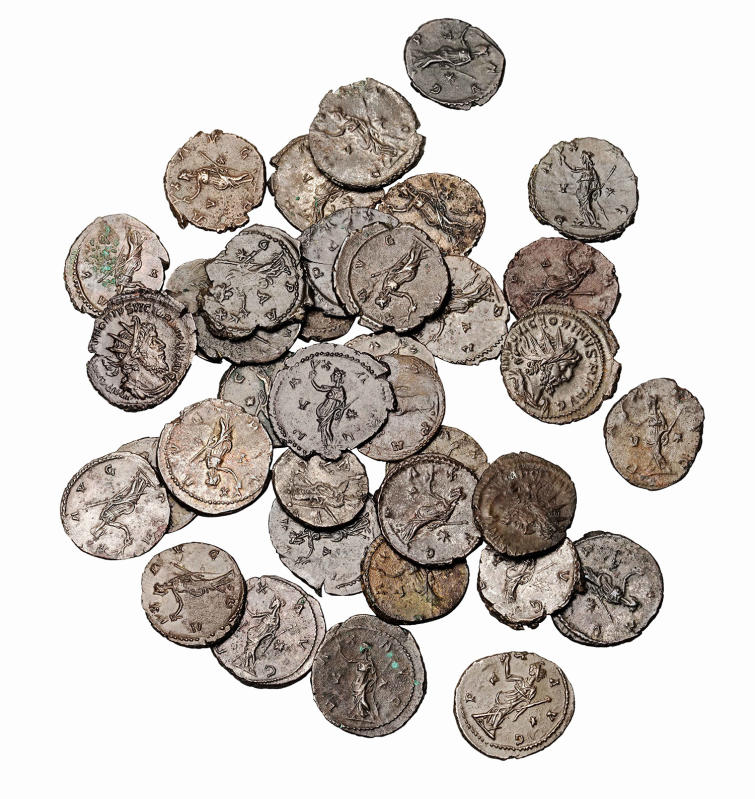
 
Heap of coins, with Roman coins depicting the goddess of peace, 3rd century AD
© Archäologisches Museum der WWU Münster, Foto: Robert Dylka
 

He will present the "inflation of peace" on coins (fig. 2) on 23 May at the Cluster of Excellence's conference "PEACE. Theories, Images and Strategies from Antiquity to the Present Day", which is part of the exhibition project.

In the exhibition with the subtitle "Eirene - Pax. Frieden in der Antike" (Peace in Antiquity), the museum will also, for the first time, present 
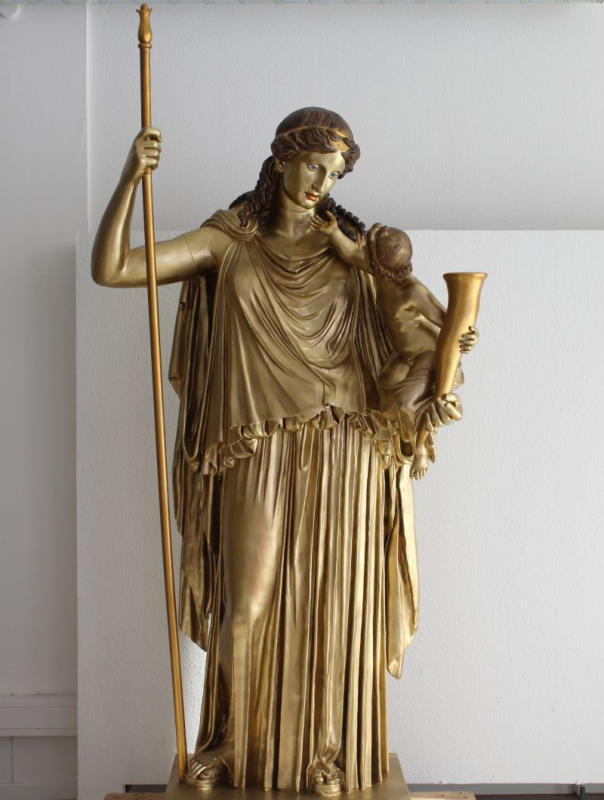
 
 Eirene by Cephisodotus, 375/74 AD; bronze-coloured copy
© Archäologisches Museum der WWU Münster, Foto: Silke Hockmann
 
a bronze-coloured copy of the famous goddess of peace "Eirene" by sculptor Cephisodotus (fig. 3). It symbolises that with peace comes prosperity. "Despite the glorification of war, people from antiquity always knew that it is not war but peace that leads to wealth," says Lichtenberger. 
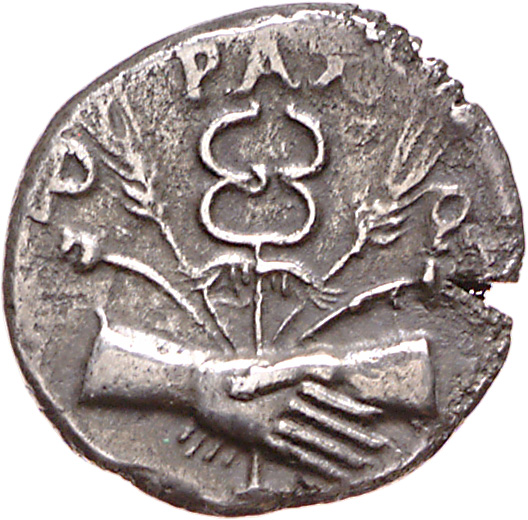
 
 Roman coins with ears and handshake from 68 AD, a year of civil war
© Staatliche Museen zu Berlin, Münzkabinett, 18228354, Foto: Dirk Sonnenwald

This ideal is also illustrated by many of the other 160 antique exhibits such as the messenger staff, the handshake and ears of grain (fig. 4). "They show how strongly our Western peace symbols of today are rooted in ancient Greek and Roman images and how they have repeated themselves over centuries. 

Accordingly, the ancient illustrations are often familiar to us."Bronze-coloured goddess of peace and doves in animal idyll
According to Lichtenberger, even the most famous symbol of peace today, the dove, originates from antiquity. The derivation is not linear, however: "While in antiquity, the dove itself did not signify peace, it was closely associated with Aphrodite, the goddess of love. It also appeared in animal idylls in which the peaceful coexistence of animals represented peace. The dove could thus be adapted as a symbol of peace by Christians."
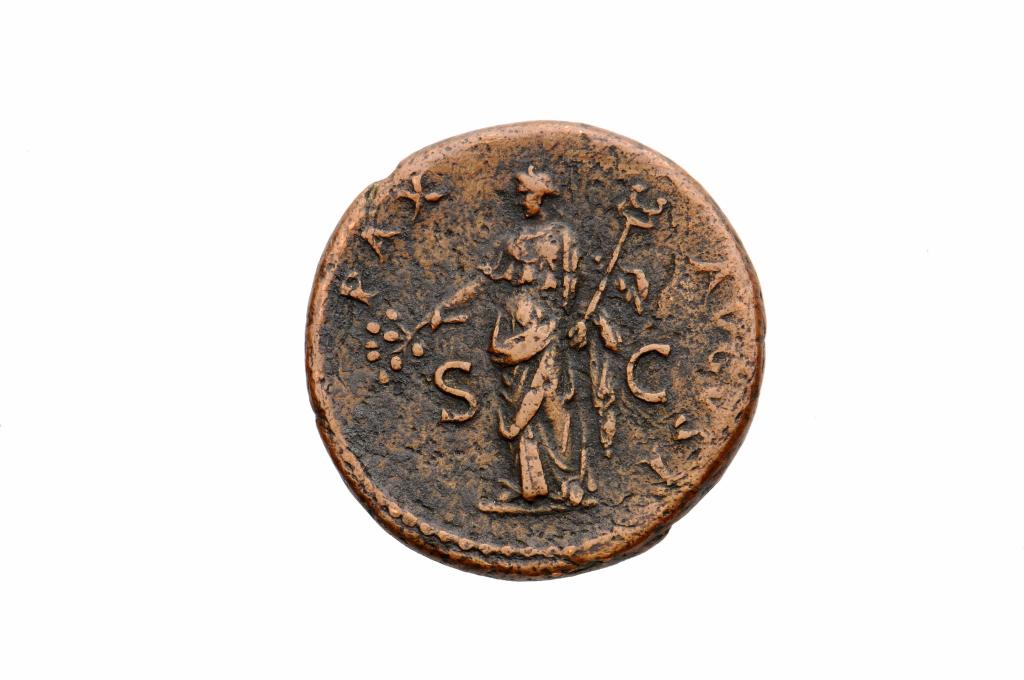


Pax with caduceus on Roman coin
© Archäologisches Museum der WWU Münster, Foto: Robert Dylka
 
 An allegory of peace in the tradition of antiquity from 1659 by Flemish painter Theodoor van Thulden, depicting horn of plenty and caduceus, also shows how far the ancient symbols extend into later centuries. "According to ancient ideas, the caduceus granted its bearer diplomatic immunity," says Nieswandt. "The fact that the goddess Pax holds it on numerous ancient coin depictions underlines once more the importance that negotiated peace had for antiquity as well". (fig. 5)

Regarding the numerous coin depictions of the goddess of peace "Pax" (fig. 2), Helge Nieswandt explains that she was often, particularly in times of war, shown on coins, the first mass medium of mankind, because rulers thus offered an ideal in reply to reality. 

The researcher will show this in his conference lecture on 23 May using an example of Roman antiquity: "When the order of the Roman Empire fell apart in the 3rd century AD, and when mostly short-lived soldier emperors took turns, there was an 'inflation of peace' on coins." Researchers see this as one example of many for the fact that people in all centuries expressed and depicted a longing for peace, but were not able to secure it in the long run. This guiding principle characterises the exhibition "Peace. From Antiquity to the Present Day".

About the bronze copy of Cephisodotus' Eirene, the scholar explains that it is a statue whose Greek original from the 4th century BC has not survived, but whose popularity and appearance are attested to by numerous Roman copies. Goddess of peace Eirene holds the infant Plutus, the personification of wealth, in her arms. 

The Archaeological Museum has commissioned a restorer with the bronze-coloured copy of this 2.05-metre and thus larger-than-life representation and will for the first time present it to the public at the opening of the exhibition on 28 April. "According to our investigations, the bronze, which is shining like gold, is only one possibility of several coloured versions, but in any case it is more plausible than the white of the plaster. The Münster reconstruction is to be understood as an incentive to see the statue differently than before. (sca/vvm)

Friday, April 20, 2018

Getty Conservation Institute Announces Near Completion of Work at the Tomb of King Tutankhamen


The Getty Conservation Institute (GCI)  has nearly completed its work at the Tomb of Tutankhamen in Egypt, one of the most famous cultural heritage sites in the world. The project —a multiyear collaboration between the GCI and Egypt’s Ministry of Antiquities (formerly known as the Supreme Council of Antiquities) focused on conservation and the creation of a sustainable plan for continued conservation and management of the tomb. Work at the legendary site included the conservation of wall paintings, environmental and infrastructure improvements, and training for future care of the site. 


Conservation work on the wall paintings in the tomb © J. Paul Getty Trust 

"This project greatly expanded our understanding of one of the best known and significant sites from antiquity, and the methodology used can serve as a model for similar sites,” says Tim Whalen, John E. and Louise Bryson Director of the Getty Conservation Institute. “The work at Tutankhamen’s tomb is representative of the kind of collaborative effort the GCI undertakes with colleagues internationally to advance conservation practice and to protect our cultural heritage.” 

The discovery of Tutankhamen’s tomb, located in Egypt’s Valley of the Kings, is considered one of the most spectacular in the history of archaeology. Built hastily upon the death of the young King Tutankhamen, the tomb was buried by flood debris at its entrance soon after it was sealed, and as a result evaded plunder for over 3,000 years. 

After discovering the tomb in 1922, Howard Carter carefully documented and stabilized the tomb’s contents, some of which have been exhibited around the world. The tomb itself became a “must -see” attraction for visitors to Egypt, which resulted in concerns regarding the site’s condition. 


 3D drawing of the tomb. (Courtesy of the Theban Mapping Project)   

The tomb still houses a handful of original objects, including the mummy of Tutankhamen himself (on display in an oxygen- free case), the quartzite sarcophagus with its granite lid on the floor beside it, the gilded wooden outermost coffin, and the wall paintings of the burial chamber. The concerns regarding the tomb included the humidity and carbon dioxide levels, and the dust introduced by visitors. 

“Humidity promotes micro biological growth and may also physically stress the wall paintings, while carbon dioxide creates an uncomfortable atmosphere for visitors themselves,” says Neville Agnew, the GCI senior principal project specialist who has led the project. “But perhaps even more harmful has been the physical damage to the wall paintings. Careful examination showed an accumulation of scratches and abrasion in areas close to where visitors and film crews have access within the tomb’s tight space.” 


The pharaoh Tutankhamen pictured on the north wall of the burial chamber © J. Paul Getty Trust

 Another serious problem in the tomb is the dust visitors bring in on their shoes and clothing, which settles on the floor and the uneven surfaces of the walls. Dust on the walls obscures the brightness of the paintings and necessitates cleaning, which increases the risk of additional paint loss. 

In 2009, the Ministry asked the GCI to collaborate on a project to conserve the tomb and its wall paintings. The GCI has had considerable experience working in Egypt, first on the Tomb of Queen Nefertari in the Valley of the Queens (1986 – 92), and later on the planning for the conservation and management of the Valley of the Queens (beginning in 2006). 

The team of experts working on the Tutankhamen project included an Egypto logist to conduct background research; environmental engineers to investigate the tomb’s microclimatic conditions; microbiologists to study mysterious brown spots on the surface of the wall paintings; documentation specialists, architects, and designers to upgrade the tomb’s infrastructure; scientists to study the original materials of the wall paintings; and conservators to carry out condition recording and treatment and to train local conservators. 

The wall paintings were found to be in relatively stable condition, apart from localized flaking and loss of paint. Most of the flaking was likely due to inconsistencies in the materials used and their application, but other losses were attributed to damage caused by visitors. 

Newly designed barriers now restrict visitor access in these areas so that further losses can be minimized. Stabilization of the paintings addressed paint flaking and plaster instability and also included dust removal and reduction of coatings from previous treatments (past treatments were not always based on thorough understanding of the paintings’ conditions and the causes of their deterioration). Condition monitoring protocols were also established to better evaluate future changes.  


Detail of a wall painting with brown spots © J. Paul Getty Trust 

Also addressed were the mysterious brown spots on the wall paintings. Other tombs do not show the same phenomenon, and Egyptian authorities wondered if the presence of visitors was causing the spots to grow, so the project conducted research to identify the microorganisms and determine if they posed a continued risk. 

The brown spots were already present when Carter first entered the tomb, and a comparison of the spots with historic photographs from the mid -1920s showed no new growth. To confirm this finding , DNA and chemical analysis were undertaken and physical samples of the spots were examined under magnification and then mounted in cross section. The investigation confirmed the spots to be microbiological in origin but concluded they were dead and thus no longer a threat. Because the spots have penetrated into the paint layer, they were not removed since this would harm the wall paintings. 

In addition to the wall paintings conservation, the GCI also facilitated upgrades to the protection and presentation of the site, including infrastructure (walkways, viewing platform, and an air filtration and ventilation system to protect against humidity, carbon dioxide, and dust), new bilingual signage and interpretive materials, training of staff, and devising a pro gram for sustainable maintenance and controlled visitation to the tomb. New lighting will be installed in the fall of 2018. 

“Because the project allowed for unprecedented study of the tomb and its wall paintings, its findings have provided a deeper understanding of tomb construction and decoration practices from the New Kingdom,” says Lori Wong, a project specialist at the GCI and an expert in wall paintings conservation. “This work has also shed new light on the tomb’s condition and the causes of its deterioration, and these findings will be used to protect the tomb for years to come.” 

A project monograph will be published, as well as a book for the general public.


Wednesday, April 18, 2018

Sweet potato history casts doubt on early contact between Polynesia and the Americas


Evidence reported in the journal Current Biology on April 12 shows that sweet potatoes arose before there were any humans around to eat them. The findings also suggest that the sweet potato crossed the ocean from America to Polynesia without any help from people. The discovery raises doubts about the existence of pre-Columbian contacts between Polynesia and the American continent.

"Apart from identifying its progenitor, we also discovered that sweet potato originated well before humans, at least 800,000 years ago," says Robert Scotland from the University of Oxford. "Therefore, it is likely that the edible root already existed when humans first found this plant."

Scotland and colleagues set out to clarify the origin and evolution of the sweet potato, which is one of the most widely consumed crops in the world and an important source of vitamin A precursors. They also aimed to explore a question that has been of interest for centuries: how did the sweet potato, a crop of American origin, come to be widespread in Polynesia by the time Europeans first arrived? In fact, researchers have suggested that the sweet potato's early presence in Polynesia was evidence of pre-European contacts between Americans and Polynesians.

The researchers combined genome skimming and target DNA capture to sequence the whole chloroplasts and 605 single-copy nuclear regions from 199 specimens representing the sweet potato and all of its crop wild relatives. The data strongly suggest that sweet potato arose after a genome duplication event. Its closest wild relative is Ipomoea trifida. The findings confirm that no other extant species was involved in the sweet potato's origin.

Phylogenetic analysis of the DNA sequences produced conflicting family trees. However, the researchers report, those conflicting patterns can be explained by a dual role for I. trifida. Sweet potato arose from I. trifida and later hybridized with I. trifida to produce another, independent sweet potato lineage.

"We demonstrate that the existence of those two different lineages is the result of an ancient hybridization between sweet potato and its progenitor," says Munoz-Rodriguez, first author of the paper. "We conclude that sweet potato evolved at least 800,000 years ago from its progenitor, and then after the two species became distinct, they hybridized."

The findings come as good news for the future of the sweet potato. That's because the loss of genetic diversity in crops is a major threat for food security. One way to improve or reinforce desirable properties in food crops is to cross them with their closest wild relatives. So, Scotland says, the identification of the sweet potato's progenitor opens the door to a more accurate understanding of its potential role in sweet potato breeding.

The new view on sweet potato history also has major implications for understanding human history.

"Our results challenge not only the hypothesis that the sweet potato was taken to Polynesia by humans, but also the long-time argued existence of ancient contacts between Americans and Polynesians," Munoz-Rodriguez says. "These contacts were considered as true based on evidence from chickens, humans, and sweet potato. Evidence from chickens and humans is now considered questionable, and thus sweet potato was the remaining biological evidence of these alleged contacts. Therefore, our results refute the dominant theory and call into question the existence of pre-European contacts across the Pacific."

Tuesday, April 17, 2018

Boy unearths treasure of the Danish king Bluetooth in Germany

René Schön and his student Luca Malaschnitschenko were looking for treasure using metal detectors in January on northern Rügen island when they chanced upon what they initially thought was a worthless piece of aluminium.

But upon closer inspection, they realised that it was a piece of silver, German media reported.
Over the weekend, the regional archaeology service began a dig covering 400 sq metres (4,300 sq ft). It has found a hoard believed to be linked to the Danish king Harald Gormsson, better known as “Harry Bluetooth”, who reigned from around AD 958 to 986.
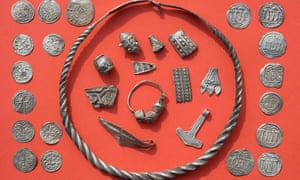
Braided necklaces, pearls, brooches, a Thor’s hammer, rings and up to 600 chipped coins were found, including more than 100 that date back to Bluetooth’s era, when he ruled over what is now Denmark, northern Germany, southern Sweden and parts of Norway.

“This trove is the biggest single discovery of Bluetooth coins in the southern Baltic Sea region and is therefore of great significance,” the lead archaeologist, Michael Schirren, told national news agency DPA.

The oldest coin is a Damascus dirham dating to 714 while the most recent is a penny dating to 983.
The find suggests that the treasure may have been buried in the late 980s – also the period when Bluetooth was known to have fled to Pomerania, where he died in 987.

“We have here the rare case of a discovery that appears to corroborate historical sources,” said the archaeologist Detlef Jantzen.

Bluetooth is credited with unifying Denmark. The Viking-born king also turned his back on old Norse religion and introduced Christianity to the Nordic country.

But he was forced to flee to Pomerania after a rebellion led by his son Sven Gabelbart.

Wednesday, April 11, 2018

Unusual climate during Roman times plunged Eurasia into hunger and disease


A recent study published in an esteemed academic journal indicates that volcanic eruptions in the mid 500s resulted in an unusually gloomy and cold period. A joint research project of the Chronology Laboratory of the Finnish Museum of Natural History and Natural Resources Institute Finland (Luke) suggests that the years 536 and 541-544 CE were very difficult for many people.

An extended period of little light may make it difficult for humans to survive. The level of production of plants is dependent on the amount of available sunlight. Food production, i.e, farming and animal husbandry, rely on the same solar energy. Humans, meanwhile, become more prone to disease if they are not exposed to enough sunlight to produce vitamin D.

"Our research shows that the climate anomaly, which covered all of the northern hemisphere, was the compound result of several volcanic eruptions," says Markku Oinonen, director of the Chronology Laboratory.

The aerosols that were released into the atmosphere with the eruptions covered the sun for a long time.

The exceptionally poor climate conditions were significantly detrimental to farming and reduced the production of vitamin D among the populace. This means that the people who were already weakened by hunger also had to grapple with a compromised immune system.

Trees are a re­cord of the past
 
The study is based on dendrochronology or tree-ring dating. The series of annual growth rings from subfossil - or intact - tree deposits covers the past 7,600 years. The trees are often found on the bottom of small lakes, and Luke has been taking samples and recording the findings since the 1990s.
"Researchers have put together an annual growth ring calendar of treeline pine spanning more than 7,600 years. Various historical events can be contrasted with the calendar. The growth ring calendar is an important indicator of global climate change," says researcher Samuli Helama from Luke.
The samples in the recent study were dated with the help of the growth ring calendar at Luke, and sample shavings were carved out of them for each calendar year. The Chronology Laboratory then conducted isotope analyses on the samples.

Car­bon iso­topes in­dic­ate sum­mer weather
 
The results of the study are based on the analysis of the variation of carbon isotopes in the annual growth rings of trees. The variety in carbon isotopes reflects the photosynthesis of the trees, which in turn is largely dependent on the amount of solar radiation available during the summer.
The new study tracks the correlation of carbon isotope variation and volcanic eruptions from the 19th century until recent years, and shows the dramatic reduction in available sunlight in 536 as well as between 541 and 544 CE. The variation of summer temperatures was similarly reconstructed on the basis of the density of the trees' annual growth rings.

Hard times brought the plague
 
The unusually poor years coincide with the bubonic plague epidemic that devastated the Roman Empire. The epidemic caused by the Yersinia pestis bacterium began in 542 CE and killed approximately half, or more, of the inhabitants of what was then considered the Eastern Roman Empire. The plague spread through Europe, from the Mediterranean, possibly as far north as Finland, and had killed tens of millions of people by the 8th century.

Tuesday, April 10, 2018

First human migration out of Africa more geographically widespread than previously thought


IMAGE
IMAGE: Fossil finger bone of Homo sapiens from the Al Wusta site, Saudi Arabia. view more 
Credit: Ian Cartwright
A project led by the Max Planck Institute for the Science of Human History has discovered a fossilized finger bone of an early modern human in the Nefud Desert of Saudi Arabia, dating to approximately 90,000 years ago. The discovery, described in Nature Ecology and Evolution, is the oldest directly dated Homo sapiens fossil outside of Africa and the Levant and indicates that early dispersals into Eurasia were more expansive than previously thought.

Researchers conducting archaeological fieldwork in the Nefud Desert of Saudi Arabia have discovered a fossilized finger bone of an early member of our species, Homo sapiens. The discovery is the oldest directly dated Homo sapiens fossil outside of Africa and the immediately adjacent Levant, and indicates that early dispersals into Eurasia were more expansive than previously thought. Prior to this discovery, it was thought that early dispersals into Eurasia were unsuccessful and remained restricted to the Mediterranean forests of the Levant, on the doorstep of Africa. The finding from the Al Wusta site shows that there were both multiple dispersals out of Africa, and these spread further than previously known.

Oldest directly dated Homo sapiens fossil outside of Africa and the Levant
The results, published in Nature Ecology and Evolution, detail the discovery made at the site of Al Wusta, an ancient fresh-water lake located in what is now the hyper-arid Nefud Desert. Numerous animal fossils, including those of hippopotamus and tiny fresh water snails were found at Al Wusta, as well as abundant stone tools made by humans. Among these finds was a well preserved and small fossil, just 3.2 cm long, which was immediately recognized as a human finger bone. The bone was scanned in three dimensions and its shape compared to various other finger bones, both of recent Homo sapiens individuals and bones from other species of primates and other forms of early humans, such as Neanderthals.

The results conclusively showed that the finger bone, the first ancient human fossil found in Arabia, belonged to our own species. Using a technique called uranium series dating, a laser was used to make microscopic holes in the fossil and measure the ratio between tiny traces of radioactive elements. These ratios revealed that the fossil was 88,000 years old. Other dates obtained from associated animals fossils and sediments converged to a date of approximately 90,000 years ago. Further environmental analyses also revealed the site to have been a freshwater lake in an ancient grassland environment far removed from today's deserts.

Lead author Dr. Huw Groucutt, of the University of Oxford and the Max Planck Institute for the Science of Human History, states, "This discovery for the first time conclusively shows that early members of our species colonized an expansive region of southwest Asia and were not just restricted to the Levant. The ability of these early people to widely colonize this region casts doubt on long held views that early dispersals out of Africa were localized and unsuccessful."

Modern deserts of the Arabian Peninsula were once lush grasslands that humans were able to colonize
Project Lead, Professor Michael Petraglia of the Max Planck Institute for the Science of Human History adds, "The Arabian Peninsula has long been considered to be far from the main stage of human evolution. This discovery firmly puts Arabia on the map as a key region for understanding our origins and expansion to the rest of the world. As fieldwork carries on, we continue to make remarkable discoveries in Saudi Arabia."

Friday, April 6, 2018

Genetics of the modern heirs of the Incas shed new lights about their origins and lineages


IMAGE
IMAGE: Iconic sacred citadelle of Machu Picchu, at the edge of the Andes and Amazon, symbol of the largest empire of the Pre Columbian Americas. view more 
Credit: Jose Sandoval
A multinational South American team from Peru, Brasil and Bolivia led by the Universidad de San Martin de Porres at Lima, Peru, published the first genetic study on the modern descendants of the imperial Inka lineages in the journal Molecular Genetics and Genomics. This work supported by funds from the Genographic Project (Geno 2.0), shows new insights about the Inkas origins and lineages.

The Inka people arrived to Cusco valley and in a few centuries they built the Tawantinsuyu, the largest empire in the Americas. The Tawantinsuyu was the cultural climax of 6,000 years of Central Andes civilizations overlapping modern countries of Peru, Bolivia, Ecuador, the South of Colombia and the North of Argentina and Chile. In contrast with the richness of archeological and cultural evidence, pre Columbian history vanishes in time as it intermingles with myths due to the lack of writing systems before the arrival of the European chroniclers.

Very little is known about the Inka origins and some genetic information could help reconstruct part of their history. Unfortunately the mummies and bodily remains of the Inka emperors, worshiped as gods, were burnt and buried in unknown locations due to religious and political persecution by the Christian Conquistadors and Inquisitors, so no direct material remain to study their DNA.

 "Thus for now, only the genetic analysis of modern families of Inka descent could provide some clues about their ancestors" remarks geneticist Jose Sandoval, first author, working at Universidad de San Martin de Porres at Lima, Peru.


There were two foundational myths for the origin of the Inkas before they established in Cusco valley to build their capital city.

One is that Manco Capac and Mama Ocllo, considered children of the Sun God and founder parents of the civilization, came from Lake Titicaca about 500 km southwards from the border of North Bolivia and South Peru, more or less the same region where Tiwanaku empire existed a few centuries before.

The second myth narrates that four Ayar brothers, with divine powers, came out from the caves inside of a hill in the area of Paccarictambo, 50 km south of Cusco and only one of them, Manco, arrived to the Cusco valley.

 Concerning the succession of the rulers (between 12 to 14), most chroniclers mention only one patrilineal heritage, however other authors think that it was a complex selection of military and administrative skills not necessarily electing the son of a previous Inka. "A unique patrilineal cluster would be expected in the first case. In the second case, two or more patrilineal pattern will be evident" says geneticist Ricardo Fujita, senior author, also at Universidad de San Martin de Porres".

The research team included historian Ronald Elward, who studied documentation of twelve Inka noble families and followed up from the conquista times to their contemporary descendants. "Most of them still living in the towns of San Sebastian and San Jeronimo, Cusco, Peru, at present, are probably the most homogeneous group of Inka lineage" says Elward.

Markers for Y chromosome and mtDNA were used for the genetic analysis of these families and compared with a database for 2400 native individuals from Peru, Bolivia, Ecuador and Brazil. "The results show distinctive patrilineal origins to two founder individuals who lived between 1000 to 1500 AD, a period between the decline of former Tiwanaku (south) and Wari (north) contemporary empires, and the rise of the Inca empire a few centuries later" says geneticist Fabricio Santos from the Universidad Federal de Minas Gerais at Belo Horizonte, Brazil.

The first patrilineal haplotype named AWKI-1 (awki means crown prince in quechua language) is found in the putative families descending of 2 earlier Incas Yahuar Huacac and Viracocha. The same pattern of the Inca descendants was also found in individuals living south to Cusco, mainly in Aymaras of Peru and Bolivia.

The second patrilineal haplotype named AWKI-2 was found in one descendant of a more recent Inca, Huayna Capac, father of the two brothers (Huascar and Atahualpa) who were fighting a fraternal war over the empire at the arrival of the Conquistadors. "AWKI-2 is also found in dozens of individuals from different locations in the Andes and occasionally in the Amazon, suggesting a populational expansion" says Dr. Santos.

"In addition to San Sebastian and San Jeronimo, most locations of AWKI-1, AWKI-2 were southwards to Cusco including the basin of lake Titicaca and neighboring Paccarictambo, in agreement with the two foundational myths of the Incas" says Ricardo Fujita, "probably two pictures at different times of the same journey with final destination Cusco" adds Fujita. "It is also remarkable that in these contemporary Inka noblility families there is a continuity since pre Columbian times" says Ronald Elward.

 The analysis of their mtDNA suggested a highly varied matrilineal marker whose counterparts are found all over the Andes reflecting a high genetic flow. "This probably reflects the political alliances by arranged marriages between Cusco nobility and daughters of lords of kingdoms and chiefdoms all over the empire" states Jose Sandoval.

This work is the continuation of several studies performed by the team to reconstruct South American history by Genetics and also funded by a previous grant of the Genographic Project (Geno 1.0) led in South America by Fabricio Santos. Two published works included the unique ancient roots of the Uros, people from the Floating Islands of the Lake Titicaca and the Quechwa-Lamistas in Peruvian Amazon. Modern Uros are Aymara speaking people that some have thought to be people from the Aymara ethnia who profited tourism by living on the floating islands. However the team showed that they were genetically isolated people who had lost their original Uro language, shifting to more the widely used Aymara language.

On the other hand the Kechwa-Lamista are Amazonian people who speak the Andean Quechua language and they were presumed descendants of Andeans Chancas, former enemies of the Incas, and were chased by them towards the Amazon. DNA showed that they are actually descendants of linguistically different Amazonian people who were gathered by Catholic missions and were taught the Quechua language (learn by the missionaries at the Andes) for a better evangelization.

"In some cases Genetics shows us something different than the official history. What is no written or badly written in historical records, can be revealed by what is written in our DNA. " concludes Ricardo Fujita. "This study is just the tip of the iceberg in trying to solve part of several enigmas of one of the most remarkable civilizations. The DNA of one Inka monarch bodily remain or of one direct descendant who lived at the beginning of the Spanish colonization could give more certainty about the Inca lineage, and our team is looking forward to it" declares Jose Sandoval.