Thursday, April 6, 2017

Steppe migrant thugs pacified by Stone Age farming women


An article in the journal Antiquity argues that Yamnaya warriors belonging to raiding parties married local Stone Age women, settling and adopting an agrarian lifestyle; during this process a Proto-Germanic language and the Corded Ware Culture was formed


In an earlier study Professor Kristian Kristiansen from the University of Gothenburg in Sweden and Lundbeck Foundation Professor Eske Willerslev from the Centre for GeoGenetics at the University of Copenhagen, and their research teams, showed that the large demographic changes during the first part of the Bronze Age happened as a result of massive migrations of Yamnaya people from the Pontic-Caspian steppes into Neolithic Europe. They were also able to show that plague was widespread in both Europe and Central Asia at this time.


Corded ware vessel, an axe and two discs made of amber from an early male grave.
CREDIT
Danish National Museum
Now Professor Kristiansen and Professor Willerslev with co-authors reveal a more detailed view of the mechanism behind the emerging culture known as the Corded Ware Culture -- the result of the encounter between the Yamnaya and the Neolithic people. Professor Kristian Kristiansen says: "We are now for the first time able to combine results from genetics, strontium isotopes on mobility and diet, and historical linguistics on language change, to demonstrate how the integration process unfolded on the ground after the Yamnaya migrations from the steppe. In our grand synthesis we argue that Yamnaya migrants were predominantly males, who married women who came from neighbouring Stone Age farming societies" These Stone Age Neolithic societies were based on large farming communities reflected in their collective burial ritual often in big stone chambers, so called megaliths. Very different from the traditions of the incoming migrants.

The origin of the Yamnaya

The Yamnaya people originated on the Caspian steppes where they lived as pastoralists and herders, using wagons as mobile homes. From burial pits archaeologists have found extensive use of thick plant mats and felt covers. Their economy was based on meat, dairy products and fish, they were tall and rather healthy with little caries in their teeth. No agriculture is documented. Barrows were aligned in groups forming lines in the landscape to mark seasonal routes and after death diseased people were put into individual graves under small family barrows. Their burial ritual thus embodied a new perception of the individual and of small monogamous family groups as the foundation of society. The continent encountered by the Yamnaya people around 3000 BC had seen a decline in the agrarian Stone Age societies, thereby allowing space for incoming migrants. This decline was probably the result of a widespread plague from Siberia to the Baltic.

"The disease dynamic here may have been comparable to the European colonization process in America after Christopher Columbus", says Kristiansen. "Perhaps Yamnaya brought plague to Europe and caused a massive collapse in the population".

"Black Youth" as migrating males and their marriage to Neolithic women

In the new synthesis article, Kristiansen and colleagues argue for a dominance of males during the early phase after the migrations, and correspond to the old Indo-European mythology of later times. These sources talk about war-bands of youths - called "Black Youth" -- who were employed in pioneer migrations as a dynamic force. Evidence from strontium isotopic analyses, published in 2016 by Kristiansen together with Douglas Price and Karl Goran Sjogren, showed that a majority of the women in Corded Ware burials in south Germany were non-locals who had married in from Neolithic societies, since they had a Neolithic diet in their childhood. These results now form part of the new synthesis. Professor Kristian Kristiansen says: "Existing archaeological evidence of a strong 90% male dominance in the early phase of the Corded Ware/Single Grave Culture settlement in Jutland, Denmark, and elsewhere can now be explained by the old Indo-European tradition of war bands of young males who did not have any inheritance to look forward to. Therefore they were probably more willing to make a career as migrating war bands."

These Neolithic women also brought new knowledge of pottery production, and started to imitate pottery containers made of wood from the Yamnaya migrants. In this way a new pottery culture was created called Corded Ware, because of the cord impressions around the neck of the pots. They were made for beer drinking, and the new migrants also learned how to grow barley from the in-married Neolithic women in order to produce beer.

Rapid genetic changeover from Neolithic to Corded Ware cultures after 3000 BC

Eske Willerslev undertook the ancient DNA analyses together with Morten Allentoft and Martin Sikora. Professor Willerslev says:

"In our big Bronze Age study, published in 2015 we were astonished to see how strong and fast the genetic changeover was from the Neolithic to the Corded Ware. There was a heavy reduction of Neolithic DNA in temperate Europe, and a dramatic increase of the new Yamnaya genomic component that was only marginally present in Europe prior to 3000 BC. Moreover, the apparent abruptness with which this change occurred indicates that it was a large-scale migration event, rather than a slow periodic inflow of people".

New words and new Proto-Germanic dialect

The Yamnaya brought the Indo-European languages into Bronze Age Europe, but as herders, they did not have words for crops or cultivation, unlike the Neolithic farmers. As the Corded Ware Culture developed it adopted words related to farming from the indigenous Neolithic people, which they were admixing with. Guus Kroonen, a historical linguist, was able to demonstrate that these new words did not belong to the original Indo-European languages. Therefore it was possible to conclude that the Neolithic people were not speaking an Indo-European language, as did the Yamnaya migrants. Thus, the process of genetic and cultural admixture was accompanied by a process of language admixture, creating the foundations for later Germanic languages, termed Proto-Germanic.

The birth of the Bronze Age

The Yamnaya migrations from the Pontic-Caspian steppe into temperate Europe changed the course of history: they brought not only a new language, but also new ideas about how society was organized around small monogamous families with individual ownership to animals and land. This new society became the foundation for the Bronze Age, and for the way European societies continued to develop to the present.

Study reveals 10,000 years of genetic continuity in northwest North America


A study of the DNA in ancient skeletal remains adds to the evidence that indigenous groups living today in southern Alaska and the western coast of British Columbia are descendants of the first humans to make their home in northwest North America more than 10,000 years ago.


Researchers are analyzing DNA from ancient individuals found in southeast Alaska, coastal British Columbia, Washington state and Montana. A new genetic analysis of some of these human remains finds that many of today's indigenous peoples living in the same regions are descendants of ancient individuals dating to at least 10,300 years ago.
CREDIT
Graphic by Julie McMahon, University of Illinois
"Our analysis suggests that this is the same population living in this part of the world over time, so we have genetic continuity from 10,000 years ago to the present," said University of Illinois anthropology professor Ripan Malhi, who led the study with University of Chicago postdoctoral researcher John Lindo; Penn State University biology professor Michael DeGiorgio; Rosita Worl, the director of the Sealaska Heritage Institute in Juneau, Alaska; and University of Oklahoma anthropology professor Brian M. Kemp.

The findings, reported in the Proceedings of the National Academy of Sciences, also suggest that these early American peoples had a complex population history, the researchers report.

The new work comes on the heels of earlier studies of ancient Americans that focused on mitochondrial DNA, which occurs outside the nucleus of cells and is passed only from mothers to their offspring.

"Mitochondrial DNA just traces the maternal line - your mother's mother's lineage - so, you're missing information about all of these other ancestors," said Lindo, the first author on the paper. "We wanted to analyze the nuclear genome so we could get a better assessment of the population history of this region."

The team looked at genomic data from Shuká Káa (Tlingit for "Man Before Us"), an ancient individual whose remains - found in a cave in southeastern Alaska - date to about 10,300 years ago. They also analyzed the genomes of three more individuals from the nearby coast of British Columbia whose remains date to between 6,075 and 1,750 years ago.

"Interestingly, the mitochondrial type that Shuká Káa belonged to was also observed from another ancient skeleton dated to about 6,000 years ago," Kemp said. "It seems to disappear after that. The nuclear DNA suggests that this is probably not about population replacement, but rather chance occurrence through time. If a female has no children or only sons, the mitochondrial DNA is not passed to the next generation. As a male, Shuká Káa could not have passed on his own mitochondrial DNA; he must have had some maternal relatives that did so."

The researchers turned their attention to nuclear DNA, which offers a more comprehensive record of a person's ancestry.

"DNA from the mitochondria and Y chromosome provide unique yet sometimes conflicting stories, but the nuclear genome provides a more comprehensive view of past events," DeGiorgio said.

"The data suggest that there were multiple genetic lineages in the Americas from at least 10,300 years ago," Malhi said.

The descendants of some of those lineages are still living in the same region today, and a few are co-authors on the new study. Their participation is the result of a long-term collaboration between the scientists and several native groups who are embracing genomic studies as a way to learn from their ancestors, said Worl, who is Tlingit, Ch'áak' (Eagle) moiety of the Shangukeidí­ (Thunderbird) Clan from the Kawdliyaayi Hít (House Lowered From the Sun) in Klukwan, Alaska.

"We supported DNA testing of Shuká Káa because we believed science ultimately would agree with what our oral traditions have always said - that we have lived in southeast Alaska since time immemorial. The initial analysis showed the young man was native, and now further studies are showing that our ancestral lineage stems from the first initial peopling of the region," said Worl, who also is an anthropologist. "Science is corroborating our oral histories.\\


Kent State archaeologist explains innovation of 'fluting' ancient stone weaponry


Approximately 13,500 years after nomadic Clovis hunters crossed the frozen land bridge from Asia to North America, researchers are still asking questions and putting together clues as to how they not only survived in a new landscape with unique new challenges but adapted with stone tools and weapons to thrive for thousands of years.


Pictured is a collection of Clovis point replicas and casts in the archaeology lab at Kent State University.
CREDIT
Kent State University
Kent State University's Metin Eren, Ph.D., director of archaeology and assistant professor in the Department of Anthropology in the College of Arts and Sciences, and his colleagues are not only asking these questions but testing their unique new theories. They want to better understand the engineering, techniques and purposes of Clovis weapon technologies. Specifically, they study stone projectile points, such as arrowheads and spear points, made by flint knapping, the ancient practice of chipping away at the edges of rocks to shape them into weapons and tools.

In their most recent article published online in the Journal of Archaeological Science, Eren and his co-authors from Southern Methodist University (Brett A. Story, David J. Meltzer and Kaitlyn A. Thomas), University of Tulsa (Briggs Buchanan), Rogers State University (Brian N. Andrews), Texas A&M University and the University of Missouri (Michael J. O'Brien) explain the flint knapping technique of "fluting" the Clovis points, which could be considered the first truly American invention. This singular technological attribute, the flake removal or "flute," is absent from the stone-tool repertoire of Pleistocene Northeast Asia, where the Clovis ancestors came from.

Archaeologists have debated for years as to why the Clovis added this flute feature to their points. Basically, it is a thin groove chipped off at the base on both sides, perhaps first made by accident, which logically makes it very thin and brittle. However, after several types of testing, the researchers have reported that this thinning of the base can make it better able to withstand and absorb the shock of colliding with a hard object, such as the bone of a mastodon or bison.

This fluted point turned out to be an invention that allowed these colonizers to travel great distances with some confidence that their weaponry would hold up at least long enough until they could find the next rock quarry to make new points.

"It was risky and couldn't have been easy to learn how to do this effectively," Eren explained. "Archaeological evidence suggests that up to one out of five points break when you try to chip this fluted base, and it takes at least 30 minutes to produce a finished specimen. So, though it was a time-consuming process and risky technique, successfully fluted Clovis points would have been extremely reliable, especially while traveling great distances into unknown regions on a new continent. They needed points that would hold up and be used over and over again."

In their article, the researchers compared standardized computer models of fluted and unfluted points, as well as experimental "real-world" test specimens, and found that the fluted-point base does in fact act as a "shock absorber," increasing point robustness and ability to withstand physical stress via stress redistribution and damage relocation. In other words, upon impact, the brittle base of the spearhead crumples and absorbs some energy, which prevents fatal breaks elsewhere on the point so it could be reused.

"It's amazing to think that people 12,000 years ago were flaking shock absorbers and engineering stone weapons in a way that it took 21st century modern engineering to figure out," Eren said.

"As engineers, we don't typically get to work with archaeologists, but this project has allowed us the exciting opportunity to provide additional tools from engineering mechanics to explore how fluting affects the behavior of Clovis points," Story said.


New DNA research shows true migration route of early farming in Europe 8,000 years ago


A NEW article co-authored by experts at the University of Huddersfield bolsters a theory that the spread of agriculture throughout Europe followed migration into the Mediterranean from the Near East more than 13,000 years ago - thousands of years earlier than widely believed.

This was during the Late Glacial period and initially the migrants were hunter-gatherers. But they later developed a knowledge of agriculture from further newly-arrived populations from the Near East - where farming began - and during the Neolithic, approximately 8,000 years ago, they began to colonise other parts of Europe, taking their farming practices with them.

The University of Huddersfield is home to the Archaeogenetics Research Group, which uses DNA analysis to solve questions from archaeology, anthropology and history. It is headed by Professor Martin Richards, and the issue of the genetic ancestry of Europeans has been one of his major research areas for many years.

Now he is a principal contributor to the article that appears in Proceedings of the Royal Society B. It describes how the researchers used almost 1,500 mitochondrial genome lineages to date the arrival of people in different regions of Europe.

It was found that in central Europe and Iberia, these could mainly be traced to the Neolithic. However, in the central and eastern Mediterranean, they predominantly dated to the much earlier Late Glacial period.

The authors write that: "This supports a scenario in which the genetic pool of Mediterranean Europe was partly a result of Late Glacial expansions from a Near Eastern refuge, and that this formed an important source pool for subsequent Neolithic expansions into the rest of Europe".

Professor Richards explained that he and his co-researchers carried out their latest investigations using modern DNA samples because in Italy and Greece there is an acute shortage of pre-Neolithic skeletal remains from which ancient samples can be taken. The warmth of the climate has resulted in low levels of preservation.

"We haven't been able to fill the gap with ancient DNA, so we found a way to get round that by looking at modern samples. Instead of dating the lineages across Europe as a whole we have dated them firstly in the Mediterranean area and then we have looked at what happens if you assume that they have arrived in that area and then moved on," said Professor Richards.

Now he hopes that new sources of ancient DNA in Italy and Greece will be discovered, so that his migration scenario can be tested more directly.

"In the past, it's been difficult to recover DNA from these kinds of environments but there have been so many technical developments in the recovery of ancient DNA in the last few years that I think it will happen soon." In fact, another team of researchers has already confirmed one of the paper's main predictions, by looking at pre-Neolithic DNA from Sardinia, just one week ago.

Thursday, March 30, 2017

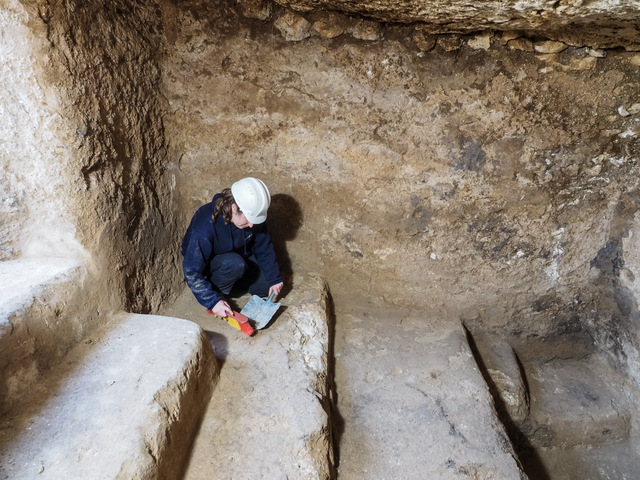
Students Unearth a 2000-Year-Old Jewish Settlement near Bet Shemesh


Photo: Assaf Peretz

 
Some 240 eleventh-grade students from Jerusalem’s Boyer High School have discovered an original and rewarding way of reducing their travel costs to Poland: Working for an entire week on archaeological excavations at Ramat Bet Shemesh, far from their computers and air-conditioned classroom


The students have been involved in unearthing exciting archaeological finds at the site. In recent months, the remains of a Jewish settlement dating to the Second Temple period at the site have been found to include an extensive complex of ritual baths and underground hiding refuges. The excavations are being carried out with funding provided by the Ministry of construction and Housing prior to the building of a new residential neighborhood in Ramat Bet Shemesh, in cooperation with the Israel Antiquities Authority and with the participation of pre-army course cadets.
The settlement, whose ancient name is unknown, has so far yielded eight ritual baths, cisterns, and hiding refuges, along with rock-hewn industrial installations. The houses themselves have not survived and their stones were taken to construct buildings in later periods. 


According to Sarah Hirshberg, Shua Kisilevitz and Sarah Levevi-Eilat, excavation directors on behalf of the Israel Antiquities Authority, “The settlement’s extraordinary significance lies in its imposing array of private ritual baths, which were incorporated in the residential buildings. Each household had its own ritual bath and a cistern. Some of the baths uncovered are simple and others are more complex and include an otzar, or collecting basin, into which the rainwater would drain. It is interesting to note that the local inhabitants adhered strictly to the rules regarding purity and impurity.” 

Underneath the dwellings and rock-hewn installations, another surprising discovery was unearthed, dating to the time of the Bar Kokhba Revolt (second century CE)—a winding labyrinth of hiding refuges connected to sophisticated and elaborate complexes. In some of the underground complexes, the rebels breached a cistern to provide those in hiding with access to water. One of the caves also yielded intact ceramic jars and cooking pots that were probably used by the rebels. The finds show that the settlement continued to exist even after the destruction of Jerusalem in 70 CE.

Minister of Construction and Housing, Yoav Galant: “Past and present are coming together in a city that has known division and now lives in harmony. We will soon be signing a roof agreement with Bet Shemesh to ensure future development. There is nothing more positive than the fact that students learning about the attempt to annihilate their people are involved in strengthening our ties with Israel and remembering the generations of the past.”


Background information on ritual baths: 


In antiquity, Judaism was already unique in its strict adherence to bodily cleanliness, as commanded in the Bible: “And bathe his body in water, and he shall be clean” (Leviticus 14:9). The act of bathing for purification purposes is also referred to in Hebrew as tvila, or ‘immersion’. During the Hasmonean period (second century BCE) there was an increased emphasis on observing purity (“ritual purity was widespread in Israel” – Tosefta, Tractate Shabbat 1:14) and a detailed code of religious laws was compiled to implement the biblical commandments in everyday life. It was during this period that special water installations, or ritual baths, began to be used for immersion.

The ritual bath is a water installation that is unique to the people of Israel. In order to fulfill their religious and spiritual purpose and cleanse a person of any impurities, the baths were installed according to Jewish religious rules. The bath has to be hewn in the bedrock or connected to the ground; it must be sealed so that its water will not seep out; and only rainwater or spring water must be used, as opposed to ‘drawn’ water.


Wednesday, March 29, 2017

Settled villages made ecological impact long before agriculture


Long before the advent of agriculture, hunter-gatherers began putting down roots in the Middle East, building more permanent homes and altering the ecological balance in ways that allowed the common house mouse to flourish, new research in the Proceedings of the National Academy of Sciences indicates.
"The research provides the first evidence that, as early as 15,000 years ago, humans were living in one place long enough to impact local animal communities -- resulting in the dominant presence of house mice," said Fiona Marshall, study co-author and a professor of anthropology at Washington University in St. Louis. "It's clear that the permanent occupation of these settlements had far-reaching consequences for local ecologies, animal domestication and human societies."
Marshall, a noted expert on animal domestication, considers the research exciting because it shows that settled hunter-gatherers rather than farmers were the first people to transform environmental relations with small mammals. By providing stable access to human shelter and food, hunter-gatherers led house mice down the path to commensalism, an early phase of domestication in which a species learns how to benefit from human interaction.
The findings have broad implications for the processes that led to animal domestication.
"The findings provide clear evidence that the ways humans have shaped the natural world are tied to varying levels of human mobility," said Marshall, the James W. and Jean L. Davis Professor in Arts & Sciences. "They suggest that the roots of animal domestication go back to human sedentism thousands of years prior to what has long been considered the dawn of agriculture."
Led by Thomas Cucchi of National Center for Scientific Research in Paris, France, and Lior Weissbrod of the University of Haifa in Israel, the study set out to explain large swings in the ratio of house mice to wild mice populations found during excavations of different prehistoric periods at an ancient Natufian hunter-gatherer site in the Jordan Valley of Israel.
Examining tiny species-related variations in the molar shapes of fossilized mice teeth dating back as far as 200,000 years, the team built a timeline showing how the populations of different mice fluctuated at the Natufian site during periods of varying human mobility.
The analysis revealed that human mobility influenced competitive relationships between two species of mice -- the house mouse (Mus musculus domesticus) and a short-tailed field mouse (M. macedonicus) -- that continue to live in and around modern settlements in Israel. These relationships are analogous to those of another pair of species called spiny mice which Weissbrod and Marshall discovered among semi-nomadic Maasai herders in southern Kenya."
Findings indicate that house mice began embedding themselves in the Jordan Valley homes of Natufian hunter-gatherers about 15,000 years ago, and that their populations rose and fell based on how often these communities picked up and moved to new locations.
When humans stayed in the same places for long runs of time, house mice out-competed their country cousins to the point of pushing most of them outside the settlement. In periods where drought, food shortages or other conditions forced hunter-gatherers to relocate more often, the populations of house mice and field mice reached a balance similar to that found among modern Maasai herders with similar mobility patterns.
The study confirms that house mice were already a fixture in the domiciles of eastern Mediterranean hunter-gatherer villages more than 3,000 years before the earliest known evidence for sedentary agriculture.
It suggests that the early hunter-gatherer settlements transformed ecological interactions and food webs, allowing house mice that benefited from human settlements to out-compete wild mice and establish themselves as the dominant population.
"The competition between commensal house mice and other wild mice continued to fluctuate as humans became more mobile in arid periods and more sedentary at other times -- indicating the sensitivity of local environments to degrees of human mobility and the complexity of human environmental relationships going back in the Pleistocene," said Weissbrod, currently a research fellow at the Zinman Institute of Archaeology at the University of Haifa.
Weissbrod's research involves analysis of microvertebrate remains from a wide range of prehistoric and historic sites in Israel and the Caucasus dealing with paleoecology and human-ecosystem interactions.
A 2010 graduate of the doctoral program in archaeological anthropology at Washington University, he began research for this study as part of a dissertation examining fluctuations in populations of mice and other small animals living around Maasai cattle herding settlements in Kenya.
Marshall helped Weissbrod to develop the ethnographic context for underlying research questions about the ecological impact of human mobility. Together they built field-based ecological frameworks for understanding changing animal human interactions through time focusing on mice and donkeys.
Working from his lab in Paris, Cucchi used a new technique called geometric morphometrics to identify the mouse fossils and reliably distinguish telltale differences in the miniscule remains of house mice and wild species. The method relies on high resolution imaging and digital analysis to categorize species-related variations in molar outlines nearly as thin as a single millimeter.
The findings, and the techniques used to document them, are important to archaeological research in a broader sense because they lend further support to the idea that fluctuations in ancient mouse populations can be used as a proxy for tracking ancient shifts in human mobility, lifestyle and food domestication.
"These findings suggest that hunter-gatherers of the Natufian culture, rather than later Neolithic farmers, were the first to adopt a sedentary way of life and unintentionally initiated a new type of ecological interaction -- close coexistence with commensal species such as the house mouse," Weissbrod said. "The human dynamic of shifts between mobile and sedentary existence was unraveled in unprecedented detail in the record of fluctuations in proportions of the two species through time."

Thursday, March 23, 2017

Farmers in Roman Empire converted to Hun lifestyle -- and vice versa


Marauding hordes of barbarian Huns, under their ferocious leader Attila, are often credited with triggering the fall of one of history's greatest empires: Rome.

Historians believe Hunnic incursions into Roman provinces bordering the Danube during the 5th century AD opened the floodgates for nomadic tribes to encroach on the empire. This caused a destabilisation that contributed to collapse of Roman power in the West.

According to Roman accounts, the Huns brought only terror and destruction. However, research from the University of Cambridge on gravesite remains in the Roman frontier region of Pannonia (now Hungary) has revealed for the first time how ordinary people may have dealt with the arrival of the Huns.

Biochemical analyses of teeth and bone to test for diet and mobility suggest that, over the course of a lifetime, some farmers on the edge of empire left their homesteads to become Hun-like roaming herdsmen, and consequently, perhaps, took up arms with the tribes.

Other remains from the same gravesites show a dietary shift indicating some Hun discovered a settled way of life and the joys of agriculture -- leaving their wanderlust, and possibly their bloodlust, behind.

Lead researcher Dr Susanne Hakenbeck, from Cambridge's Department of Archaeology, says the Huns may have brought ways of life that appealed to some farmers in the area, as well learning from and settling among the locals. She says this could be evidence of the steady infiltration that shook an empire.

"We know from contemporary accounts that this was a time when treaties between tribes and Romans were forged and fractured, loyalties sworn and broken. The lifestyle shifts we see in the skeletons may reflect that turmoil," says Hakenbeck.

"However, while written accounts of the last century of the Roman Empire focus on convulsions of violence, our new data appear to show some degree of cooperation and coexistence of people living in the frontier zone. Far from being a clash of cultures, alternating between lifestyles may have been an insurance policy in unstable political times."

For the study, published today in the journal PLOS ONE, Hakenbeck and colleagues tested skeletal remains at five 5th-century sites around Pannonia, including one in a former civic centre as well as rural homesteads.

The team analysed the isotope ratios of carbon, nitrogen, strontium and oxygen in bones and teeth. They compared this data to sites in central Germany, where typical farmers of the time lived, and locations in Siberia and Mongolia, home to nomadic herders up to the Mongol period and beyond.

The results allowed researchers to distinguish between settled agricultural populations and nomadic animal herders in the former Roman border area through isotopic traces of diet and mobility in the skeletons.

All the Pannonian gravesites not only held examples of both lifestyles, but also many individuals that shifted between lifestyles in both directions over the course of a lifetime. "The exchange of subsistence strategies is evidence for a way of life we don't see anywhere else in Europe at this time," says Hakenbeck.

She says there are no clear lifestyle patterns based on sex or accompanying grave goods, or even 'skull modification' - the binding of the head as a baby to create a pointed skull - commonly associated with the Hun.

"Nomadic animal herding and skull modification may be practices imported by Hun tribes into the bounds of empire and adopted by some of the agriculturalist inhabitants."

The diet of farmers was relatively boring, says Hakenbeck, consisting primarily of plants such as wheat, vegetables and pulses, with a modicum of meat and almost no fish.

The herders' diet on the other hand was high in animal protein and augmented with fish. They also ate large quantities of millet, which has a distinctive carbon isotope ratio that can be identified in human bones. Millet is a hardy plant that was hugely popular with nomadic populations of central Asia because it grows in a few short weeks.

Roman sources of the time were dismissive of this lifestyle. Ammianus Marcellinus, a Roman official, wrote of the Hun that they "care nothing for using the ploughshare, but they live upon flesh and an abundance of milk."

"While Roman authors considered them incomprehensibly uncivilised and barely human, it seems many of citizens at the edge of Rome's empire were drawn to the Hun lifestyle, just as some nomads took to a more settled way of life," says Hakenbeck.

However, there is one account that hints at the appeal of the Hun, that of Roman politician Priscus. While on a diplomatic mission to the court of Attila, he describes encountering a former merchant who had abandoned life in the Empire for that of the Hun enemy as, after war, they "live in inactivity, enjoying what they have got, and not at all, or very little, harassed.