Tuesday, December 6, 2016
Plant-based menu of prehistoric man
A tiny grape pip (scale 1mm), left on the ground some 780,000 years ago, is one of more than 9,000 remains of edible plants discovered in an old Stone Age site in Israel on the shoreline of Lake Hula in the northern Jordan valley, dating back to the Acheulian culture from 1.75-0.25 million years ago. The floral collection provides rich testimony of the plant-based diet of our prehistoric ancestors.
While around the world remains of Paleolithic plants are scarce, this unique macro-botanical assemblage has allowed researchers from the Hebrew University of Jerusalem and Bar Ilan University to study the vegetal diet of humans from early-mid-Pleistocene, which is central to understanding the evolution, adaptation and exploitation of the environment by hominins.
The findings were recovered during archeological excavations at the waterlogged site of Gesher Benot Ya'aqov, where the earliest evidence of human-controlled fire in western Asia was discovered in recent years.
Prof. Naama Goren-Inbar of the Institute of Archeology at the Hebrew University of Jerusalem, who conducted the excavations with colleagues, have long studied findings of hominid occupations in the Levantine Corridor, through which several hominin waves dispersed out of Africa.
In a research paper that will be published in the Proceedings of the National Academy of Sciences (PNAS) on December 5, titled "The plant component of an Acheulian diet: a case study from Gesher Benot Ya'aqov, Israel", Prof. Goren-Inbar reveals the discovery of the ancient macrobotanical remains, which for the first time indicate to the rich variety of plant assortments and subsistence opportunities that were available to the early humans on the transition from an African-based to a Eurasian diet.
"In recent years we were met with a golden opportunity to reveal numerous remains of fruits, nuts and seeds from trees, shrubs and the lake, alongside the remains of animals and man-made stone tools in one locality," Prof. Goren-Inbar said.
Of the remains found on site, Prof. Goren-Inbar and Dr. Yoel Melamed of the Faculty of Life Sciences at Bar Ilan University have identified 55 species of edible plants, including seeds, fruits, nuts, leaves, stems, roots and tubers.
The findings, many of them minor in size, have been preserved for hundreds of thousands of years thanks to the damp conditions in the vicinity of the site, said Dr. Melamed. The basalts under and in the site were dated by Ar/Ar and the dates were further confirmed by results of paleomagnetic analyses.
"This region is known for the wealth of plants, but what surprised us were the sources of plant food coming from the lake. We found more than 10 species that existed here in prehistoric times but no longer today, such as two types of water nuts, from which seven were edible," explained Dr. Melamed.
The site was submerged under the Jordan River and the Hula Lake in conditions of humidity and lack of oxygen, aided by the fast covering of layers of sediments, in which archaeologists also found stone tools and animal fossils.
Gesher Benot Ya'aqov is also the place where Prof. Goren-Inbar found the earliest evidence of the use of fire in Eurasia (LINK). "The use of fire is very important because a lot of the plants are toxic or inedible. Using fire, like roasting nuts and roots for example, allows the use of various parts of the plant and increases the diversity of the plant component of the Acheulian diet, alongside aquatic and terrestrial fauna," said Prof. Goren-Inbar.
The use of fire and the availability of a diverse range of flora highlight the ability of prehistoric man to adjust to a new environment, to exploit the environment for his own benefit and to colonize beyond Africa.

Neolithic Syrians were first to domesticate cereals
11,000 years ago, a Syrian community began a practice which would change man's relationship with his surroundings forever: the initiation of cereal domestication and, with it, the commencement of agriculture, a process which lasted several millennia. The discoveries, made at the Tell Qarassa North archaeological site, situated near the city of Sweida in Syria, are the oldest evidence of the domestication of three species of cereal: one of barley and two of wheat (spelt and farrow).
The team from the Spanish National Research Council (CSIC) and the Universities of Cantabria and the Basque Country (both in northern Spain) was led by CSIC's Juan José Ibáñez, and excavated in the area between 2009 and 2010. Scientific investigators from the Universities of Copenhagen and London also collaborated in the study which is published in the latest edition of the magazine Proceedings of the National Academy of Sciences (PNAS).
The Neolithic man in question lived at a time of huge changes. They gathered wild wheat and barley and gradually began the process of domesticating them. That is to say, they began to build a local economy based around controlling the reproduction of the foods they ate.
The origins of agriculture
Although it was already known that cereal breeding took place in the Near East, it was not known whether the first domesticated cereals appeared in one region or in several regions simultaneously, or, if the first case were true, in which region. "The process began when hunter gatherer communities started collecting wild cereals, leading in turn to these wild cereals being sown, then reaped using sickles. This initial crop husbandry led to the selective breeding of cereal grains. Gradually, domestic traits became more and more dominant", explains Ibañez.
To be precise, it is this work at Tell Qarrassa which allows samples of cereals from the very first phase in the domestication process to be identified. Of all the cereals which were grown at the site, around 30% show domestic traits whilst the remainder continue to show traits which are characteristic of wild cereals.
"We now know that the cereals from Tell Qarassa were sown in autumn and harvested in February and March, before reaching full maturity to prevent the risk- given that they were still partially wild- of heads breaking off and being lost at harvest. The crop was cut close to the ground so as to make full use of the straw and, once collected, it would be thrashed and the grain cleaned in the courtyards outside their homes before being stored inside. Prior to being eaten, the grain was crushed in a mortar and pestle then ground in hand mills", explains the CSIC investigator.
The information obtained at Tell Qarassa shows both the advanced level of technical development of these first farming communities and also that the domestication process of cereals unfolded at varying rates in the different regions of the Near East. "It has yet to be discovered whether the later appearance of domesticated cereals in these regions was due to the use of those cereals originating in the south of Syria which we have been studying, or whether other independent domestication processes took place elsewhere", concludes Ibañez.
Friday, December 2, 2016
Bitumen from Middle East discovered in 7th century buried ship in UK
Middle Eastern Bitumen, a rare, tar-like material, is present in the seventh century ship buried at Sutton Hoo, according to a study published in the open-access journal PLOS ONE on December 01, 2016 by Pauline Burger and colleagues from the British Museum, UK and the University of Aberdeen.
The seventh century ship found within a burial mound at Sutton Hoo, UK was first excavated in 1939 and is known for the spectacular treasure it contained including jewellery, silverware, coins, and ceremonial armour. The site is thought to be an example of the European ship-burial rites of the time, and also includes a burial chamber where a corpse was likely laid. Fragments of black organic material found in this chamber were originally identified as locally-produced 'Stockholm Tar' and linked to repair and maintenance of the ship. The authors of the present study re-evaluated these previously-identified samples, as well as other tar-like materials found at the site, using imaging techniques and isotopic analysis and found the samples had been originally misidentified.
By comparing the samples from Sutton Hoo to various reference materials, the researchers' analysis revealed that the previously-identified 'Stockholm Tar' lumps actually displayed the molecular and isotopic characteristics of archaeological bitumen, and specifically bitumen from the Middle East rather than from a local British source. Archaeological finds of bitumen from this period in Britain are extremely rare and the authors state that this finding is the first material evidence for trading of Middle Eastern bitumen northwards into the British Isles.
While the original form and purpose of the bitumen could not be discerned from the remaining fragments, the authors suggest that it may have been included deliberately in the burial chamber, possibly the remaining components of ornamental objects adorning the grave, or perhaps included as a prestigious raw material.
Wednesday, November 30, 2016
Analysis of Iron Age ceramics suggests complex pattern of Eastern Mediterranean trade
Cypriot-style pottery may have been locally produced as well as imported and traded in Turkey during the Iron Age, according to a study published November 30, 2016 in the open-access journal PLOS ONE by Steven Karacic from Florida State University, USA, and James Osborne of the University of Chicago, USA.
White Painted and Bichrome Wares are Cypriot-style ceramics produced during the Iron Age that may provide clues about trade in the Eastern Mediterranean at that time. Although these ceramics are often assumed to be imports from Cyprus, excavations in southern Turkey have suggested that some pottery was produced locally, challenging previous assumptions about trade in the Eastern Mediterranean.
The authors of the present study analyzed White Painted and Bichrome Wares recovered from three sites in the Hatay region of Turkey: Tell Tayinat, Çatal Höyük, and Tell Judaidah, using techniques which bombarded the pottery with x-rays and neutrons, providing insight into the chemical elements they contained. Imported and local versions of this pottery had different elemental compositions, which helped the authors determine where this pottery was produced. When compared with existing datasets, the researchers found that Çatal Höyük and Tell Judaidah may only have had access to pottery imported from Cyprus whereas Tell Tayinat may have made Cypriot-style pottery locally as well as importing it.
The authors suggest that feasting practices amongst the affluent in Tell Tayinat may have driven demand for Cypriot-style pottery, resulting in either local potters producing this pottery or Cypriot potters settling in the vicinity. Usually, pottery styles are expected to become increasingly rare the further away they are found from their origin of production, so these findings suggest a complex pattern of exchange in the Eastern Mediterranean during the Iron Age.
"We were surprised to find that locally produced Cypriot-style pottery was consumed at Tell Tayinat but not the other sites included in our study," says Karacic. "These results indicate complex social and economic interactions between the Amuq and Cyprus that we are only just beginning to understand for the Iron Age."
Saturday, November 26, 2016
Early America: Evidence of original 1620 Plymouth settlement discovered

Students with the remains of Constance the calf.
Credit: Image courtesy of University of Massachusetts Boston
Three hundred and ninety-five years after Pilgrims celebrated the first Thanksgiving in Plymouth, Massachusetts, researchers from UMass Boston's Andrew Fiske Memorial Center for Archaeological Research can say they have definitively discovered evidence of the original 1620 Plymouth settlement. Part of the proof involves a calf that UMass Boston students have affectionately named Constance.
For the fourth summer, David Landon, associate director of the Fiske Center, led a group of undergraduate and graduate students in a field school in Plymouth offered through UMass Boston's College of Advancing and Professional Studies. Landon and the students spent five weeks on Burial Hill looking for the site of the original Pilgrim settlement. Landon's goal when he started was to find evidence of the original settlement prior to the 400th anniversary of the founding of the Plymouth Colony in 2020. He met his goal four years early, in the first year of a three-year, $200,000 National Endowment for the Humanities (NEH) grant.
Because the original structures weren't built with bricks, the research team couldn't look for foundations. Rather, they had to look for "post and ground construction" -- basically holes for wood, and dirt.
"While we're digging, we're constantly in the process of trying to interpret what we're finding. It really goes to just moving slowly and trying to see if there are any patterns in the flow that we can map out. As soon as that starts, it becomes a slow process. It's about much more than the artifacts -- it's about trying to pin down soil color and trying to understand constructed features that are no longer there," Landon said.
But then Landon's team did start finding 17th century artifacts: 17th century pottery, tins, trade beads, and musket balls -- around that post and ground construction. Landon says the students and researchers were at this point cautiously optimistic that they had found a location inside the settlement walls. And then they found "Constance" -- a calf buried whole in the bottom-most pit. Because native people didn't have domestic cattle, Landon says we know that she lived -- and died -- in the confines of the original Plymouth settlement.
"Constance is a great symbol of this. Oftentimes success in the colony depended on herds of cattle. It became a centerpiece of the economy. So the calf does connect us to that story," Landon said.
Kathryn Ness is the curator of collections at Plimoth Plantation, UMass Boston's partner in this project. She says this discovery is huge.
"Finding evidence of colonial activity inside the original 1620 Plymouth settlement is an incredibly exciting discovery that has the potential to change dramatically our understanding of early European colonization in New England. For the first time, we have proof of where the settlement was located and what kinds of items the Pilgrims owned and used," Ness said. "At Plimoth Plantation, the team's findings will help us further refine our exhibits, as we use archaeological evidence and historical documents as the basis for our portrayal of the past and to ensure that our buildings, activities, and reproduction objects are as accurate as possible. We are looking forward to learning more about their discoveries and seeing what they find next season!"
Landon and more students and researchers will be back next summer.
"We've opened the first window but we want a bigger view. We want the bay window. We want to see if we can find other components," Landon said.
For now, researchers and students are cleaning, labeling, and researching what was found this past summer. They're also going to be trying to figure out how Constance died and why she was buried, rather than eaten.
Wednesday, November 23, 2016
Israel: 3,800 Year Old Pottery Vessel with the 3-D Image of a Person
The vessel was discovered together with daggers, an axe head and arrowheads that were apparently buried as funerary offerings for one of the respected members of the ancient settlement.
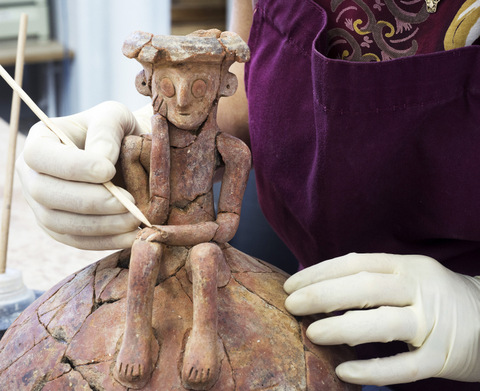
Photographer: Clara Amit
A small extraordinary jug from the Middle Bronze Age was revealed with the assistance of pupils in the Land of Israel and Archaeology matriculation stream in an Israel Antiquities Authority archaeological excavation that was recently conducted in the city of Yehud prior to the construction of residential buildings.
According to Gilad Itach, excavation director on behalf of the Israel Antiquities Authority, “It literally happened on the last day of the excavation when right in front of our eyes and those of the excited students an unusual ceramic vessel c. 18 cm high was exposed that bears the image of a person. It seems that at first the jug, which is typical of the period, was prepared, and afterwards the unique sculpture was added, the likes of which have never before been discovered in previous research. The level of precision and attention to detail in creating this almost 4,000 year old sculpture is extremely impressive. The neck of the jug served as a base for forming the upper portion of the figure, after which the arms, legs and a face were added to the sculpture. One can see that the face of the figure seems to be resting on its hand as if in a state of reflection”. Itach added, “It is unclear if the figure was made by the potter who prepared the jug or by another craftsman”.
Efrat Zilber, supervisor responsible for coordinating the Land of Israel and Archaeology matriculation stream in the Ministry of Education emphasized that “the archaeological excavations provide an opportunity for an intensive and direct experience that connects the pupils with our country’s past. An experiential learning experience involving research methods employed in archaeology takes place while revealing the artifacts. The pupils meet experts in a variety of fields who share their knowledge with them, enrich the pupils while also enriching their world”.
In addition to the unique pottery vessel, other vessels and metal items were found such as daggers, arrowheads, an axe head, sheep bones and what are very likely the bones of a donkey. According to Itach, “It seems that these objects are funerary offerings that were buried in honor of an important member of the ancient community. It was customary in antiquity to believe that the objects that were interred alongside the individual continued with him into the next world. To the best of my knowledge such a rich funerary assemblage that also includes such a unique pottery vessel has never before been discovered in the country”.
In addition, a variety of evidence regarding the kind of life that existed there 6,000 years ago was exposed – among other things, pits and shafts were revealed that contained thousands of fragments of pottery vessels, hundreds of flint and basalt implements, animal bones, and a churn which is a unique vessel that was widely used in the Chalcolithic period for making butter.
Monday, November 21, 2016
Native Americans raised classic holiday bird
Hundreds of years before the first Thanksgiving, Native Americans were raising and feasting on America's classic holiday meal.
Florida State University Associate Professor of Anthropology Tanya Peres and graduate student Kelly Ledford write in a paper published today in the Journal of Archaeological Science: Reports that Native Americans as early as 1200 - 1400 A.D. were managing and raising turkeys.
This is the first time scientists have suggested that turkeys were potentially domesticated by early Native Americans in the southeastern United States.
"In the Americas, we have just a few domesticated animals," Peres said. "Researchers haven't really talked about the possibility of Native Americans domesticating or raising turkeys."
Researchers knew that turkeys had been a part of Native American life long before the first Thanksgiving in 1621.
Their feathers were used on arrows, in headdresses and clothing. The meat was used for food. Their bones were used for tools including scratchers used in ritual ceremonies. There are even representations of turkeys in artifacts from the time. An intricately engraved marine shell pendant found at a site in central Tennessee shows two turkeys facing each other.
But this new research indicates turkeys were more than just a casual part of life for Native Americans of that era. Peres and Ledford came across a few curiosities as they examined skeletons of turkeys from archaeological sites in Tennessee that led them to believe that Native Americans were actively managing these fowls.
For one, the groupings researchers worked on had more male turkeys than a typical flock.
In a typical flock of turkeys, there are usually more females, Peres said. But in the flock they examined, they found more remains of males. That would only happen if it were designed that way, she said.
"It appears Native Americans were favoring males for their bones for tools," Peres said. "And they certainly would have favored males for their feathers. They tend to be much brighter and more colorful than the female species. Female feathers tend to be a dull grey or brown to blend in to their surroundings since they have to sit on the nest and protect the chicks."
The other immediately noticeable trait that stood out to Peres and Ledford was that these ancient American gobblers were big boned -- much larger than today's average wild turkey. That could be the result of them being purposefully cared for or fed diets of corn.
"The skeletons of the archaeological turkeys we examined were quite robust in comparison to the skeletons of our modern comparatives," Ledford said. "The domestication process typically results in an overall increase in the size of the animal so we knew this was a research avenue we needed to explore."
Peres and Ledford are working with colleagues at Washington State University to perform a DNA sequencing of these turkeys and also conduct experiments to see what the turkeys were eating. If they were being fed corn, a chemical signature should appear in the remains.
Ledford is also collecting data from additional sites across the southeastern United States to see if this pattern of managing turkeys was consistent across settlements or if it was an isolated practice.
"It might be that not everybody was practicing this, but some people were for sure," Peres said.
Subscribe to:
Posts (Atom)