Thursday, June 18, 2015
A Rare Inscription from the Time of King David was Discovered in the Valley of Elah
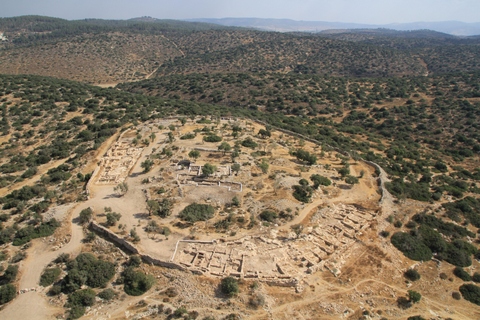
Photographic credit: Tal Rogovsky
A rare inscription from the time of King David was discovered at Khirbet Qeiyafain the Valley of Elah. A ceramic jar c. 3,000 years old that was broken into numerous sherds was discovered in 2012 in excavations carried out there by Prof. Yosef Garfinkel of the Institute of Archaeology of the Hebrew University and Saar Ganor of the Israel Antiquities Authority. Letters written in ancient Canaanite script could be discerned on several of the sherds, sparking the curiosity of researchers.
Intensive restoration work conducted in the laboratories of the Israel Antiquities Authority Artifacts Treatment Department, during which hundreds of pottery sherds were glued together to form a whole jar, solved the riddle – the jar was incised with the inscription: Eshbaʽal Ben Badaʽ. Dr. Mitka Golub and Dr. Haggai Misgav were among the team of researchers involved in deciphering the text.
According to Professor Yosef Garfinkel of the Institute of Archaeology of the Hebrew University and Saar Ganor of the IAA, "This is the first time that the name Eshbaʽal has appeared on an ancient inscription in the country. Eshbaʽal Ben Shaul, who ruled over Israel at the same time as David, is known from the Bible. Eshbaʽal was murdered by assassins and decapitated and his head was brought to David in Hebron (II Samuel, Chaps. 3-4).
It is interesting to note that the name Eshbaʽal appears in the Bible, and now also in the archaeological record, only during the reign of King David, in the first half of the tenth century BCE. This name was not used later in the First Temple period.The correlation between the biblical tradition and the archaeological finds indicates this was a common name only during that period. The name Bedaʽ is unique and does not occur in ancient inscriptions or in the biblical tradition."
According to the researchers, the fact that the name Eshbaʽal was incised on a jar suggests that he was an important person. He was apparently the owner of a large agricultural estate and the produce collected there was packed and transported in jars that bore his name. This is clear evidence of social stratification and the creation of an established economic class that occurred at the time of the formation of the Kingdom of Judah.
Garfinkel and Ganor add, "In II Samuel there was apparently reluctance to use the name Eshbaʽal, which was reminiscent of the Canaanite storm god Baʽal, and the original name was therefore changed to Ish-Bashat, but the original name of Eshbaʽal was preserved in the Book of Chronicles. Thus, for example, the name of the warlord Gideon Ben Joash was also changed from Jerrubaal to Jerubesheth."
Khirbet Qeiyafais identified with the biblical city Shaʽarayim. During several seasons of excavations directed by Prof. Yosef Garfinkel and Saar Ganor, a fortified city, two gates, a palace and storerooms, dwellings and cultic rooms were exposed there. The city dates from the time of David, that is, the late eleventh and early tenth centuries BCE. Unique artifacts that were previously unknown were discovered at the site. For example, in 2008 the world’s earliest Hebrew inscription was uncovered there. Now, another inscription from the same period is being published from the site.
According to Garfinkel and Ganor,"Until about five years ago we knew of no inscriptions dating to the tenth century BCE from the Kingdom of Judah. In recent years four inscriptions have been published: two from Khirbet Qeiyafa, one from Jerusalem and one from Bet Shemesh. This completely changes our understanding of the distribution of writing in the Kingdom of Judah and it is now clear that writing was far more widespread than previously thought. It seems that the organization of the kingdom required a cadre of clerks and writers and their activity is also manifested in the appearance of inscriptions. "
Wednesday, June 17, 2015
Direct evidence of what early Palaeolithic people ate and the quality of the air they breathed
Most dentists recommend a proper teeth cleaning every six months to prevent, among other things, the implacable buildup of calculus or tartar -- hardened dental plaque. Routine calculus buildup can only be removed through the use of ultrasonic tools or dental hand instruments. But what of 400,000-year-old dental tartar?
Tel Aviv University researchers, in collaboration with scholars from Spain, the U.K. and Australia, have uncovered evidence of food and potential respiratory irritants entrapped in the dental calculus of 400,000-year-old teeth at Qesem Cave near Tel Aviv, the site of many major discoveries from the late Lower Paleolithic period. The research provides direct evidence of what early Palaeolithic people ate and the quality of the air they breathed inside Qesem Cave.
Possible respiratory irritants, including traces of charcoal found in the dental calculus, may have resulted from smoke inhalation from indoor fires used for roasting meat on a daily basis. This earliest direct evidence for inhaled environmental pollution may well have had a deleterious effect on the health of these early humans.
"Human teeth of this age have never been studied before for dental calculus, and we had very low expectations because of the age of the plaque," said Prof. Gopher. "However, our international collaborators, using a combination of methods, found many materials entrapped within the calculus. Because the cave was sealed for 200,000 years, everything, including the teeth and its calculus, were preserved exceedingly well."
In what Prof. Barkai describes as a "time capsule," the analysed calculus revealed three major findings: charcoal from indoor fires; evidence for the ingestion of essential plant-based dietary components; and fibers that might have been used to clean teeth or were remnants of raw materials.
"Prof. Karen Hardy published outstanding research on the dental calculus of Neanderthals from El Sidron cave in Spain, but these dated back just 40,000-50,000 years -- we are talking far earlier than this," said Prof. Barkai.
"This is the first evidence that the world's first indoor BBQs had health-related consequences," said Prof. Barkai. "The people who lived in Qesem not only enjoyed the benefits of fire -- roasting their meat indoors -- but they also had to find a way of controlling the fire -- of living with it.
"This is one of the first, if not the first, cases of manmade pollution on the planet. I live near power plants, near chemical factories. On the one hand, we are dependent on technology, but on the other, we are inhaling its pollutants. Progress has a price -- and we find possibly the first evidence of this at Qesem Cave 400,000 years ago."
The researchers also found minute traces of essential fatty acids, possibly from nuts or seeds, and small particles of starch in the analysed calculus. "We know that the cave dwellers ate animals, and exploited them entirely," said Prof. Barkai. "We know that they hunted them, butchered them, roasted them, broke their bones to extract their marrow, and even used the butchered bones as hammers to shape flint tools. Now we have direct evidence of a tiny piece of the plant-based part of their diet also, in addition to the animal meat and fat they consumed.
"We have come full circle in our understanding of their diet and hunting and gathering practices."
Within the calculus, the researchers also discovered small plant fibers, which they suspect may have been used to clean teeth -- prehistoric tooth picks.
"Our findings are rare -- there is no other similar discovery from this time period," said Prof. Barkai. "The charcoal and starch findings give us a more comprehensive idea of how these people lived their lives -- and this broader view came directly from their teeth."
Thursday, June 11, 2015
When modern Eurasia was born
Was it a massive migration? Or was it rather a slow and persistent seeping of people, items and ideas that laid the foundation for the demographic map of Europe and Central Asia that we see today? The Bronze Age (about 5,000 - 3,000 years ago) was a period with large cultural upheavals. But just how these upheavals came to be have remained shrouded in mystery.
Assistant Professor Morten Allentoft from the Centre for GeoGenetics at the Natural History Museum of Denmark at the University of Copenhagen is a geneticist and is first author on the paper in Nature. He says:
- Both archaeologists and linguists have had theories about how cultures and languages have spread in our part of the world. We geneticists have now collaborated with them to publish an explanation based on a record amount of DNA-analyses of skeletons from the Bronze Age.
So far the archaeologists have been divided into two different camps. Professor Kristian Kristiansen of the University of Gothenburg, who initiated the project together with Lundbeck Foundation Professor Eske Willerslev says:
- The driving force in our study was to understand the big economical and social changes that happened at the beginning of the third millennium BC, spanning the Urals to Scandinavia. The old Neolithic farming cultures were replaced by a completely new perception of family, property and personhood. I and other archaeologists share the opinion that these changes came about as a result of massive migrations.
With this new investigation the researchers confirm that the changes came about as a result of migrations. The researchers think that this is interesting also because later developments in the Bronze Age are a continuation of this new social perception. Things add up because the migrations can also explain the origin of the northern European language families. Both language and genetics have been with us all the way up to the present. Kristian Kristiansen even thinks that it was crucial events that happened during these few centuries, as crucial as the colonization of the Americas.
One of the main findings from the study is how these migrations resulted in huge changes to the European gene-pool, in particular conferring a large degree of admixture on the present populations. Genetically speaking, ancient Europeans from the time post these migrations are much more similar to modern Europeans than those prior the Bronze Age.
Mobile warrior people
The re-writing of the genetic map began in the early Bronze Age, about 5,000 years ago. From the steppes in the Caucasus, the Yamnaya Culture migrated principally westward into North- and Central Europe, and to a lesser degree, into western Siberia. Yamnaya was characterized by a new system of family and property. In northern Europe the Yamnaya mixed with the Stone Age people who inhabited this region and along the way established the Corded Ware Culture, which genetically speaking resembles present day Europeans living north of the Alps today.
Later, about 4,000 years ago the Sintashta Culture evolved in the Caucasus. This culture's sophisticated new weapons and chariots were rapidly expanding across Europe. The area east of the Urals and far into Central Asia was colonized around 3,800 years ago by the Andronovo Culture. The researchers' investigation shows that this culture had a European DNA-background.
During the last part of the Bronze Age, and at the beginning of the Iron Age, East Asian peoples arrived in Central Asia. Here it is not genetic admixture we see, but rather a replacement of genes. The European genes in the area disappear.
A new scale
These new results derive from DNA-analyses of skeletons excavated across large areas of Europe and Central Asia, thus enabling these crucial glimpses into the dynamics of the Bronze Age. In addition to the population movement insights, the data also held other surprises. For example, contrary to the research team's expectations, the data revealed that lactose tolerance rose to high frequency in Europeans, in comparison to prior belief that it evolved earlier in time (5,000 - 7,000 years ago). Co-author and Associate Professor Martin Sikora from the Centre for GeoGenetics says:
- Previously the common belief was that lactose tolerance developed in the Balkans or in the Middle East in connection with the introduction of farming during the Stone Age. But now we can see that even late in the Bronze Age the mutation that gives rise to the tolerance is rare in Europe. We think that it may have been introduced into Europe with the Yamnaya herders from Caukasus but that the selection that has made most Europeans lactose tolerant has happened at a much later time.
The paper in Nature not only gives us a new glimpse into the Bronze Age. It is also the first time an actual population evolutionary study back in time has been made to this extent. Geneticist and director of the Centre for GeoGenetics Eske Willerslev elaborates:
- Our study is the first real large-scale population genomic study ever undertaken on ancient individuals. We analysed genome sequence data from 101 past individuals. This is more than a doubling of the number of genomic sequenced individuals of pre-historic man generated to date. The study is without any comparison to anything previously made. The results show that the genetic composition and distribution of peoples in Europe and Asia today is a surprisingly late phenomenon - only a few thousand years old.
Thursday, May 28, 2015
Out of Africa via Egypt
New research suggests that European
and Asian (Eurasian) peoples originated when early Africans moved north -
through the region that is now Egypt - to expand into the rest of the world.
The findings, published in the American Journal of Human Genetics,
answer a long-standing question as to whether early humans emerged from Africa
by a route via Egypt, or via Ethiopia.
The extensive public catalogue of the
genetic diversity in Ethiopian and Egyptian populations developed for the
project also now provides a valuable, freely available, reference panel for
future medical and anthropological studies in these areas.
Two geographically plausible routes
have been proposed for humans to emerge from Africa: through the current Egypt
and Sinai (Northern Route), or through Ethiopia, the Bab el Mandeb strait and
the Arabian Peninsula (Southern Route). Some lines of evidence have previously
favoured one, some the other.
"The most exciting consequence
of our results is that we draw back the veil that has been hiding an episode in
the history of all Eurasians, improving the understanding of billions of people
of their evolutionary history," says Dr Luca Pagani, first author from the
Wellcome Trust Sanger Institute and University of Cambridge. "It is
exciting that, in our genomic era, the DNA of living people allows us to
explore and understand events as ancient as 60,000 years ago."
The team produced whole-genome
sequences from 225 people from modern Egypt and Ethiopia. In previous studies,
they and others have shown that these modern populations have been subject to
gene flow from West Asian populations, so they excluded the Eurasian
contribution to the genomes of the modern African people.
The remaining masked genomic regions
from Egyptian samples were more similar to non-African samples and present in
higher frequencies outside Africa than the masked Ethiopian genomic regions,
pointing to Egypt as the more likely gateway in the exodus to the rest of the
world.
The team also used high-quality
genomes to estimate the time that the populations split from one another:
people outside Africa split from the Egyptian genomes more recently than from
the Ethiopians (55,000 as opposed to 65, 000 years ago), supporting the idea
that Egypt was last stop on the route out of Africa.
"While our results do not
address controversies about the timing and possible complexities of the
expansion out of Africa, they paint a clear picture in which the main migration
out of Africa followed a Northern, rather than a Southern route," says Dr
Toomas Kivisild, a senior author from the Department of Archaeology and
Anthropology, University of Cambridge.
The Northern Route as the
preferential direction taken out of Africa is in better agreement with the
known genetic mixture of all non-Africans with Neanderthals, who were present
in the Levant at the time, and with the recent discovery of early modern human
fossils in Israel (close to the Northern Route) dating to around 55,000 years
ago.
"This important study still
leaves questions to answer," says Dr Chris Tyler-Smith, a senior author
from the Wellcome Trust Sanger Institute. "For example, did other
migrations also leave Africa around this time, but leave no trace in
present-day genomes? To answer this, we need ancient genomes from populations
along the possible routes. Similarly, by adding present-day genomes from
Oceania, we can discover whether or not there was a separate, perhaps Southern,
migration to these regions.
"Our approach shows how it is possible to use the
latest genomic data and tools to answer these intriguing questions of our human
origins and migrations."
Wednesday, May 27, 2015
A Section of Ancient Jerusalem’s Lower Aqueduct was Exposed in the Eastern Jerusalem
A section of Jerusalem’s Lower Aqueduct, which conveyed water to the city more than 2,000 years ago, was exposed in the Umm Tuba quarter (near Har Homa) during the construction of a sewer line in the neighborhood by the Gihon Company. This line is just part of an extensive project directed by Zohar Yinon, CEO of the Gihon Company Ltd, to install a modern sewer system for the benefit of the residents of Umm Tuba and Sur Bahar.
The Israel Antiquities Authority conducted an archaeological excavation there following the discovery of the aqueduct. According to Ya’akov Billig, the excavation director, “The Lower Aqueduct to Jerusalem, which the Hasmonean kings constructed more than two thousand years ago in order to provide water to Jerusalem, operated intermittently until about one hundred years ago. The aqueduct begins at the ‘En ‘Eitam spring, near Solomon’s Pools south of Bethlehem, and is approximately 21 kilometers long. Despite its length, it flows along a very gentle downward slope whereby the water level falls just one meter per kilometer of distance. At first, the water was conveyed inside an open channel and about 500 years ago, during the Ottoman period, a terra cotta pipe was installed inside the channel in order to better protect the water”.
The aqueduct’s route was built in open areas in the past, but with the expansion of Jerusalem in the modern era, it now runs through a number of neighborhoods: Umm Tuba, Sur Bahar, East Talpiot and Abu Tor. Since this is one of Jerusalem’s principal sources of water, the city’s rulers took care to preserve it for some two thousand years, until it was replaced about a century ago by a modern electrically operated system. Due to its historical and archaeological importance, the Israel Antiquities Authority is taking steps to prevent any damage to the aqueduct, and is working to expose sections of its remains, study them and make them accessible to the general public.
The Umm Tuba section of the aqueduct was documented, studied, and covered up again for the sake of future generations. Other sections of the long aqueduct have been conserved for the public in the Armon Ha-Natziv tunnels, on the Sherover promenade, around the Sultan's Pool and additional projects are planned whose themes include the Lower Aqueduct.
The Israel Antiquities Authority noted favorably the professional attitude and thorough efforts on the part of the Gihon Company regarding the excavation and discovery of antiquities.
Thursday, May 21, 2015
World's oldest stone tools challenge ideas about first toolmakers
Scientists working in the desert badlands of
northwestern Kenya have found stone tools dating back 3.3 million years,
long before the advent of modern humans, and by far the oldest such
artifacts yet discovered. The tools, whose makers may or may not have
been some sort of human ancestor, push the known date of such tools back
by 700,000 years; they also may challenge the notion that our own most
direct ancestors were the first to bang two rocks together to create a
new technology.
The discovery is the first evidence that an even earlier group of
proto-humans may have had the thinking abilities needed to figure out
how to make sharp-edged tools. The stone tools mark "a new beginning to
the known archaeological record," say the authors of a new paper about
the discovery, published today in the leading scientific journal Nature.
"The whole site's surprising, it just rewrites the book on a lot of things that we thought were true," said geologist Chris Lepre of the Lamont-Doherty Earth Observatory and Rutgers University, a co-author of the paper who precisely dated the artifacts.
The tools "shed light on an unexpected and previously unknown period of hominin behavior and can tell us a lot about cognitive development in our ancestors that we can't understand from fossils alone," said lead author Sonia Harmand, of the Turkana Basin Institute at Stony Brook University and the Universite Paris Ouest Nanterre.
Hominins are a group of species that includes modern humans, Homo sapiens, and our closest evolutionary ancestors. Anthropologists long thought that our relatives in the genus Homo -- the line leading directly to Homo sapiens -- were the first to craft such stone tools. But researchers have been uncovering tantalizing clues that some other, earlier species of hominin, distant cousins, if you will, might have figured it out.
The researchers do not know who made these oldest of tools. But earlier finds suggest a possible answer: The skull of a 3.3-million-year-old hominin, Kenyanthropus platytops, was found in 1999 about a kilometer from the tool site. A K. platyops tooth and a bone from a skull were discovered a few hundred meters away, and an as-yet unidentified tooth has been found about 100 meters away.
The precise family tree of modern humans is contentious, and so far, no one knows exactly how K. platyops relates to other hominin species. Kenyanthropus predates the earliest known Homo species by a half a million years. This species could have made the tools; or, the toolmaker could have been some other species from the same era, such as Australopithecus afarensis, or an as-yet undiscovered early type of Homo.
Lepre said a layer of volcanic ash below the tool site set a "floor" on the site's age: It matched ash elsewhere that had been dated to about 3.3 million years ago, based on the ratio of argon isotopes in the material. To more sharply define the time period of the tools, Lepre and co-author and Lamont-Doherty colleague Dennis Kent examined magnetic minerals beneath, around and above the spots where the tools were found.
The Earth's magnetic field periodically reverses itself, and the chronology of those changes is well documented going back millions of years. "We essentially have a magnetic tape recorder that records the magnetic field ... the music of the outer core," Kent said. By tracing the variations in the polarity of the samples, they dated the site to 3.33 million to 3.11 million years.
Lepre's wife and another co-author, Rhoda Quinn of Rutgers, studied carbon isotopes in the soil, which along with animal fossils at the site allowed researchers to reconstruct the area's vegetation. This led to another surprise: The area was at that time a partially wooded, shrubby environment. Conventional thinking has been that sophisticated tool-making came in response to a change in climate that led to the spread of broad savannah grasslands, and the consequent evolution of large groups of animals that could serve as a source of food for human ancestors.
One line of thinking is that hominins started knapping -- banging one rock against another to make sharp-edged stones -- so they could cut meat off of animal carcasses, said paper co-author Jason Lewis of the Turkana Basin Institute and Rutgers. But the size and markings of the newly discovered tools "suggest they were doing something different as well, especially if they were in a more wooded environment with access to various plant resources," Lewis said. The researchers think the tools could have been used for breaking open nuts or tubers, bashing open dead logs to get at insects inside, or maybe something not yet thought of.
"The capabilities of our ancestors and the environmental forces leading to early stone technology are a great scientific mystery," said Richard Potts, director of the Human Origins Program at the Smithsonian's National Museum of Natural History, who was not involved in the research. The newly dated tools "begin to lift the veil on that mystery, at an earlier time than expected," he said.
Potts said he had examined the stone tools during a visit to Kenya in February.
"Researchers have thought there must be some way of flaking stone that preceded the simplest tools known until now," he said. "Harmand's team shows us just what this even simpler altering of rocks looked like before technology became a fundamental part of early human behavior."
Ancient stone artifacts from East Africa were first uncovered at Olduvai Gorge in Tanzania in the mid-20th century, and those tools were later associated with fossil discoveries in the 1960s of the early human ancestor Homo habilis. That species has been dated to 2.1 million to 1.5 million years ago.
Subsequent finds have pushed back the dates of humans' evolutionary ancestors, and of stone tools, raising questions about who first made that cognitive leap. The discovery of a partial lower jaw in the Afar region of Ethiopia, announced on March 4, pushes the fossil record for the genus Homo to 2.8 million years ago. Evidence from recent papers, the authors note, suggests that there is anatomical evidence that Homo had evolved into several distinct lines by 2 million years ago.
There is some evidence of more primitive tool use going back even before the new find. In 2009, researchers at Dikika, Ethiopia, dug up 3.39 million-year-old animal bones marked with slashes and other cut marks, evidence that someone used stones to trim flesh from bone and perhaps crush bones to get at the marrow inside. That is the earliest evidence of meat and marrow consumption by hominins. No tools were found at the site, so it's unclear whether the marks were made with crafted tools or simply sharp-edged stones. The only hominin fossil remains in the area dating to that time are from Australopithecus afarensis.
The new find came about almost by accident: Harmand and Lewis said that on the morning of July 9, 2011, they had wandered off on the wrong path, and climbed a hill to scout a fresh route back to their intended track. They wrote that they "could feel that something was special about this particular place." They fanned out and surveyed a nearby patch of craggy outcrops. "By teatime," they wrote, "local Turkana tribesman Sammy Lokorodi had helped [us] spot what [we] had come searching for."
By the end of the 2012 field season, excavations at the site, named Lomekwi 3, had uncovered 149 stone artifacts tied to tool-making, from stone cores and flakes to rocks used for hammering and others possibly used as anvils to strike on.
The researchers tried knapping stones themselves to better understand how the tools they found might have been made. They concluded that the techniques used "could represent a technological stage between a hypothetical pounding-oriented stone tool use by an earlier hominin and the flaking-oriented knapping behavior of [later] toolmakers." Chimpanzees and other primates are known to use a stone to hammer open nuts atop another stone. But using a stone for multiple purposes, and using one to crack apart another into a sharper tool, is more advanced behavior.
The find also has implications for understanding the evolution of the human brain. The toolmaking required a level of hand motor control that suggests that changes in the brain and spinal tract needed for such activity could have occurred before 3.3 million years ago, the authors said.
"This is a momentous and well-researched discovery," said paleoanthropologist Bernard Wood of George Washington University, who was not involved in the study. "I have seen some of these artifacts in the flesh, and I am convinced they were fashioned deliberately." Wood said he found it intriguing to see how different the tools are from so-called Oldowan stone tools, which up to now have been considered the oldest and most primitive.
Lepre, who has been conducting fieldwork in eastern Africa for about 15 years, said he arrived at the dig site about a week after the discovery. The site is several hours' drive on rough roads from the nearest town, located in a hot, dry landscape he said is reminiscent of Arizona and New Mexico. Lepre collected chunks of sediment from a series of depths and brought them back to Lamont-Doherty for analysis. He and Kent used a bandsaw to trim the samples into sugar cube-size blocks and inserted them into a magnetometer, which measured the polarity of tiny grains of the minerals hematite and magnetite contained in the sediment.
"The magnetics pretty much clinches that the age is something like 3.3 million years old," said Kent, who also is a professor at Rutgers.
Earlier dating work by Lepre and Kent helped lead to another landmark paper in 2011: a study that suggested Homo erectus, another precursor to modern humans, was using more advanced tool-making methods 1.8 million years ago, at least 300,000 years earlier than previously thought.
"I realized when you [figure out] these things, you don't solve anything, you just open up new questions," said Lepre. "I get excited, then realize there's a lot more work to do."

"The whole site's surprising, it just rewrites the book on a lot of things that we thought were true," said geologist Chris Lepre of the Lamont-Doherty Earth Observatory and Rutgers University, a co-author of the paper who precisely dated the artifacts.
The tools "shed light on an unexpected and previously unknown period of hominin behavior and can tell us a lot about cognitive development in our ancestors that we can't understand from fossils alone," said lead author Sonia Harmand, of the Turkana Basin Institute at Stony Brook University and the Universite Paris Ouest Nanterre.
Hominins are a group of species that includes modern humans, Homo sapiens, and our closest evolutionary ancestors. Anthropologists long thought that our relatives in the genus Homo -- the line leading directly to Homo sapiens -- were the first to craft such stone tools. But researchers have been uncovering tantalizing clues that some other, earlier species of hominin, distant cousins, if you will, might have figured it out.
The researchers do not know who made these oldest of tools. But earlier finds suggest a possible answer: The skull of a 3.3-million-year-old hominin, Kenyanthropus platytops, was found in 1999 about a kilometer from the tool site. A K. platyops tooth and a bone from a skull were discovered a few hundred meters away, and an as-yet unidentified tooth has been found about 100 meters away.
The precise family tree of modern humans is contentious, and so far, no one knows exactly how K. platyops relates to other hominin species. Kenyanthropus predates the earliest known Homo species by a half a million years. This species could have made the tools; or, the toolmaker could have been some other species from the same era, such as Australopithecus afarensis, or an as-yet undiscovered early type of Homo.
Lepre said a layer of volcanic ash below the tool site set a "floor" on the site's age: It matched ash elsewhere that had been dated to about 3.3 million years ago, based on the ratio of argon isotopes in the material. To more sharply define the time period of the tools, Lepre and co-author and Lamont-Doherty colleague Dennis Kent examined magnetic minerals beneath, around and above the spots where the tools were found.
The Earth's magnetic field periodically reverses itself, and the chronology of those changes is well documented going back millions of years. "We essentially have a magnetic tape recorder that records the magnetic field ... the music of the outer core," Kent said. By tracing the variations in the polarity of the samples, they dated the site to 3.33 million to 3.11 million years.
Lepre's wife and another co-author, Rhoda Quinn of Rutgers, studied carbon isotopes in the soil, which along with animal fossils at the site allowed researchers to reconstruct the area's vegetation. This led to another surprise: The area was at that time a partially wooded, shrubby environment. Conventional thinking has been that sophisticated tool-making came in response to a change in climate that led to the spread of broad savannah grasslands, and the consequent evolution of large groups of animals that could serve as a source of food for human ancestors.
One line of thinking is that hominins started knapping -- banging one rock against another to make sharp-edged stones -- so they could cut meat off of animal carcasses, said paper co-author Jason Lewis of the Turkana Basin Institute and Rutgers. But the size and markings of the newly discovered tools "suggest they were doing something different as well, especially if they were in a more wooded environment with access to various plant resources," Lewis said. The researchers think the tools could have been used for breaking open nuts or tubers, bashing open dead logs to get at insects inside, or maybe something not yet thought of.
"The capabilities of our ancestors and the environmental forces leading to early stone technology are a great scientific mystery," said Richard Potts, director of the Human Origins Program at the Smithsonian's National Museum of Natural History, who was not involved in the research. The newly dated tools "begin to lift the veil on that mystery, at an earlier time than expected," he said.
Potts said he had examined the stone tools during a visit to Kenya in February.
"Researchers have thought there must be some way of flaking stone that preceded the simplest tools known until now," he said. "Harmand's team shows us just what this even simpler altering of rocks looked like before technology became a fundamental part of early human behavior."
Ancient stone artifacts from East Africa were first uncovered at Olduvai Gorge in Tanzania in the mid-20th century, and those tools were later associated with fossil discoveries in the 1960s of the early human ancestor Homo habilis. That species has been dated to 2.1 million to 1.5 million years ago.
Subsequent finds have pushed back the dates of humans' evolutionary ancestors, and of stone tools, raising questions about who first made that cognitive leap. The discovery of a partial lower jaw in the Afar region of Ethiopia, announced on March 4, pushes the fossil record for the genus Homo to 2.8 million years ago. Evidence from recent papers, the authors note, suggests that there is anatomical evidence that Homo had evolved into several distinct lines by 2 million years ago.
There is some evidence of more primitive tool use going back even before the new find. In 2009, researchers at Dikika, Ethiopia, dug up 3.39 million-year-old animal bones marked with slashes and other cut marks, evidence that someone used stones to trim flesh from bone and perhaps crush bones to get at the marrow inside. That is the earliest evidence of meat and marrow consumption by hominins. No tools were found at the site, so it's unclear whether the marks were made with crafted tools or simply sharp-edged stones. The only hominin fossil remains in the area dating to that time are from Australopithecus afarensis.
The new find came about almost by accident: Harmand and Lewis said that on the morning of July 9, 2011, they had wandered off on the wrong path, and climbed a hill to scout a fresh route back to their intended track. They wrote that they "could feel that something was special about this particular place." They fanned out and surveyed a nearby patch of craggy outcrops. "By teatime," they wrote, "local Turkana tribesman Sammy Lokorodi had helped [us] spot what [we] had come searching for."
By the end of the 2012 field season, excavations at the site, named Lomekwi 3, had uncovered 149 stone artifacts tied to tool-making, from stone cores and flakes to rocks used for hammering and others possibly used as anvils to strike on.
The researchers tried knapping stones themselves to better understand how the tools they found might have been made. They concluded that the techniques used "could represent a technological stage between a hypothetical pounding-oriented stone tool use by an earlier hominin and the flaking-oriented knapping behavior of [later] toolmakers." Chimpanzees and other primates are known to use a stone to hammer open nuts atop another stone. But using a stone for multiple purposes, and using one to crack apart another into a sharper tool, is more advanced behavior.
The find also has implications for understanding the evolution of the human brain. The toolmaking required a level of hand motor control that suggests that changes in the brain and spinal tract needed for such activity could have occurred before 3.3 million years ago, the authors said.
"This is a momentous and well-researched discovery," said paleoanthropologist Bernard Wood of George Washington University, who was not involved in the study. "I have seen some of these artifacts in the flesh, and I am convinced they were fashioned deliberately." Wood said he found it intriguing to see how different the tools are from so-called Oldowan stone tools, which up to now have been considered the oldest and most primitive.
Lepre, who has been conducting fieldwork in eastern Africa for about 15 years, said he arrived at the dig site about a week after the discovery. The site is several hours' drive on rough roads from the nearest town, located in a hot, dry landscape he said is reminiscent of Arizona and New Mexico. Lepre collected chunks of sediment from a series of depths and brought them back to Lamont-Doherty for analysis. He and Kent used a bandsaw to trim the samples into sugar cube-size blocks and inserted them into a magnetometer, which measured the polarity of tiny grains of the minerals hematite and magnetite contained in the sediment.
"The magnetics pretty much clinches that the age is something like 3.3 million years old," said Kent, who also is a professor at Rutgers.
Earlier dating work by Lepre and Kent helped lead to another landmark paper in 2011: a study that suggested Homo erectus, another precursor to modern humans, was using more advanced tool-making methods 1.8 million years ago, at least 300,000 years earlier than previously thought.
"I realized when you [figure out] these things, you don't solve anything, you just open up new questions," said Lepre. "I get excited, then realize there's a lot more work to do."
Tuesday, May 19, 2015
Most European men descend from a handful of Bronze Age forefathers
Geneticists from the University of Leicester have discovered that most European men descend from just a handful of Bronze Age forefathers, due to a 'population explosion' several thousand years ago.
The project, which was funded by the Wellcome Trust, was led by Professor Mark Jobling from the University of Leicester's Department of Genetics and the study is published in the prestigious journal Nature Communications.
The research team determined the DNA sequences of a large part of the Y chromosome, passed exclusively from fathers to sons, in 334 men from 17 European and Middle Eastern populations.
This research used new methods for analysing DNA variation that provides a less biased picture of diversity, and also a better estimate of the timing of population events.
This allowed the construction of a genealogical tree of European Y chromosomes that could be used to calculate the ages of branches. Three very young branches, whose shapes indicate recent expansions, account for the Y chromosomes of 64% of the men studied.
Professor Jobling said: "The population expansion falls within the Bronze Age, which involved changes in burial practices, the spread of horse-riding and developments in weaponry. Dominant males linked with these cultures could be responsible for the Y chromosome patterns we see today."
In addition, past population sizes were estimated, and showed that a continuous swathe of populations from the Balkans to the British Isles underwent an explosion in male population size between 2000 and 4000 years ago.
This contrasts with previous results for the Y chromosome, and also with the picture presented by maternally-inherited mitochondrial DNA, which suggests much more ancient population growth.
Previous research has focused on the proportion of modern Europeans descending from Paleolithic -- Old Stone Age -- hunter-gatherer populations or more recent Neolithic farmers, reflecting a transition that began about 10,000 years ago.
Chiara Batini from the University of Leicester's Department of Genetics, lead author of the study, added: "Given the cultural complexity of the Bronze Age, it's difficult to link a particular event to the population growth that we infer. But Y-chromosome DNA sequences from skeletal remains are becoming available, and this will help us to understand what happened, and when."
Subscribe to:
Posts (Atom)
.jpg)
.jpg)
.jpg)