Tuesday, October 28, 2014

Genomic data support early contact between Easter Island and Americas


 IMAGE: This image shows Botocudos Chief Brasil.
Click here for more information.
People may have been making their way from Easter Island to the Americas well before the Dutch commander Jakob Roggeveen arrived with his ships in 1722, according to new genomic evidence showing that the Rapanui people living on that most isolated of islands had significant contact with Native American populations hundreds of years earlier. The findings reported in the Cell Press journal Current Biology on October 23 lend the first genetic support for such an early trans-Pacific route between Polynesia and the Americas, an impressive trek of more than 4,000 kilometers (nearly 2,500 miles).

The findings are a reminder that "early human populations extensively explored the planet," says Anna-Sapfo Malaspinas from the Natural History Museum of Denmark's Centre for GeoGenetics. "Textbook versions of human colonization events—the peopling of the Americas, for example—need to be re-evaluated utilizing genomic data."

On that note, a second article that will appear in the same issue of Current Biology by Malaspinas along with Eske Willerslev and their colleagues examined two human skulls representing the indigenous "Botocudos" of Brazil to find that their genomic ancestry is Polynesian, with no detectable Native American component at all.

 IMAGE: The Rapanui are famous for building giant stone platforms and statues.
Click here for more information.
Archaeological evidence had suggested that 30 to 100 Polynesian men, women, and children first landed on Easter Island, also known as Rapa Nui, around AD 1200, arriving in two or more double-hulled canoes. After settling on the isolated island, the Rapanui famously built giant stone platforms and over 900 statues, some weighing as much as 82 tons.

While it may have taken weeks for Polynesians to reach even the closest nearby islands, there are hints of contact with the larger world. For example, there is evidence for the presence of crops native to the Americas in Polynesia, including the Andean sweet potato, long before the first reported European contact.

Genome-wide analysis of 27 native Rapanui now confirms significant contact between the island people and Native Americans sometime between approximately AD 1300 and AD 1500, 19 to 23 generations ago. The Rapanui population began mixing with Europeans only much later, in about 1850. The ancestry of the Rapanui today is ?76% Polynesian, 8% Native American, and 16% European.

 IMAGE: The Rapanui are famous for building giant stone platforms and statues.
Click here for more information.
The new evidence about the Rapanui suggests one of two scenarios: either Native Americans sailed to Rapa Nui or Polynesians sailed to the Americas and back. The researchers say that it seems more likely that the Rapanui successfully made the trip back and forth, given simulations presented in previous studies showing that "all sailing voyages heading intentionally east from Rapa Nui would always reach the Americas, with a trip lasting from two weeks to approximately two months." On the other hand, the trip from the Americas to Rapa Nui is much more challenging, which would have made it likely to fail or miss the island completely. From the Americas, Rapa Nui is indeed a small target, which might also explain why it took Europeans so long to find it.

Tuesday, October 21, 2014

2,000 Year Old Commemorative Inscription in Latin Uncovered in Jerusalem


According to Dr. Rina Avner, excavation director on behalf of the Israel Antiquities Authority, “This is an extraordinary find of enormous historical importance”
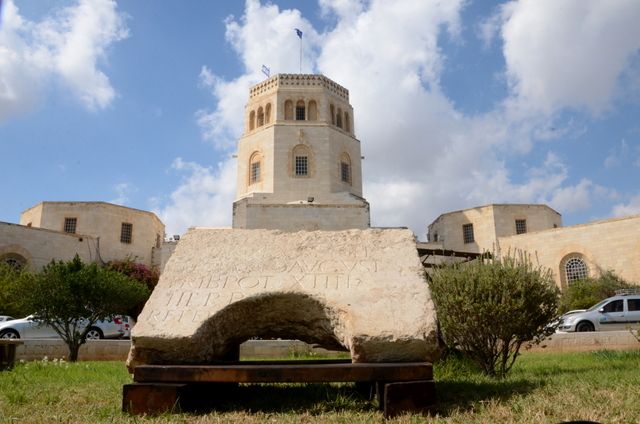
Photograph of the inscription against the background of the Rockefeller Museum, seat of the Israel Antiquities Authority. Photographic credit: Yoli Shwartz, courtesy of the Israel Antiquities Authorit


All of the information regarding the inscription will be presented in a conference open to the public on “Innovations in the Archaeology of Jerusalem and its Surroundings”, to be held this Thursday (23/10) on the Mount Scopus campus of the  Hebrew University of Jerusalem


A rare find of tremendous historical significance was discovered in Jerusalem: a fragment of a stone engraved with an official Latin inscription dedicated to the Roman emperor Hadrian. Researchers believe this is among the most important Latin inscriptions ever discovered in Jerusalem.

During the past year the Israel Antiquities Authority conducted salvage excavations in several areas north of Damascus Gate. In one of those areas a stone fragment bearing an official Latin inscription from the Roman period was discovered. According to Dr. Rina Avner and Roie Greenwald, excavation directors on behalf of the Israel Antiquities Authority, “We found the inscription incorporated in secondary use around the opening of a deep cistern. In antiquity, as today, it was customary to recycle building materials and the official inscription was evidently removed from its original location and integrated in a floor for the practical purpose of building the cistern. Furthermore, in order to fit it with the capstone, the bottom part of the inscription was sawed round.”

Upon finding the inscription it was immediately clear to the excavators that they had uncovered an especially significant discovery, as indicated by the size and clarity of the letters.

The inscriptions, consisting of six lines of Latin text engraved on hard limestone, was read and translated by Avner Ecker and Hannah Cotton of the Hebrew University of Jerusalem. The English translation of the inscription is as follows: (1st hand)To the Imperator Caesar Traianus Hadrianus Augustus, son of the deified Traianus Parthicus, grandson of the deified Nerva, high priest, invested with tribunician power for the 14th time, consul for the third time, father of the country (dedicated by) the 10th legion Fretensis (2nd hand) Antoniniana. 

According to Ecker and Cotton, “This inscription was dedicated by Legio X Fretensis to the emperor Hadrian in the year 129/130 CE.” Their analysis shows that the fragment of the inscription revealed by the IAA archaeologists is none other than the right half of a complete inscription, the other part of which was discovered nearby in the late nineteenth century and was published by the pre-eminent French archaeologist Charles Clermont-Ganneau. That stone is currently on display in the courtyard of Studium Biblicum Franciscanum Museum.

Only a small number of ancient official Latin inscriptions have been discovered in archaeological excavations throughout the country and in Jerusalem in particular, and there is no doubt that this is one of the most important of them. The significance of the inscription stems from the fact that it specifically mentions the name and titles of Hadrian who was an extremely prominent emperor, as well as a clear date. The latter is a significant and tangible confirmation of the historical account regarding the presence of the Tenth Legion in Jerusalem during the period between the two revolts, and possibly even the location of the legion’s military camp in the city, and of one of the reasons for the outbreak of the Bar Kokhba revolt several years later and the establishment of ‘Aelia Capitolina’. Even after 2,000 years the inscription is in an impressive state of preservation. Once the excavation findings are published the inscription will be conserved and put on display for the public.

The events of the Bar Kokhba revolt are ascribed to the reign of the emperor Hadrian. He is remembered in Jewish history for having issued dictates imposing the persecution and forced conversions of Jews, which the sources referred to as the ‘Hadrianic decrees’.

The history of the Bar Kokhba revolt is known from, among other things, the works of the contemporary Roman historian Cassius Dio, who also mentions Hadrian’s visit to Jerusalem in the year 129/130 CE, within the framework of the emperor’s travels in the eastern empire. These travels are also documented on coins issued in honor of the occasion and in inscriptions specifically engraved prior to his arrival in different cities. This is apparently exactly what happened in Jerusalem.

The completion of the two parts of the text reveals an especially large inscription that is quite impressive. According to Dr. Abner, “The inscription itself might have set in the top of a free-standing triumphal arch on the city’s northern boundary such the Arch of Titus in Rome.”

The fate of Jerusalem following the destruction of the Second Temple (70 CE) and prior to the Bar Kokhba revolt (132-136 AD) is one of the major issues in the history of the city and in terms of the Jewish people's connection to it.

We know from ancient writers and the inscriptions on coins that the new city, which Hadrian established, was granted the status of ‘colonia’ (that is, a city whose citizens and gods are Roman) and its name was changed to Aelia Capitolina (COLONIA AELIA CAPITOLINA in Latin). That name incorporates within it the emperor’s name that is in the inscription, whose full name is Publius Aelius Hadrianus, and Rome’s main family of dieties.

There is no doubt that the discovery of this inscription will contribute greatly to the long-standing question about the reasons that led to the outbreak of the Bar Kokhba revolt: were the reasons for the rebellion the construction of Aelia Capitolina and the establishment of the pagan temple on the site of the Jewish temple.


Thursday, October 9, 2014

Greek Bronze Age ended 100 years earlier than thought, new evidence suggests


Conventional estimates for the collapse of the Aegean civilization may be incorrect by up to a century, according to new radiocarbon analyses.

While historical chronologies traditionally place the end of the Greek Bronze Age at around 1025 BCE, this latest research suggests a date 70 to 100 years earlier.

Archaeologists from the University of Birmingham selected 60 samples of animal bones, plant remains and building timbers, excavated at Assiros in northern Greece, to be radiocarbon dated and correlated with 95.4% accuracy using Bayesian statistical methodology at the University of Oxford and the Akademie der Wissenschaften Heidelberg, Germany.

The findings are published in the journal PLOS One.

Dr Ken Wardle of the Department of Classics, Ancient History and Archaeology at the University of Birmingham said: 'These new results tell a story that is totally independent of and rather different from the conventional historical accounts of the date of the end of the Greek Bronze Age.

'Until very recently the chronology of the later part of the Greek Bronze Age was entirely based on historical dates derived from Egypt and the Near East with the aid of exported or imported objects such as Minoan or Mycenaean pottery or Egyptian scarabs.

'But if we accept the 14C radiocarbon dating – and there is no good reason not to – we have to rethink our understanding of a long sequence of dates from the middle of the 14th century BCE to the beginning of the 11th century BCE.

'This is a fundamental reassessment and is important not just for Greece but in the wider Mediterranean context. It affects the ways in which we understand the relationships between different areas, including the hotly debated dates of developments in Israel and Spain.'

The dates derived from the samples meticulously excavated at Assiros – 25km from modern-day Thessaloniki – represent the most complete data set for the Greek Bronze Age, covering 400 years from the mid-14th century to the 10th century BCE. They tell a similar story to those determined for the volcanic eruption in Santorini (Thera), which has been re-dated from 1525 BCE to 1625 BCE as a result of scientific evidence.

Wednesday, October 8, 2014

An Ancient Ritual Bath and Graffiti left by Australian Soldiers during the Second World War were Exposed at Ha-Ela Junction


The ritual bath (miqwe). Photographic credit: Assaf Peretz, courtesy of the Israel Antiquities Authority.

The discoveries were revealed in archaeological excavations carried out by the Israel Antiquities Authority prior to widening Highway 38.

A 1,900 year old ritual bath (miqwe) was recently exposed at Ha-Ela Junction in excavations undertaken by the Israel Antiquities Authority and financed by the Netivei Israel Company, prior to widening Highway 38. An enormous 1,700 years old water cistern was revealed nearby in which graffiti was discovered that had been engraved on the reservoir’s ceiling by Australian soldiers during the Second World War.

According to Yoav Tsur, excavation director on behalf of the Israel Antiquities Authority, “We exposed a miqwe in which there are five steps; the fifth step being a bench where one could sit at the edge of the immersion pool. We found fragments of magnificent pottery vessels there dating to the second century CE, among them lamps, red burnished vessels, a jug and cooking pots. Apparently the miqwe ceased to be used during the second century CE, perhaps in light of the Bar Kokhba revolt. A rock-hewn opening was exposed south of the miqwe, which appears to have been the entrance to a large water cistern. It seems that in an early phase it was a smaller reservoir and functioned as the “otzar” (water collecting vat) for the miqwe. When the miqwe ceased to be used the cistern’s original cavity was increased to its current large dimensions and an extensive surface was built nearby which facilitated drawing water.

During the course of the excavation the archaeologists were surprised to discover some contemporary yet intriguing finds: graffiti engraved on the ceiling of the cistern indicating the place had been exposed until the 1940’s. The inscriptions were read by Assaf Peretz, an archaeologist and historian with the Israel Antiquities Authority, who said, “Among other things, two English names were identified that are carved in the rock: Cpl Scarlett and Walsh. Next to the names are carved the initials RAE and two numbers – NX7792 and NX9168. The date 30/05/1940 appears below the graffiti. Since the initials Cpl signify the rank of corporal, we can assume that these were soldiers who wanted to leave their mark there. An inquiry with the proper authorities revealed that the numbers engraved inside the cistern are actually soldiers’ serial numbers and that RAE stands for Royal Australian Engineers. A search in the Australian government archives revealed the following information: Corporal Philip William Scarlett was born in Melbourne in 1918, was drafted into the army in 1939, survived the war and died in 1970, shortly before his fifty-second birthday. His comrade, Patrick Raphael Walsh, was born in 1910 in Cowra, was drafted in 1939, survived the war and passed away in 2005 at the age of 95. It seems that the two were members of the Australian Sixth Division which was stationed in the country at the time of the British Mandate and was undergoing training prior to being sent into combat in France. Because France surrendered before the troops were ready they were ultimately sent to Egypt in October 1940 where they fought at the front in the Western Desert”. The archaeologists added, “If the relatives of these people are acquainted with the story, we’ll be happy if they contact us and we’ll share with them the warm greetings left behind by Scarlett and Walsh”.

Peretz adds, “The fins of British mortar bombs were found while searching the site, as were twenty-seven rifle cartridges, six of which were manufactured in Australia and fired in the region”.

According to Tsur, “The finds from this excavation allow us to reconstruct a double story: about the Jewish settlement in the second century CE, probably against the background of the events of the Bar Kokhba revolt, and another story, no less fascinating, about a group of Australian soldiers who visited the site c. 1,700 years later and left their mark there”.

Pablo Betzer, the district archaeologist for Judah of the Israel Antiquities Authority, points out that in the wake of the discovery the Israel Antiquities Authority requested that Netivei Israel Company modify the junction’s construction plan in order to preserve the finds there and rehabilitate them as part of the landscape alongside the road. The Netivei Israel Company has agreed to so.