Monday, May 12, 2014

Prehistoric people of Europe used mind-altering substances to aid in communication with the spiritual world


Unlike modern Man, the prehistoric people of Europe did not use mind-altering substances simply for their hedonistic pleasure. The use of alcohol and plant drugs – such as opium poppies and hallucinogenic mushrooms – was highly regulated and went hand-in-hand with the belief system and sacred burial rituals of many preindustrial societies. Elisa Guerra-Doce of the Universidad de Valladolid in Spain contends that their use was an integral part of prehistoric beliefs, and that these substances were believed to aid in communication with the spiritual world. Guerra-Doce’s research appears in Springer’s Journal of Archaeological Method and Theory.

Despite the fact that the consumption of these substances is as ancient as human society itself, it is only fairly recently that researchers have started to look into the historical and cultural contexts in which mind-altering products were used in Europe. To add to the body of literature about the anthropology of intoxication in prehistoric European societies, Guerra-Doce systematically documented the cultural significance of consuming inebriating substances in these cultures.

In the research, four different types of archaeological documents were examined: the macrofossil remains of the leaves, fruits or seeds of psychoactive plants; residues suggestive of alcoholic beverages; psychoactive alkaloids found in archaeological artifacts and skeletal remains from prehistoric times; and artistic depictions of mood-altering plant species and drinking scenes. These remnants include bits of the opium poppy in the teeth of a male adult in a Neolithic site in Spain, charred Cannabis seeds in bowls found in Romania, traces of barley beer on several ceramic vessels recovered in Iberia, and abstract designs in the Italian Alps that depict the ritual use of hallucinogenic mushrooms.

Because Guerra-Doce mainly found traces of sensory-altering products in tombs and ceremonial places, she believes such substances are strongly linked to ritual usage. They were consumed in order to alter the usual state of consciousness, or even to achieve a trance state. The details of the rituals are still unclear, but the hypothesis is that the substances were either used in the course of mortuary rites, to provide sustenance for the deceased in their journey into the afterlife, or as a kind of tribute to the underworld deities.

She adds that the right to use such substances may have been highly regulated given that they were a means to connect with the spirit world, and therefore played a sacred role among prehistoric European societies.

“Far from being consumed for hedonistic purposes, drug plants and alcoholic drinks had a sacred role among prehistoric societies,” says Guerra-Doce. “It is not surprising that most of the evidence derives from both elite burials and restricted ceremonial sites, suggesting the possibility that the consumption of mind-altering products was socially controlled in prehistoric Europe.”


Thursday, May 8, 2014

'Rice theory' explains north-south China cultural differences, study shows


A new cultural psychology study has found that psychological differences between the people of northern and southern China mirror the differences between community-oriented East Asia and the more individualistic Western world – and the differences seem to have come about because southern China has grown rice for thousands of years, whereas the north has grown wheat.

"It's easy to think of China as a single culture, but we found that China has very distinct northern and southern psychological cultures and that southern China's history of rice farming can explain why people in southern China are more interdependent than people in the wheat-growing north," said Thomas Talhelm, a University of Virginia Ph.D. student in cultural psychology and the study's lead author. He calls it the "rice theory."

The findings appear in the May 9 issue of the journal Science.

Talhelm and his co-authors at universities in China and Michigan propose that the methods of cooperative rice farming – common to southern China for generations – make the culture in that region interdependent, while people in the wheat-growing north are more individualistic, a reflection of the independent form of farming practiced there over hundreds of years.

"The data suggests that legacies of farming are continuing to affect people in the modern world," Talhelm said. "It has resulted in two distinct cultural psychologies that mirror the differences between East Asia and the West."

According to Talhelm, Chinese people have long been aware of cultural differences between the north region and the southern, which are divided by the Yangtze River – the largest river in China, flowing west to east across the vast country. People in the north are thought to be more aggressive and independent, while people to the south are considered more cooperative and interdependent.

"This has sometimes been attributed to different climates – warmer in the south, colder in the north – which certainly affects agriculture, but it appears to be more related to what Chinese people have been growing for thousands of years," Talhelm said.

He notes that rice farming is extremely labor-intensive, requiring about twice the number of hours from planting to harvest as does wheat. And because most rice is grown on irrigated land, requiring the sharing of water and the building of dikes and canals that constantly require maintenance, rice farmers must work together to develop and maintain an infrastructure upon which all depend. This, Talhelm argues, has led to the interdependent culture in the southern region.

Wheat, on the other hand, is grown on dry land, relying on rain for moisture. Farmers are able to depend more on themselves, leading to more of an independent mindset that permeates northern Chinese culture.

Talhelm developed his rice theory after living in China for four years. He first went to the country in 2007 as a high school English teacher in Guangzhou, in the rice-growing south.

A year later, he moved to Beijing, in the north. On his first trip there, he noticed that people were more outgoing and individualistic than in the south.

"I noticed it first when a museum curator told me my Chinese was clearly better than my roommate's," Talhelm said. "The curator was being direct and a little less concerned about how her statement might make us feel."

After three years in China, including time as a journalist, he later went back as a U.Va. doctoral student on a Fulbright scholarship.

"I was pretty sure the differences I was seeing were real, but I had no idea why northern and southern China were so different – where did these differences come from?" Talhelm asked.

He soon found that the Yangtze was an important cultural divider in China. "I found out that the Yangtze River helped divide dialects in China, and I soon learned that the Yangtze also roughly divides rice farming and wheat farming," he said.

He dug into anthropologists' accounts of pre-modern rice and wheat villages and realized that they might account for the different mindsets, carried forward from an agrarian past into modernity.

"The idea is that rice provides economic incentives to cooperate, and over many generations, those cultures become more interdependent, whereas societies that do not have to depend on each other as much have the freedom of individualism," Talhelm said.

He went about investigating this with his Chinese colleagues by conducting psychological studies of the thought styles of 1,162 Han Chinese college students in the north and south and in counties at the borders of the rice-wheat divide.

They found through a series of tests that northern Chinese were indeed more individualistic and analytic-thinking – more similar to Westerners – while southerners were interdependent, holistic-thinking and fiercely loyal to friends, as psychological testing has shown is common in other rice-growing East Asian nations, such as Japan and Korea.

The study was conducted in six Chinese cities: Beijing in the north; Fujian in the southeast; Guangdong in the south; Yunnan in the southwest; Sichuan in the west central; and Liaoning in the northeast.

Talhelm said that one of the most striking findings was that counties on the north-south border – just across the Yangtze River from each other – exhibited the same north/south psychological characteristics as areas much more distantly separated north and south.

Friday, May 2, 2014

Neanderthals were not inferior to modern humans


If you think Neanderthals were stupid and primitive, it's time to think again.
The widely held notion that Neanderthals were dimwitted and that their inferior intelligence allowed them to be driven to extinction by the much brighter ancestors of modern humans is not supported by scientific evidence, according to a researcher at the University of Colorado Boulder.
Neanderthals thrived in a large swath of Europe and Asia between about 350,000 and 40,000 years ago. They disappeared after our ancestors, a group referred to as "anatomically modern humans," crossed into Europe from Africa.
In the past, some researchers have tried to explain the demise of the Neanderthals by suggesting that the newcomers were superior to Neanderthals in key ways, including their ability to hunt, communicate, innovate and adapt to different environments.
But in an extensive review of recent Neanderthal research, CU-Boulder researcher Paola Villa and co-author Wil Roebroeks, an archaeologist at Leiden University in the Netherlands, make the case that the available evidence does not support the opinion that Neanderthals were less advanced than anatomically modern humans. Their paper was published April 30, 2014 in the journal PLOS ONE.
"The evidence for cognitive inferiority is simply not there," said Villa, a curator at the University of Colorado Museum of Natural History. "What we are saying is that the conventional view of Neanderthals is not true."
Villa and Roebroeks scrutinized nearly a dozen common explanations for Neanderthal extinction that rely largely on the notion that the Neanderthals were inferior to anatomically modern humans. These include the hypotheses that Neanderthals did not use complex, symbolic communication; that they were less efficient hunters who had inferior weapons; and that they had a narrow diet that put them at a competitive disadvantage to anatomically modern humans, who ate a broad range of things.
The researchers found that none of the hypotheses were supported by the available research. For example, evidence from multiple archaeological sites in Europe suggests that Neanderthals hunted as a group, using the landscape to aid them.
Researchers have shown that Neanderthals likely herded hundreds of bison to their death by steering them into a sinkhole in southwestern France. At another site used by Neanderthals, this one in the Channel Islands, fossilized remains of 18 mammoths and five woolly rhinoceroses were discovered at the base of a deep ravine. These findings imply that Neanderthals could plan ahead, communicate as a group and make efficient use of their surroundings, the authors said.
Other archaeological evidence unearthed at Neanderthal sites provides reason to believe that Neanderthals did in fact have a diverse diet. Microfossils found in Neanderthal teeth and food remains left behind at cooking sites indicate that they may have eaten wild peas, acorns, pistachios, grass seeds, wild olives, pine nuts and date palms depending on what was locally available.
Additionally, researchers have found ochre, a kind of earth pigment, at sites inhabited by Neanderthals, which may have been used for body painting. Ornaments have also been collected at Neanderthal sites. Taken together, these findings suggest that Neanderthals had cultural rituals and symbolic communication.
Villa and Roebroeks say that the past misrepresentation of Neanderthals' cognitive ability may be linked to the tendency of researchers to compare Neanderthals, who lived in the Middle Paleolithic, to modern humans living during the more recent Upper Paleolithic period, when leaps in technology were being made.
"Researchers were comparing Neanderthals not to their contemporaries on other continents but to their successors," Villa said. "It would be like comparing the performance of Model T Fords, widely used in America and Europe in the early part of the last century, to the performance of a modern-day Ferrari and conclude that Henry Ford was cognitively inferior to Enzo Ferrari."
Although many still search for a simple explanation and like to attribute the Neanderthal demise to a single factor, such as cognitive or technological inferiority, archaeology shows that there is no support for such interpretations, the authors said.
But if Neanderthals were not technologically and cognitively disadvantaged, why didn't they survive?
The researchers argue that the real reason for Neanderthal extinction is likely complex, but they say some clues may be found in recent analyses of the Neanderthal genome over the last several years. These genomic studies suggest that anatomically modern humans and Neanderthals likely interbred and that the resulting male children may have had reduced fertility. Recent genomic studies also suggest that Neanderthals lived in small groups. All of these factors could have contributed to the decline of the Neanderthals, who were eventually swamped and assimilated by the increasing numbers of modern immigrants.

Friday, April 25, 2014

New Method Confirms Humans and Neandertals Interbred


Technical objections to the idea that Neandertals interbred with the ancestors of Eurasians have been overcome, thanks to a genome analysis method described in the April 2014 issue of the journal GENETICS. The technique can more confidently detect the genetic signatures of interbreeding than previous approaches and will be useful for evolutionary studies of other ancient or rare DNA samples.

“Our approach can distinguish between two subtly different scenarios that could explain the genetic similarities shared by Neandertals and modern humans from Europe and Asia,” said study co-author Konrad Lohse, a population geneticist at the University of Edinburgh.
The first scenario is that Neandertals occasionally interbred with modern humans after they migrated out of Africa. The alternative scenario is that the humans who left Africa evolved from the same ancestral subpopulation that had previously given rise to the Neandertals.

Many researchers argue the interbreeding scenario is more likely, because it fits the genetic patterns seen in studies that compared genomes from many modern humans. But the new approach completely rules out the alternative scenario without requiring all the extra data, by using only the information from one genome each of several types: Neandertal, European/Asian, African and chimpanzee.

The same method will be useful in other studies of interbreeding where limited samples are available. “Because the method makes maximum use of the information contained in individual genomes, it is particularly exciting for revealing the history of species that are rare or extinct,” said Lohse. In fact, the authors originally developed the method while studying the history of insect populations in Europe and island species of pigs in South East Asia, some of which are extremely rare.

Lohse cautions against reading too much into the fact that the new method estimates a slightly higher genetic contribution of Neandertals to modern humans than previous studies. Estimating this contribution is complex and is likely to vary slightly between different approaches.

“This work is important because it closes a hole in the argument about whether Neandertals interbred with humans. And the method can be applied to understanding the evolutionary history of other organisms, including endangered species,” said Mark Johnston, Editor-in-Chief of the journal GENETICS.

Tuesday, April 22, 2014

First Eurasians left Africa up to 130,000 years ago


A team of researchers led by the University of Tübingen's Professor Katerina Harvati has shown that anatomically modern humans spread from Africa to Asia and Europe in several migratory movements. The first ancestors of today's non-African peoples probably took a southern route through the Arabian Peninsula as early as 130,000 years ago, the researchers found. The study is published by Professor Katerina Harvati and her team from the Institute for Archaeological Sciences at the University of Tübingen and the Senckenberg Center for Human Evolution and Palaeoenvironment, in collaboration with colleagues from the University of Ferrara, Italy, and the National Museum of Natural History, France. The study appears in the online Early Edition of the Proceedings of the National Academy of Sciences.


The Out-of-Africa model that best fits both the genetic and cranial shape data. A first migration along the Indian Ocean rim occurred as early as 130 thousand years ago (green arrow) and was followed by a second, more recent migration wave into Eurasia (red arrow).
Credit: Katerina Harvati/University of Tübingen and Senckenberg Center for Human Evolution and Palaeoenvironment


The scientists tested different hypothetical dispersal scenarios, taking into account the geography of potential migration routes, genetic data and cranial comparisons. They found that the first wave of migration out of Africa started earlier than previously thought, taking place as early as the late Middle Pleistocene -- with a second dispersal to northern Eurasia following about 50,000 years ago.

Most scientists agree that all humans living today are descended from a common ancestor population which existed 100,000 to 200,000 years ago in Africa. The decreasing genetic and phenotypic diversity observed in humans at increasing distances from Sub-Saharan Africa has often been interpreted as evidence of a single dispersal 50,000 to 75,000 years ago. However, recent genetic, archaeological and palaeoanthropological studies challenge this scenario.

Professor Harvati's team tested the competing out-of-Africa models of a single dispersal against multiple dispersals of anatomically modern humans. The scientists compared modern human crania from different parts of the world, neutral genetic data, and geographical distances associated with different dispersal routes. Likewise, they reconstructed population split times from both the genetic data and as predicted by each competing model. Because each dispersal scenario is associated with specific geographic and temporal predictions, the researchers were able to test them against the observed neutral biological distances between groups, as revealed from both genetic and cranial data.

"Both lines of evidence -- anatomical cranial comparisons as well as genetic data -- support a multiple dispersal model," says Katerina Harvati. The first group of our ancestors left Africa about 130,000 years ago and followed a coastal route through the Arabian Peninsula to Australia and the west Pacific region. "Australian aborigines, Papuans and Melanesians were relatively isolated after the early dispersal along the southern route," says Hugo Reyes-Centeno, first author of the study and member of the Tübingen team. He adds that other Asian populations appear to be descended from members of a later migratory movement from Africa to northern Eurasia about 50,000 years ago.

The researchers are confident that continued field work and advances in genetics will allow for fine-tuning of models of human expansion out of Africa. So far we can only speculate whether, for example, severe droughts in East Africa occurring between 135,000 and 75,000 years ago prompted migration or had an impact on the local evolution of human populations. The southern route region is a vast geographical space that has been understudied by archaeologists and anthropologists, so future work in this area will help support their findings.

Friday, April 18, 2014

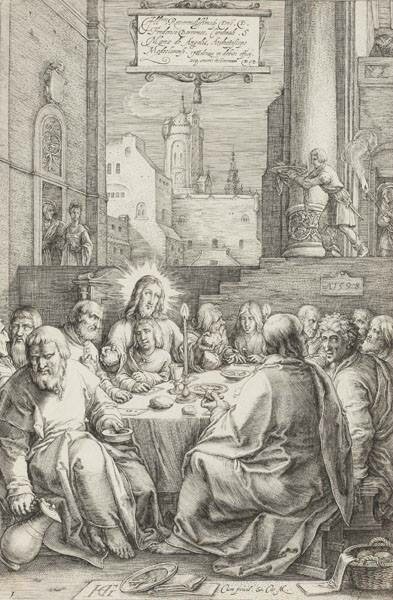
A woman at the Last Supper

 I have commented before on a woman at the Last Supper

 in Da Vinci's famous picture:

http://archaeologynewsreport.blogspot.com/2013/02/a-woman-sitting-at-da-vincis-last-supper.html

and Federico Barocci's, painted in 1580,

http://archaeologynewsreport.blogspot.com/2013/06/more-on-woman-in-da-vincis-last-supper.html

Here's still another manifestation:


Hendrick Goltzius, The Last Supper, 1598. Engraving, state i/iii, plate and sheet 20.1 x 13.4 cm. University of San Diego

The second person to Christ's left is pretty clearly a young woman - notice her hair, youthful features, no beard. He also seem to have his arm around a child!


Wednesday, April 16, 2014

A gold signet ring bearing the name of Egyptian Pharoah Seti I in a 3,300-year-old coffin at the foot of Tel Shadud in the Jezreel Valley

 Complete article


Gold scarab with symbol of Pharaoh Seti I set in a ring found in a 3,300 year old coffin in the Jezreel Valley
Photo Credit: Clara Amit, courtesy of the Israel Antiquities Authority


A gold signet ring bearing the name of Egyptian Pharoah Seti I was among the personal belongings of a wealthy Canaanite recently discovered in a 3,300-year-old coffin at the foot of Tel Shadud in the Jezreel Valley.


The skeleton of an adult was found inside the clay coffin. Next to it was more pottery, a bronze dagger, bronze bowl and hammered pieces of bronze.

Also found next to the deceased was an Egyptian scarab seal, encased in gold and affixed to a ring. This item is used to seal documents and objects.

The name of the crown of Pharaoh Seti I, who ruled ancient Egypt in the 13th century BCE, appears on the seal. Seti I was the father of Ramses II, identified by some scholars are the pharaoh mentioned in the Biblical story of the Israelites’ Exodus from Egypt.


The Egyptian coffin lid after it was cleaned up.
Photo by: Clara Amit, courtesy of the Israel Antiquities Authority


Already in the first year of his reign (1294 BCE) a revolt broke out against Seti I in the Beit Shean Valley, but he conquered that region and established Egyptian rule in Canaan.

Seti’s name on the seal symbolizes power and protection, and the reference to him on the scarab found in the coffin aided the researchers in dating the time of burial. A cemetery dating to Seti I’s reign was previously uncovered at Beit Shean, the center of Egyptian rule in the Land of Israel, and similar clay coffins were exposed.

Tel Shadud preserves the Biblical name “Sarid” and the mound, located in the northern part of the Jezreel Valley close to Kibbutz Sarid, is often referred to as Tel Sarid.

The graves of two men and two women who may have been family members were located nearby, researchers said, noting the find is evidence of Egyptian control of the Jezreel Valley in the 13th century BCE (Late Bronze Age).