Friday, November 9, 2012
Neandertals might have produced sophisticated tools, body ornaments
A population of Neandertals produced sophisticated bone tools and body ornaments more than 40,000 years ago, a study finds. Jean-Jacques Hublin and colleagues analyzed bone samples from two sites in France: Grotte du Renne and Saint Césaire, where Neandertal remains are associated with artifacts from a period called the Châtelperronian.
The researchers extracted collagen from the samples and performed radiocarbon dating using an accelerator mass spectrometer. At Grotte du Renne, the Châtelperronian artifacts were dated to between 44,500 and 41,000 years ago, and a Neandertal tibia bone from Saint Césaire was found to date close to 41,950 years ago. These ages are significant because modern humans replaced the last known European Neandertals starting around 50,000 years ago. Given the dating results, the authors conclude that Neandertals must have made the bone tools and body ornaments found at the sites.
The findings contradict prior research that concluded that modern humans made the Châtelperronian items. However, because Neandertals produced body ornaments only after modern humans arrived in neighboring regions, cultural exchange likely took place between modern humans and Neandertals, according to the authors.

Thursday, November 8, 2012
Extreme weather preceded collapse of Maya civilization
Decades of extreme weather crippled, and ultimately decimated, first the political culture and later the human population of the ancient Maya, according to a new study by an interdisciplinary team of researchers that includes two University of California, Davis, scientists.
The collapse of the Maya is one of the world's most enduring mysteries. Now, for the first time, researchers have combined a precise climatic record of the Maya environment with a precise record of Maya political history to provide a better understanding of the role weather had in the civilization's downfall.
Their findings are published in the Nov. 9, 2012 issue of the journal Science.
"Here you had an amazing state-level society that had created calendars, magnificent architecture, works of art, and was engaged in trade throughout Central America," said UC Davis anthropology professor and co-author Bruce Winterhalder. "They were incredible craftspersons, proficient in agriculture, statesmanship and warfare—and within about 80 years, it fell completely apart."
To determine what was happening in the sociopolitical realm during each of those years, the study tapped the extensive Maya Hieroglyphic Database Project, run by UC Davis Native American Language Center director and linguist Martha Macri, a specialist in Mayan hieroglyphs who has been tracking the culture's stone monuments for nearly 30 years.
"Every one of these Maya monuments is political history," said Macri.
Inscribed on each monument is the date it was erected and dates of significant events, such as a ruler's birthday or accession to power, as well as dates of some deaths, burials and major battles. The researchers noted that the number of monuments carved decreased in the years leading to the collapse.
But the monuments made no mention of ecological events, such as storms, drought or references to crop successes or failures.
For that information, the research team collected a stalagmite from a cave in Belize, less than 1 mile from the Maya site of Uxbenka and about 18 miles from three other important centers. Using oxygen isotope dating in 0.1 millimeter increments along the length of the stalagmite, the scientists uncovered a physical record of rainfall over the past 2,000 years.
Combined, the stalagmite and hieroglyphs allowed the researchers to link precipitation to politics. Periods of high and increasing rainfall coincided with a rise in population and political centers between 300 and 660 AD. A climate reversal and drying trend between 660 and 1000 AD triggered political competition, increased warfare, overall sociopolitical instability, and finally, political collapse. This was followed by an extended drought between 1020 and 1100 AD that likely corresponded with crop failures, death, famine, migration and, ultimately, the collapse of the Maya population.
"It has long been suspected that weather events can cause a lot of political unrest and subject societies to disease and invasion," Macri said. "But now it's clear. There is physical evidence that correlates right along with it. We are dependent on climatological events that are beyond our control."
Said Winterhalder: "It's a cautionary tale about how fragile our political structure might be. Are we in danger the same way the Classic Maya were in danger? I don't know. But I suspect that just before their rapid descent and disappearance, Maya political elites were quite confident about their achievements."
A Neolithic well uncovered in the Jezreel Valley
A rare well dating to the Neolithic period was uncovered in recent excavations the Israel Antiquities Authority carried out at ‘Enot Nisanit’, along the western fringes of the Jezreel Valley prior to enlarging Ha-Yogev Junction (Highway 66) by the National Roads Company. Archaeologists estimate the well was built approximately 8,500 years ago.
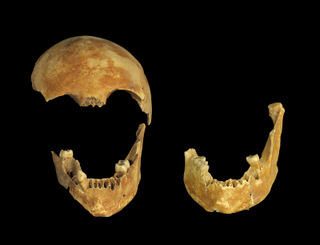
The skull that was exposed during the excavation. Photographic credit: Clara Amit, courtesy of the Israel Antiquities Authority
During the excavations the skeletal remains of a woman approximately 19 years of age and a man older than her were uncovered deep inside the well. How did these come to be in the well? Was this an accident or perhaps murder? As of now the answer to this question remains a mystery.
According to Yotam Tepper, excavation director on behalf of the Israel Antiquities Authority, “What is clear is that after these unknown individuals fell into the well it was no longer used for the simple reason that the well water was contaminated and was no longer potable”.
Tepper adds, “The impressive well that was revealed was connected to an ancient farming settlement and it seems the inhabitants used it for their subsistence and living. The upper part of the well was built of stones and its lower part was hewn in the bedrock. Two capstones, which narrowed the opening, were set in place at the top of the well. It is c. 8 meters deep and its upper part measures about 1.3 meters in diameter”.
The flint implements that were exposed during the excavation. Photographic credit: Clara Amit, courtesy of the Israel Antiquities Authority
Tepper says, “Numerous artifacts indicating the identity of the people who quarried it – the first farmers of the Jezreel Valley – were recovered from inside the well. The finds include, among other things, deeply denticulated sickle blades knapped from flint which were used for harvesting, as well as arrow heads and stone implements. The excavation of the accumulations in the well shaft yielded animal bones, organic finds and charcoal which will enable future studies about the domestication of plants and animals, and also allow researchers to determine the exact age of the well by means of advanced methods of absolute dating”.
“The well that was exposed in the Jezreel Valley reflects the impressive quarrying ability of the site’s ancient inhabitants and the extensive knowledge they possessed regarding the local hydrology and geology which enabled them to quarry the limestone bedrock down to the level of the water table. No doubt the quarrying of the well was a community effort that lasted a long time”, said Tepper.
According to Dr. Omri Barzilai, head of the Prehistory Branch of the Israel Antiquities Authority, “Wells from this period are unique finds in the archaeology of Israel, and probably also in the prehistoric world in general. The two oldest wells in the world were previously exposed in Cyprus and they indicated the beginning of the domestication phenomenon: it seems that ancient man tried to devise ways of protecting his drinking water from potential contamination by the animals he raised, and therefore he enclosed the water in places that were not accessible to them. The wells had another important advantage: quarrying them provided access to an available source of water that was not dependent upon springs or streams. Another well, which is about 1,000 years later than those in Cyprus, was previously exposed at the Atlit Yam site in Israel, and another well from this period has now been exposed at the ‘Enot Nisanit’ site. The exposure of these wells makes an important contribution to the study of man’s culture and economy in a period when pottery vessels and metallic objects had still not yet been invented”.
Same Scribe's Works Found Among Dead Sea Scrolls At Qumran and At Masada

Qumran
Recently Ada Yardeni, the foremost paleographer working in Israel today, made a startling claim: More than 50 Dead Sea Scroll manuscripts were copied by the same scribe.1 The 54 manuscripts came from six different caves: Qumran Caves 1, 2, 3, 4, 6 and 11. Even more surprising, Yardeni identified the same scribal hand in a manuscript of the Joshua Apocryphon found 30 miles south of Qumran at the famous desert fortress of Masada, the last holdout in the Jewish revolt against Rome.
Complete article
“It seems likely that some manuscripts from Qumran were carried south by refugees fleeing the Roman destruction of Qumran in 68 C.E. [Masada is south of Qumran]. But that’s only a best guess.”
Source of this quote.
Friday, November 2, 2012
Rare find, only artifact of its kind, that of Bes, ever found in Jerusalem.
Excavations in in the Ophel area, located between the southern wall of the Old City of Jerusalem and the City of David to its south. have been conducted by Dr. Eilat Mazar of the Hebrew University Institute of Archaeology. The excavations are at a level dating from the period of King Solomon.
An exciting find at that level was
only about one inch in length, was a small white necklace pendant made from faience (see video below). Originally green, the pendant was a figurine depicting the ancient Egyptian god Bes, a deity worshipped as a fertility god and protector of families and households, and in particular, of mothers, children and childbirth. The find is rare in that it is the first and only artifact of its kind, that of Bes, ever found in Jerusalem.
More info here.
Monday, October 22, 2012
A comprehensive analysis of the anthropological and genetic history of humans' expansion out of Africa
A new, comprehensive review of humans' anthropological and genetic records gives the most up-to-date story of the "Out of Africa" expansion that occurred about 45,000 to 60,000 years ago.
This expansion, detailed by three Stanford geneticists, had a dramatic effect on human genetic diversity, which persists in present-day populations. As a small group of modern humans migrated out of Africa into Eurasia and the Americas, their genetic diversity was substantially reduced.
In studying these migrations, genomic projects haven't fully taken into account the rich archaeological and anthropological data available, and vice versa. This review integrates both sides of the story and provides a foundation that could lead to better understanding of ancient humans and, possibly, genomic and medical advances.
"People are doing amazing genome sequencing, but they don't always understand human demographic history" that can help inform an investigation, said review co-author Brenna Henn, a postdoctoral fellow in genetics at the Stanford School of Medicine who has a PhD in anthropology from Stanford. "We wanted to write this as a primer on pre-human history for people who are not anthropologists."
This model of the Out of Africa expansion provides the framework for testing other anthropological and genetic models, Henn said, and will allow researchers to constrain various parameters on computer simulations, which will ultimately improve their accuracy.
"The basic notion is that all of these disciplines have to be considered simultaneously when thinking about movements of ancient populations," said Marcus Feldman, a professor of biology at Stanford and the senior author of the paper. "What we're proposing is a story that has potential to explain any of the fossil record that subsequently becomes available, and to be able to tell what was the size of the population in that place at that time."
The anthropological information can inform geneticists when they investigate certain genetic changes that emerge over time. For example, geneticists have found that genes for lactose intolerance and gluten sensitivity began to emerge in populations expanding into Europe around 10,000 years ago.
The anthropological record helps explain this: It was around this time that humans embraced agriculture, including milk and wheat production. The populations that prospered – and thus those who survived to pass on these mutations – were those who embraced these unnatural food sources. This, said Feldman, is an example of how human movements drove a new form of natural selection.
Populations that expand from a small founding group can also exhibit reduced genetic diversity – known as a "bottleneck" – a classic example being the Ashkenazi Jewish population, which has a fairly large number of genetic diseases that can be attributed to its small number of founders. When this small group moved from the Rhineland to Eastern Europe, reproduction occurred mainly within the group, eventually leading to situations in which mothers and fathers were related. This meant that offspring often received the same deleterious gene from each parent and, as this process continued, ultimately resulted in a population in which certain diseases and cancers are more prevalent.
"If you know something about the demographic history of populations, you may be able to learn something about the reasons why a group today has a certain genetic abnormality – either good or bad," Feldman said. "That's one of the reasons why in our work we focus on the importance of migration and history of mixing in human populations. It helps you assess the kinds of things you might be looking for in a first clinical assessment. It doesn't have the immediacy of prescribing chemotherapy – it's a more general look at what's the status of human variability in DNA, and how might that inform a clinician."
The study is published in the current edition of the Proceedings of the National Academy of Sciences and was co-authored by Feldman's longtime collaborator, population geneticist Luigi Luca Cavalli-Sforza of Stanford and the Università Vita-Salute San Raffaele in Italy.
Saturday, October 20, 2012
The exact spot where Julius Caesar was stabbed located

Archaeologists believe they have found the exact spot where Julius Caesar was stabbed and killed by a group of rival Roman senators more than 2,000 years ago.
Caesar, who was the head of the Roman Republic, was stabbed to death by a group of senators, including his friend Brutus, during the Ides of March, March 15, 44 BC.
Archaeologists recently announced in a new Spanish National Research Council report that they have unearthed a large concrete structure almost 10 feet wide by 6.5 feet tall, which they believe was erected by Augustus, Julius Caesar’s successor, to condemn the assassination of the former leader.
The concrete structure is located at the base of the Curia (theater) of Pompey, which is the same spot classical writers report that the stabbing took place.
Read more at http://www.inquisitr.com/362522/archaeologists-discover-exact-spot-julius-caesar-was-stabbed/#gU7TMjm0fHBY3Xu6.99
Subscribe to:
Posts (Atom)