Saturday, October 20, 2012
New discoveries at Bethsaida
Complete article
... Dr. Nicolae Roddy... and his excavation colleagues were assigned to carefully uncover and explore an area that contained finds of the Roman period of ancient Bethsaida, the fishing town that was, according to the Biblical account, the home of the New Testament Christian apostles Peter, Andrew and Phillip, and likely James and John as well.
"We uncovered a paved street from the time of Jesus's disciples, which runs westward through the residential area from the corner of the Fisherman's House [an excavated structural feature so-named because of the fishing implements associated with it] down toward the Jordan valley", said Roddy. "I tell people that Andrew, Peter, and Phillip almost certainly walked on it because they would have had to have gone out of their way to avoid it!"
The paved road is actually only one feature among many remarkable finds uncovered in recent years during excavations at the ancient site. Identifying it as the possible site of Bethsaida in 1987, University of Nebraska's Dr. Rami Arav, Director of the Bethsaida Excavations Project for more than 20 years, has thus far revealed a settlement site that saw human occupation from before the time of the early Israelite and Judahite kings up through Hellenistic and Roman times and beyond. And although the site is best known in the literature as the birth and dwelling place of some of the Christian apostles and the fishing village frequented by Jesus where some of the best-known miracles of the Biblical account were performed, it is now also thought to be the site where, 3,000 years ago, the ancient Geshurites established the capital of their kingom (Biblical Geshure). Among the more ancient finds of this earlier period are a massive 4-chambered city gate complex, massive defensive walls, a palace, and clear evidence of a destruction event dated to the time of the invasion by the Assyrian King Tiglath Pileser III in 732 B.C.
The Kingdom of Geshur is known from the Hebrew Bible as being closely allied with ancient Israel during the period of the United Monarchy of kings David and Solomon, and for having been visited by King David, who married Ma'achah, the daughter of the king of Geshur...

Evidence of 2nd Viking Outpost Found in Canada
Complete, very interesting article
...Archaeologist Patricia Sutherland (has) announced new evidence that points strongly to the discovery of the second Viking outpost ever discovered in the Americas.
...Archaeologists have long known that Viking seafarers set sail for the New World
around A.D. 1000. A popular Icelandic saga tells of the exploits of Leif Eriksson, a Viking chieftain from Greenland who sailed westward to seek his fortune. According to the saga, Eriksson stopped long enough on Baffin Island to walk the coast—named Helluland, an Old Norse word meaning "stone-slab land"—before heading south to a place he called Vinland.
In the 1960s two Norwegian researchers, Helge Ingstad and Anne Stine Ingstad, discovered and excavated the Viking base camp at L'Anse aux Meadows (map) on the northern tip of Newfoundland—the first confirmed Viking outpost in the Americas. Dated to between 989 and 1020, the camp boasted three Viking halls, as well as an assortment of huts for weaving, ironworking, and ship repair.
As reported in the November issue of National Geographic magazine, Sutherland first caught wind of another possible Viking way station in 1999, when she spotted two unusual pieces of cord that had been excavated from a Baffin Island site by an earlier archaeologist and stored at the Canadian Museum of Civilization in Gatineau, Quebec.
Sutherland noticed that the strands bore little resemblance to the animal sinew Arctic hunters twisted into cordage. The cords turned out to be expertly woven Viking yarn, identical in technique to yarn produced by Viking women living in Greenland in the 14th century.
The discovery prompted Sutherland to scour other museum collections for more Viking artifacts from Baffin Island and other sites. She found more pieces of Viking yarn and a small trove of previously overlooked Viking gear, from wooden tally sticks for recording trade transactions to dozens of Viking whetstones...
...Since 2001 Sutherland's team has been exploring Tanfield Valley and carefully excavating surviving parts of the mysterious ruins. They have discovered a wide range of evidence pointing to the presence of Viking seafarers: pelt fragments from Old World rats; a whalebone shovel similar to those used by Viking settlers in Greenland to cut sod; large stones that appear to have been cut and shaped by someone familiar with European stone masonry; and more Viking yarn and whetstones. And the stone ruins bear a striking resemblance to some Viking buildings in Greenland...
Monday, October 15, 2012
Archaeologists to mount new expedition to Troy
Troy, the palatial city of prehistory, sacked by the Greeks through trickery and a fabled wooden horse, will be excavated anew beginning in 2013 by a cross-disciplinary team of archaeologists and other scientists, it was announced today (Monday, Oct. 15).
The new expedition will be led by University of Wisconsin-Madison classics Professor William Aylward, an archaeologist with long experience digging in the ruins of classical antiquity, including Troy itself. The new international project at Troy, to be conducted under the auspices of and in cooperation with Turkey's Çanakkale Onsekiz Mart University, will begin a series of summer-time expeditions beginning in 2013.
"Troy is a touchstone of Western civilization," says Aylward. "Although the site has been excavated in the past, there is much yet to be discovered. Our plan is to extend work to unexplored areas of the site and to systematically employ new technologies to extract even more information about the people who lived here thousands of years ago."
Troy and the Trojan War were immortalized in Homer's epic poem the Iliad centuries after the supposed events of the conflict. The site was occupied almost continuously for about 4,500 years, from the beginning of the Bronze Age to the 13th century A.D., when it was abandoned and consigned to myth. It was rediscovered in the 1870s by the wealthy German businessman and pioneering archaeologist Heinrich Schliemann whose work at Troy laid the foundations for modern archaeology.
"Our goal is to add a new layer of information to what we already know about Troy," says Aylward, who is contributing an international team of archaeologists and scientists to conduct what promises to be the most comprehensive dig since Troy's discovery over 140 years ago. "The archaeological record is rich. If we take a closer look with new scientific tools for study of ancient biological and cultural environments, there is much to be found for telling the story of this world heritage site."
The site of Troy is in modern Turkey and is situated on the Dardanelles, a crossroads between East and West and a flashpoint for conflict in both ancient and modern times. The archaeological site is a complex layer cake of history and prehistory, with 10 cities superimposed one atop the other, some with clear evidence for violent destruction.
Following the demise of Troy at the end of the Bronze Age, the site was re-settled by Greeks, Romans and others, who all claimed Homer's Troy and its cast of characters – Achilles, Helen, Patroclus, Priam and Ajax – as their own cultural heritage. The ancient city was visited by the Persian general Xerxes, Alexander the Great, and Roman emperors, including Augustus and Hadrian. Homer's epic poems about a lost age of heroes and the legendary Trojan War have endured as sources of inspiration for art and literature ever since.
Although archaeologists have been digging at Troy for almost 140 years, with the exception of a 50-year hiatus between 1938 and 1988, less than one-fifth of the site has been scientifically excavated. With about 4,500 years of nearly uninterrupted settlement at a crossroads between Europe and Asia, Troy is fundamental for questions about the development of civilization in Europe and the Near East. "Troy deserves a world-class archaeological program," says Aylward.
In its heyday, Troy's citadel, with walls 12 feet thick and more than 30 feet high, was about 6 acres in size. A walled lower town covered an expanse of 50 acres, much of which is unexplored. Mysteries abound. Ancient Troy's royal cemetery, for example, has yet to be discovered and archaeologists are eager to add to the single example of prehistoric writing known from Troy, a small bronze seal from the Bronze Age.
"Major gaps in our knowledge involve the identity of the prehistoric Trojans, the location of their principal cemeteries and the nature of their writing system," says Aylward. "The enduring question of the historicity of the Trojan War is also worthy of further exploration."
In future work at Troy, Aylward plans an array of collaborations in order to deploy powerful new scientific techniques to reveal the hidden record of the ancient city and its inhabitants. New methods to examine chemical residues on pottery from ancient kitchens and banquet halls, for example, may reveal secrets of ancient Trojan culinary proclivities, and genomic analyses of human and animal remains may shed light on diseases and afflictions at a crossroads of civilization.
Much of the new work in the area of "molecular archaeology," which includes DNA sequencing and protein analysis, will be conducted in collaboration with the UW-Madison Biotechnology Center, which has become an active partner in the new Troy project. This past summer, researchers from the center participated in reconnaissance for future studies.
The new Wisconsin expedition to Troy builds on years of existing work and international collaboration at the site. The new program to be inaugurated in 2013 will be conducted under the auspices of Çanakkale Onsekiz Mart University, which is situated near the site of Troy.
Wednesday, October 3, 2012
Tomb of Maya queen K’abel discovered in Guatemala
Archaeologists in Guatemala have discovered the tomb of Lady K’abel, a seventh-century Maya Holy Snake Lord considered one of the great queens of Classic Maya civilization.
The tomb was discovered during excavations of the royal Maya city of El Perú-Waka’ in northwestern Petén, Guatemala, by a team of archaeologists led by Washington University in St. Louis’ David Freidel, co-director of the expedition.
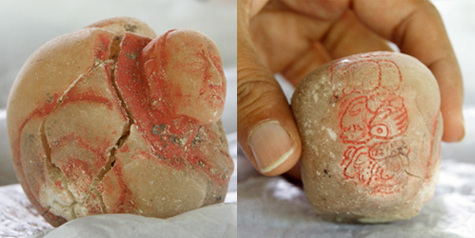
A small, carved alabaster jar (PICTURED ABOVE) found in the burial chamber caused the archaeologists to conclude the tomb was that of Lady K’abel.
The white jar is carved as a conch shell, with a head and arm of an aged woman emerging from the opening. The depiction of the woman, mature with a lined face and a strand of hair in front of her ear, and four glyphs carved into the jar, point to the jar as belonging to K’abel.
Based on this and other evidence, including ceramic vessels found in the tomb and stela (large stone slab) carvings on the outside, the tomb is likely that of K’abel, says Freidel, PhD, professor of anthropology in Arts & Sciences and Maya scholar.
Freidel says the discovery is significant not only because the tomb is that of a notable historical figure in Maya history, but also because the newly uncovered tomb is a rare situation in which Maya archaeological and historical records meet.
“The Classic Maya civilization is the only ‘classical’ archaeological field in the New World — in the sense that like archaeology in Ancient Egypt, Greece, Mesopotamia or China, there is both an archaeological material record and an historical record based on texts and images,” Freidel says.
WUSTL archaeologist David Freidel, PhD, was part of a team that discovered the tomb of Lady K’abel, a seventh-century Maya Holy Snake Lord considered one of the great queens of Classic Maya civilization.
“The precise nature of the text and image information on the white stone jar and its tomb context constitute a remarkable and rare conjunction of these two kinds of records in the Maya area.”
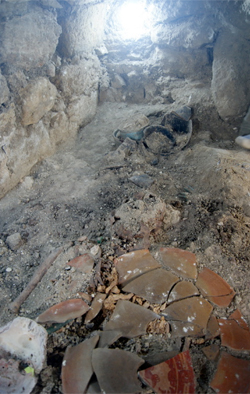
EL PERU WAKA REGIONAL ARCHAEOLOGICAL PROJECT
The burial chamber. The queen’s skull is above the plate fragments.
The discovery of the tomb of the great queen was “serendipitous, to put it mildly,” Freidel says.
The team at El Perú-Waka’ has focused on uncovering and studying “ritually-charged” features such as shrines, altars and dedicatory offerings rather than on locating burial locations of particular individuals.
“In retrospect, it makes a lot of sense that the people of Waka’ buried her in this particularly prominent place in their city,” Freidel says.
Olivia Navarro-Farr, PhD, assistant professor of anthropology at the College of Wooster in Ohio, originally began excavating the locale while still a doctoral student of Freidel’s. Continuing to investigate this area this season was of major interest to both she and Freidel because it had been the location of a temple that received much reverence and ritual attention for generations after the fall of the dynasty at El Perú.
With the discovery, archaeologists now understand the likely reason why the temple was so revered: K’abel was buried there, Freidel says.
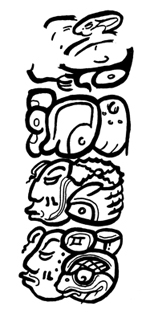
Drawing of the glyphs on the back of the alabaster vessel (pictured at top of story) by Stanley Guenter.
K’abel, considered the greatest ruler of the Late Classic period, ruled with her husband, K’inich Bahlam, for at least 20 years (672-692 AD), Freidel says. She was the military governor of the Wak kingdom for her family, the imperial house of the Snake King, and she carried the title “Kaloomte’,” translated to “Supreme Warrior,” higher in authority than her husband, the king.
K’abel also is famous for her portrayal on the famous Maya stela, Stela 34 of El Perú, now in the Cleveland Art Museum.
El Perú-Waka’, located approximately 75 km west of the famous city of Tikal, is an ancient Maya city in northwestern Petén, Guatemala. It was part of Classic Maya civilization (200-900 AD) in the southern lowlands and consists of nearly a square kilometer of plazas, palaces, temple pyramids and residences surrounded by many square kilometers of dispersed residences and temples.
This discovery was made under the auspices of the National Institute of Anthropology and History in Guatemala. The El Perú-Waka’ project is sponsored by the Foundation for the Cultural and Natural Patrimony of Guatemala (PACUNAM).
The project was originally funded by the Jerome E. Glick Foundation of St. Louis and has received support from the Alphawood Foundation, the National Geographic Society, the National Science Foundation and the U.S. Department of the Interior, in addition to private benefactors.
Friday, September 28, 2012
Buddhist statue, discovered by Nazi expedition, is made of meteorite

It sounds like an artifact from an Indiana Jones film; a 1,000 year-old ancient Buddhist statue which was first recovered by a Nazi expedition in 1938 has been analysed by scientists and has been found to be carved from a meteorite. The findings, published in Meteoritics and Planetary Science, reveal the priceless statue to be a rare ataxite class of meteorite.
The statue, known as the Iron Man, weighs 10kg and is believed to represent a stylistic hybrid between the Buddhist and pre-Buddhist Bon culture that portrays the god Vaisravana, the Buddhist King of the North, also known as Jambhala in Tibet.
The statue was discovered in 1938 by an expedition of German scientists led by renowned zoologist Ernst Schäfer. The expedition was supported by Nazi SS Chief Heinrich Himmler and the entire expeditionary team were believed to have been SS members.
Schäfer would later claim that he accepted SS support to advance his scientific research into the wildlife and anthropology of Tibet. However, historians believe Himmler's support may have been based on his belief that the origins of the Aryan race could be found in Tibet.
It is unknown how the statue was discovered, but it is believed that the large swastika carved into the centre of the figure may have encouraged the team to take it back to Germany. Once it arrived in Munich it became part of a private collection and only became available for study following an auction in 2007.
The first team to study the origins of the statue was led by Dr Elmar Buchner from Stuttgart University. The team was able to classify it as an ataxite, a rare class of iron meteorite with high contents of nickel.
"The statue was chiseled from a fragment of the Chinga meteorite which crashed into the border areas between Mongolia and Siberia about 15,000 years ago," said Dr Buchner. "While the first debris was officially discovered in 1913 by gold prospectors, we believe that this individual meteorite fragment was collected many centuries before."
Meteorites inspired worship from many ancient cultures ranging from the Inuit's of Greenland to the aborigines of Australia. Even today one of the most famous worship sites in the world, Mecca in Saudi Arabia, is based upon the Black Stone, believed to be a stony meteorite. Dr Buchner's team believe the Iron Man originated from the Bon culture of the 11th Century.
"The Iron Man statue is the only known illustration of a human figure to be carved into a meteorite, which means we have nothing to compare it to when assessing value," concluded Dr Buchner. "Its origins alone may value it at $20,000; however, if our estimation of its age is correct and it is nearly a thousand years old it could be invaluable."
4,200-year-old fortification, unique in continental Europe
The archaeological excavations carried out this year at the site of La Bastida (Totana, Murcia) have shed light on an imposing fortification system, unique for its time. The discovery, together with all other discoveries made in recent years, reaffirm that the city was the most advanced settlement in Europe in political and military terms during the Bronze Age (ca. 4,200 years ago -2,200 BCE-), and is comparable only to the Minoan civilisation of Crete.
The discovery was presented today by Pedro Alberto Cruz Sánchez, Secretary of Culture of the Region of Murcia and Vicente Lull, professor of Prehistory of the Universitat Autònoma de Barcelona (UAB) and director of the excavation. The event also included the presence of Iván Martínez Flores, executive administrator of the research and head of the UAB Area for Strategic Projects.
The fortification consisted of a wall measuring two to three metres thick, built with large stones and lime mortar and supported by thick pyramid-based towers located at short distances of some four metres. The original height of the defensive wall was approximately 6 or 7 metres. Until now six towers have been discovered along a length of 70 metres, although the full perimeter of the fortification measured up to 300 metres. The entrance to the enclosure was a passageway constructed with strong walls and large doors at the end, held shut with thick wooden beams.
One of the most relevant architectural elements discovered is the ogival arched postern gate, or secondary door, located near the main entrance. The arch is in very good conditions and is the first one to be found in Prehistoric Europe. Precedents can be found in the second city of Troy (Turkey) and in the urban world of the Middle East (Palestine, Israel and Jordan), influenced by the civilisations of Mesopotamia and Egypt. This indicates that people from the East participated in the construction of the fortification. These people would have reached La Bastida after the crisis which devastated their region 4,300 years ago. It was not until some 400 to 800 years later that civilisations like the Hittites and Mycenaeans, or city-states such as Ugarit, incorporated these innovative methods into their military architecture.
A Construction Designed for Combat
The fortification of La Bastida is an impressive construction due to its monumentality, the expertise demonstrated in architecture and engineering, its antiquity and because it helps us today to learn about such a distant past which is also easily recognisable in the present. It also represents an innovation in the art of attacking and defending fortifications, especially on the military front. The construction was designed solely for military purposes, by people experienced in fighting methods unknown in those times to the West.
The towers and exterior walls denote advanced knowledge of architecture and engineering, with slopes of over 40 per cent. The lime mortar used offered exceptional solidity to the construction, strongly holding the stones and making the wall impermeable, as well as eliminating any elements attackers could hold on to.
The postern gate, as a hidden and covered entrance, demanded great planning of the defensive structure as a whole and of the correct engineering technique to fit it perfectly into the wall.
Continental Europe's First Bronze Age City
The latest excavations and the result of Carbon 14 dating indicate that La Bastida was probably the most powerful city of Europe during the Bronze Age and a fortified site since it was first built, in circa 2,200 BCE, with a defence system never before seen in Europe.
The fortification was not the only discovery made. From 2008 to 2011, excavations unearthed large residences measuring over 70 square metres distributed throughout the city's four hectares. These large houses and public buildings were alternated with other smaller constructions, all separated by entries, passageways and squares. A large pool held by a 20-metre dyke with a capacity for almost 400,000 litres of water also clearly denotes that the city's population was of a complexity and that it used advanced techniques incomparable to other cities of its time.
The discoveries made at La Bastida reveal a military, political and social rupture: the establishment of a violent and classist ruling society, which lasted seven centuries and conditioned the development of other communities living in the Iberian Peninsula. Overall, archaeologists are redefining what is known of the origin of economic and political inequalities in Europe, as well as military institution and the role played by violence in the formation of identities.
Ancient synagogue discovered in Turkey

The second synagogue from the Lycian civilization has been discovered in Finike. AA photo
Archaeological teams digging in the ancient city of Limyra in the Mediterranean province of Antalya have announced the discovery of a second synagogue from the Lycian civilization...
Dr. Martin Seyer of the Austrian Archaeology Institute: “We first found a bath and a menorah. After some [further] investigation, we found out that it was a synagogue,” he said.
The synagogue in Limyra, which is located in Turunçova in Antalya’s Finike district, is the second to be found in the historical Lycian region after one discovered in 2009 in the ancient city of Myra in Antalya’s Demre district. Limyra was the former capital of the Lycian Federation...
Complete article
Subscribe to:
Posts (Atom)