Thursday, December 24, 2009

Modern Behavior of Early Humans

Found Half-Million Years Earlier Than Previously Thought

Evidence of sophisticated, human behavior has been discovered by Hebrew University of Jerusalem researchers as early as 750,000 years ago -- some half a million years earlier than has previously been estimated by archaeologists.


These are stone tools discovered at the Gesher Benot Ya'aqov archaeological site in Israel. (Credit: Photos by Gonen Sharon for the Hebrew University of Jerusalem)


The discovery was made in the course of excavations at the prehistoric Gesher Benot Ya'aqov site, located along the Dead Sea rift in the southern Hula Valley of northern Israel, by a team from the Hebrew University Institute of Archaeology. Analysis of the spatial distribution of the findings there reveals a pattern of specific areas in which various activities were carried out. This kind of designation indicates a formalized conceptualization of living space, requiring social organization and communication between group members. Such organizational skills are thought to be unique to modern humans.

Attempts until now to trace the origins of such behavior at various prehistoric sites in the world have concentrated on spatial analyses of Middle Paleolithic sites, where activity areas, particularly those associated with hearths, have been found dating back only to some 250,000 years ago.

The new Hebrew University study, a report on which was recently published in the journal Science, describes an Acheulian (an early stone tools culture) layer at Gesher Benot Ya'aqov that has been dated to about 750,000 years ago. The evidence found there consists of numerous stone tools, animal bones and a rich collection of botanical remains.

Analyses of the spatial distribution of all these finds revealed two activity areas in the layer: the first area is characterized by abundant evidence of flint tool manufacturing. A high density of fish remains in this area also suggests that the processing and consumption of many fish were carried out in this area -- one of the earliest evidences for fish consumption by prehistoric people anywhere.

In the second area, identified evidence indicates a greater variation of activities -- all of which took place in the vicinity of a hearth. The many wood pieces found in this area were used as fuel for the fire. Processing of basalt and limestone was spatially restricted to the hearth area, where activities indicate the use of large stone tools such as hand axes, chopping tools, scrapers, and awls. The presence of stone hammers, and in particular of pitted anvils (used as nutting stones), suggest that nut processing was carried out near the hearth and may have involved the use of nut roasting. In addition, fish and crabs were probably consumed near the hearth.

Saturday, December 19, 2009

Rare 2,500 Year Old Marble Discus

Rare 2,500 Year Old Marble Discus that was meant to Protect Ancient Ships from the Evil Eye Found in the Sea

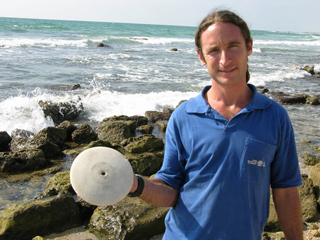
A marble discus, which dates to the fifth-fourth century BCE, was found by David Shalom, a lifeguard, while diving in the antiquities site of Yavne-Yam, next to Palmahim beach. The lifeguard gave the discus to the Israel Antiquities Authority.


The white discus, which is flat on one side and convex on the other, measures 20 centimeters in diameter. In the middle of the discus are a perforation and the remains of two circles that are painted around the center of it. This object has been identified as representing the pupil of an eye that adorned the bow of an ancient warship or cargo ship. Its Greek name is ophtalmoi and a lead coupling or bronze nail that was driven through the hole in the center of the discus was used to attach the object to the hull of the ship.

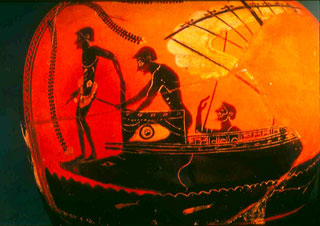
According to Kobi Sharvit, the director of the Marine Unit of the Israel Antiquities Authority, “We know from drawings on pottery vessels, pithoi and ancient coins, as well as from historic sources of the fifth century BCE that this model was very common on the bows of ships and was used to protect them from the evil eye and envy, and was meant as a navigation aid and to act as a pair of eyes which looked ahead and warned of danger.


Courtesy of The British Museum

"This decoration is also prevalent today on modern boats in Portugal, Malta, Greece and in the Far East.

Even though this item was common and one would expect that many such objects would be found, it is actually quite rare: to date we know of only four other such ancient artifacts that were discovered in the Mediterranean Sea. Two were recovered from ancient cargo shipwrecks (440-425 BCE) that were found along the western coast of Turkey between the islands of Samos and Chios at the site of Tektas Burnu and two items were recovered from the Mediterranean Sea off the coast of Israel: one from the Carmel coast and the other which was just discovered at Yavne-Yam.

The port city of Yavne-Yam was first settled in the Middle Bronze Age and was inhabited until the Middle Ages. Near the tell is a natural anchorage that is protected by kurkar reefs in the west and two capes located to the south and north.

During the course of archaeological surveys that have been performed there by the Marine Unit of the Israel Antiquities Authority since the 1980’s artifacts were found that originated in shipwrecks, including anchors of various sizes and weights with one to three holes in them, fishing equipment, lead connectors and stone plumbs that belong to stone anchors. Other objects that were found which were used onboard boats include an oven for cooking that is made of lead, grindstones, stone bowls, fishing gear (bronze hooks, lead weights for fishing nets and lead plumbs for measuring the depth of the seabed), as well as storage jars, amphorae, bowls and cooking pots that date to the Late Bronze Age, Persian, Hellenistic, Roman and Byzantine periods. All of these bear witness to the extensive commercial activity that transpired there.

Most of the pottery vessels are of types that were manufactured in the Land of Israel or in the Eastern Mediterranean; however, some were imported from more distant lands along the Mediterranean Sea. A concentration of artifacts was discovered at the site which date to the Bronze Age and include dozens of gold objects (earrings, beads, pieces of jewelry and waste from the jewelry industry) and a hematite seal of Syrian provenance. The concentration was located scattered in an area where twenty hematite seals, bronze arrowheads, axes and two small statues of the god Ba’al were found in the past. The archaeological finds indicate that the anchorage was used continuously from the Late Bronze Age until Middle Ages.

Hasmonean rule reached the Negev

The Israel Antiquities Authority has found physical proof that the Hasmoneans' rule, which lasted from the middle of the second century BCE to the middle of the first, extended deep into the Negev.

"We are talking about a revolutionary discovery that will redraw the maps of the region which describe that era," Dr. Tali Erickson-Gini, the scientific editor of the excavation, said in a statement.

"Despite the evidence of the historian Josephus, according to which [the Hasmoneans' rule extended south of Gaza], no clear archeological proof of this has been found in the field. And it was because of this lack of proof that historians were inclined to dismiss the possibility that the Hasmoneans did indeed control the Negev."

The excavation centered around one of the sites - Horvat Ma'agura, about two miles west of the Sde Boker region - where the "Incense Road" ran between Petra and Gaza.

The IAA found that after the Hasmoneans conquered Gaza in 99 BCE, King Alexander Jannaeus - the great-grandson of Hasmonean leader Matityahu - built a fortress that was used to halt the Nabateans along the Incense Road.


The layout of the fortress originally led researchers to believe that it was a Roman stronghold from centuries later, but it is now clear that the Hasmoneans used the fortress to keep enemies out of their land until 66 BCE.

The IAA also found coins of Jannaeus at Nessana - about 40 kilometers west of Horvat Ma'agura - further solidifying proof that the Negev was under Hasmonean rule.

But the IAA also discovered what some might consider a disconcerting fact about the type of soldiers that Jannaeus used to fight off the Nabateans.

"The army that Alexander Jannaeus engaged was for the most part a mercenary force that was composed of non-Jewish soldiers," Erickson-Gini said. "We were able to confirm this based on the imported vessels that were found alongside the Jewish vessels there, and from the wine that was brought there from abroad. Apparently Alexander Jannaeus could not depend on Jewish soldiers because of the sharp political divisions that existed among the people."

Friday, December 18, 2009

Farmers Became Amorites 2000 BC

The climate change that took place in Mesopotamia around 2000 BC did not lead to war, but in fact led to the development of a new shared identity. Although increasing drought often leads to competition and conflict, there seems to be no evidence of this in northern Mesopotamia according to Dutch researcher Arne Wossink.

Wossink studied how the farmers and nomads in northern Mesopotamia -- currently the border area between Turkey, Syria and Iraq -- responded to the changes in climate that took place between 3000 and 1600 BC. He expected to find considerable evidence of competition: as food and water became scarcer the natural result could well be conflict. He discovered, however, that the farmers developed much closer bonds with the semi-nomadic cattle farmers.

Competition caused by rapid population growth

The archaeologist analysed previous finds from the area as well as ancient texts. His research shows the importance of not seeing climate as the only cause: human responses in particular play a major role. Wossink studied three regions and only one of these demonstrated traces of competition between settlements. However, the completion in this area was probably due to the strong population growth that was taking place there.

Access to trade

The farmers in northern Mesopotamia chose not to compete with one another, but to adapt to the circumstances. Wossink shows that the arrival of the Amorites, who had until that time been regarded as (semi-)nomadic, was not simply a process of infiltration. The rise in the Amorites should be seen as the spread of an identity that brought crop farmers and cattle farmers together. By adopting the Amoritic identity, the farmers gained access to a large trading network that was necessary to survive the period of drought.

Valley in Jordan Inhabited&Irrigated for 13,000 Yrs

You can make major discoveries by walking across a field and picking up every loose item you find. Dutch researcher Eva Kaptijn succeeded in discovering -- based on 100,000 finds -- that the Zerqa Valley in Jordan had been successively inhabited and irrigated for more than 13,000 years. But it was not just communities that built irrigation systems: the irrigation systems also built communities.

Archaeologist Eva Kaptijn has given up digging in favour of gathering. With her colleagues, she has been applying an intensive field exploration technique: 15 metres apart, the researchers would walk forward for 50 metres. On the outward leg, they'd pick up all the earthenware and, on the way back, all of the other material. This resulted in more than 100,000 finds, varying from about 13,000 years to just a few decades old.

Based on further research on the finds and where they were located, Kaptijn succeeded in working out the extent of habitation in the Zerqa Valley in Jordan over the past millennia. The area where she undertook her research is also called the Zerqa Triangle; it is bounded by the River Zerqa and forms part of the Jordan Valley. The area covers roughly 72 square kilometres. Kaptijn discovered that the triangle had been inhabited, on and off, for thousands of years, but that this habitation was always highly dependent on the irrigation methods used by those who lived there. While the soil in the valley is very rich, there was usually not enough rainfall to cultivate plants without some additional irrigation.

Irrigation shapes the community

The irrigation methods exerted a major influence on the people who lived in the valley; power was often dependent on controlling the allocation of water. Kaptijn discovered that the type of irrigation system could result in a community of internally egalitarian tribes, with these tribes being linked to each other in a strict, hierarchical order. At other times, the valley was actually dominated by a large-scale, almost capitalist cultivation of sugar cane.

Wednesday, December 16, 2009

Jesus-era shrouded man in Jerusalem had leprosy


Burial shroud proves Turin Shroud not from 1st century C.E. Jerusalem


IMAGE: This is part of the tomb where the shrouded man was found. Note the remains of plaster around the entrance.


The DNA of a 1st century shrouded man found in a tomb on the edge of the Old City of Jerusalem has revealed the earliest proven case of leprosy. Details of the research will be published December 16 in the PloS ONE Journal.

The burial cave, which is known as the Tomb of the Shroud, is located in the lower Hinnom Valley and is part of a 1st century C.E. cemetery known as Akeldama or 'Field of Blood' (Matthew 27:3-8; Acts 1:19) - next to the area where Judas is said to have committed suicide. The tomb of the shrouded man is located next to the tomb of Annas, the high priest (6-15 C.E.), who was the father in law of Caiaphas, the high priest who betrayed Jesus to the Romans. It is thus thought that this shrouded man was either a priest or a member of the aristocracy. According to Prof. Gibson, the view from the tomb would have looked directly toward the Jewish Temple.


IMAGE: This is a sample of hair of the shrouded man, which had been ritually cut before burial.


No second burial

What is particularly rare about this tomb is that it was clear this man, which is dated by radiocarbon methods to 1-50 C.E., did not receive a secondary burial. Secondary burials were common practice at the time, where the bones were removed after a year and placed in an ossuary (a stone bone box). In this case, however, the entrance to this part of the tomb was completely sealed with plaster. Prof. Spigelman believes this is due to the fact that this man had suffered from leprosy and died of tuberculosis, as the DNA of both diseases was found in his bones.

Historically, disfiguring diseases - particularly leprosy - caused the afflicted individuals to be ostracized from their communities. However, a number of indications – the location and size of the tomb, the type of textiles used as shroud wrappings, and the clean state of the hair – suggest that the shrouded individual was a fairly affluent member of society in Jerusalem and that tuberculosis and leprosy may have crossed social boundaries in the first century C.E.

Disproves Turin Shroud?

This is also the first time fragments of a burial shroud have been found from the time of Jesus in Jerusalem. The shroud is very different to that of the Turin Shroud, hitherto assumed to be the one that was used to wrap the body of Jesus. Unlike the complex weave of the Turin Shroud, this is made up of a simple two-way weave, as the textiles historian Dr. Orit Shamir was able to show.


IMAGE: This is a sample of the shroud which shows the simple two-way weave used for burial shrouds in 1st century C.E. Jerusalem.


Based on the assumption that this is representative of a typical burial shroud widely used at the time of Jesus, the researchers conclude that the Turin Shroud did not originate from Jesus-era Jerusalem.

The excavation also found a clump of the shrouded man's hair, which had been ritually cut prior to his burial. These are both unique discoveries because organic remains are hardly ever preserved in the Jerusalem area owing to high humidity levels in the ground.

Social health in antiquity

According to Prof. Spigelman and Prof. Greenblatt, the origins and development of leprosy are largely obscure. Leprosy in the Old Testament may well refer to skin rashes such as psoriasis. The leprosy known to us today was thought to have originated in India and brought over to the Near East and to Mediterranean countries in the Hellenistic period. The results from the first-century C.E. Tomb of the Shroud fill a vital gap in our knowledge of this disease.

Furthermore, the new research has shown that molecular pathology clearly adds a new dimension to the archaeological exploration of disease in ancient times and provides us with a better understanding of the evolution, geographic distribution and epidemiology of disease and social health in antiquity.

The co-infection of both leprosy and tuberculosis here and in 30 percent of DNA remains in Israel and Europe from the ancient and modern period provided evidence for the postulate that the medieval plague of leprosy was eliminated by an increased level of tuberculosis in Europe as the area urbanized.

Tuesday, December 15, 2009

Beehives In Ancient Near East Discovered

Archaeological proof of the Biblical description of Israel really as "the land of milk and honey" (or at least the latter) has been uncovered by researchers from the Hebrew University of Jerusalem Institute of Archaeology.


Amihai Mazar, Eleazar L. Sukenik Professor of Archaeology at the Hebrew University, revealed that the first apiary (beehive colony) dating from the Biblical period has been found in excavations he directed this summer at Tel Rehov in Israel's Beth Shean Valley. This is the earliest apiary to be revealed to date in an archaeological excavation anywhere in the ancient Near East, said Prof. Mazar. It dates from the 10th to early 9th centuries B.C.E.

Tel Rehov is believed to have been one of the most important cities of Israel during the Israelite monarchy. The beehives there were found in the center of a built-up area there that has been excavated since 1997 by Dr. Nava Panitz-Cohen of the Hebrew University. Three rows of beehives were found in the apiary, containing more than 30 hives. It is estimated, however, based on excavations to date, that in all the total area would have contained some 100 beehives.

Each row contained at least three tiers of hives, each of which is a cylinder composed of unbaked clay and dry straw, around 80 centimeters long and 40 centimeters in diameter.

One end of the cylinder was closed and had a small hole in it, which allowed for the entry and exit of the bees. The opposite end was covered with a clay lid that could be removed when the beekeeper extracted the honeycombs. Experienced beekeepers and scholars who visited the site estimated that as much as half a ton of honey could be culled each year from these hives.

Prof. Mazar emphasizes the uniqueness of this latest find by pointing out that actual beehives have never been discovered at any site in the ancient Near East. While fired ceramic vessels that served as beehives are known in the Hellenistic and Roman periods, none were found in situ, and beekeeping on an industrial level such as the apiary at Tel Rehov is hitherto unknown in the archaeological record. Pictorial depictions of apiaries are known from Pharaonic Egypt, showing extraction of honey from stacked cylinders which are very similar to those found at Tel Rehov.

Cylindrical clay beehives placed in horizontal rows, similar to those found at Tel Rehov, are well-known in numerous contemporary traditional cultures in Arab villages in Israel, as well as throughout the Mediterranean. The various products of beehives are put to diverse use: the honey is, of course, a delicacy, but is also known for its medicinal and cultic value. Beeswax was also utilized in the metal and leather industries, as well as for writing material when coated on wooden tablets.

The term "honey" appears 55 times in the Bible, 16 of which as part of the image of Israel as "the land of milk and honey". It is commonly believed that the term refers to honey produced from fruits such as dates and figs. Bees' honey, on the other hand, is mentioned explicitly only twice, both related to wild bees. The first instance is how Samson culled bees' honey from inside the corpse of the lion in the Soreq Valley (Judges 14: 8-9). The second case is the story of Jonathan, King Saul's son, who dipped his hand into a honeycomb during the battle of Mikhmash (Samuel I 14:27).

While the Bible tells us nothing about beekeeping in Israel at that time, the discovery of the apiary at Tel Rehov indicates that beekeeping and the extraction of bees' honey and honeycomb was a highly developed industry as early as the First Temple period. Thus, it is possible that the term "honey" in the Bible indeed pertains to bees' honey.

Cultic objects were also found in the apiary, including a four-horned altar adorned with figures of naked fertility goddesses, as well as an elaborately painted chalice. This could be evidence of deviant cultic practices by the ancient Israelites related to the production of honey and beeswax.

Study of the beehives found at Tel Rehov is being conducted with the participation of various researchers. Dr. Guy Bloch of the Silberman Institute of Life Sciences of the Hebrew University is studying the biological aspects of the finds; he already discovered parts of bees' bodies in the remains of honeycomb extracted from inside the hives. Dr. Dvori Namdar of the Weizmann Institute of Science succeeded in identifying beeswax molecules from the walls of the beehives, and Prof. Mina Evron from Haifa University is analyzing the pollen remains in the hives.

Dating of the beehives was done by measuring the decaying of the 14C isotope in organic materials, using grains of wheat found next to the beehives. This grain was dated at the laboratory of Groningen University in Holland to the period between the mid-10th century B.C.E. until the early 9th century B.C.E. This is the time period attributed to the reign of King Solomon and the first kings of the northern Kingdom of Israel following the division of the monarchy. The city of Rehov is indeed mentioned in an Egyptian inscription dating to the time of the Pharaoh Shoshenq I (Biblical Shishak), whom the Bible notes as the contemporary of King Solomon and who invaded Israel following that monarch's death.

A particularly fascinating find at the site is an inscription on a ceramic storage jar found near the beehives that reads "To nmsh". This name was also found inscribed on another storage jar from a slightly later occupation level at Tel Rehov, dated to the time of the Omride Dynasty in the 9th century BCE. Moreover, this same name was found on a contemporary jar from nearby Tel Amal, situated in the Gan HaShelosha National Park (Sachne).

The name "Nimshi" is known in the Bible as the name of the father and in several verses the grandfather of Israelite King Jehu, the founder of the dynasty that usurped power from the Omrides (II Kings: 9-12). It is possible that the discovery of three inscriptions bearing this name in the same region and dating to the same period indicates that Jehu's family originated from the Beth Shean Valley and possibly even from the large city located at Tel Rehov. The large apiary discovered at the site might have belonged to this illustrious local clan.