Lecturer in population, medical and evolutionary genomics, University of Sheffield
Disclosure statement
Eran Elhaik consults DNA Diagnostics Centre.
Eran Elhaik was partially supported by a Genographic grant (GP 01-12),
The Royal Society International Exchanges Award to E.E. and Michael
Neely (IE140020), MRC Confidence in Concept Scheme award 2014-University
of Sheffield to E.E. (Ref: MC_PC_14115), and a National Science
Foundation grant DEB-1456634 to Tatiana Tatarinova and E.E.
At 1,000 years, the search for the location of Ashkenaz
– thought to be the birthplace of Ashkanazic Jews and the Yiddish
language – is one of the longest quests in human history. It is perhaps
second only in length to the search for Noah’s Ark which began in the
3rd century AD.
The place name Ashkenaz occurs three times in the Bible, but by the
Middle Ages the exact origin of Ashkenaz was forgotten. Because of the
migration of the Ashkenazic Jews it later became associated with Germany.
This led to all German Jews being considered “Ashkenazic”, a term which
was then applied to central and eastern European Jews who follow Ashkenazic religious customs and who speak Yiddish.
The Yiddish language – which consists of Hebrew, German, Slavic
elements and is written in Aramaic – has been spoken at least since the
9th century AD, but its origins have been debated by linguists for
several centuries. While some have suggested a German origin, others believe a more complex beginning for the language,
starting in Slavic lands in Khazaria – the Middle Age Khazar Empire
that covered present-day southern Russia, Kazakhstan, Ukraine, and parts
of the Caucasus – and followed by Ukraine, and finally Germany.
Although the language adopted a German vocabulary it retained its Slavic
grammar – which is why Yiddish is often referred to as “bad German”.
The inability of linguists to reach a consensus have led some to decry that the mystery of where Yiddish came from will never be solved. But now for the first time a pioneering tool that converts genome data into ancestral coordinates, is helping to pinpoint the DNA of Yiddish speakers.
In the largest genomic study of Ashkenazic Jews,
and the first one to study Yiddish speakers, we applied our Geographic
Population Structure (GPS) tool – which operates in a similar way to the
sat nav in your car – to the genomes of more than 360 Yiddish and
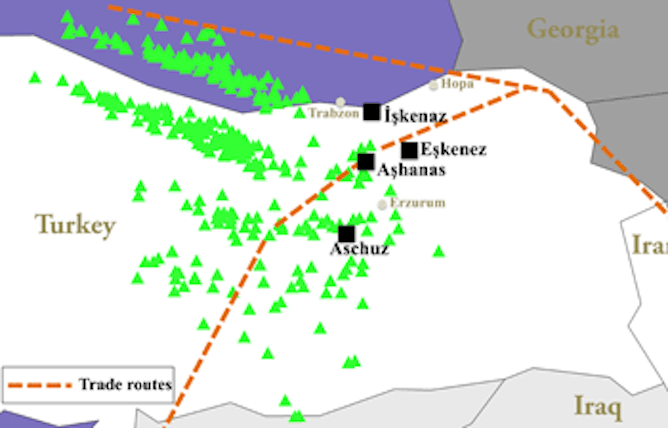
non-Yiddish speaking Ashkenazic Jews. DNA of Yiddish speakers could have originated from four ancient villages in north-west Turkey.Author provided, Author provided
Surprisingly, our GPS homed in on north-east Turkey, where we found four primeval villages, one of which was abandoned in the mid-7th century AD.
These ancient villages identified by the GPS tool are clustered close to the Silk Road – the ancient network of trade routes – and are named Iskenaz, Eskenaz, Ashanaz, and Ashkuz. And it is likely that these are the villages that mark the location of the lost lands of Ashkenaz.
The history of a people
Located on the cross roads of ancient trade routes, this region suggests that the Yiddish language was developed by Iranian and Ashkenazic Jews as they traded on the Silk Road from the first centuries AD to around the 9th century when they arrived in Slavic lands.
Putting together evidence from linguistic, history, and genetics, we concluded that the ancient Ashkenazic Jews were merchants who developed Yiddish as a secret language – with 251 words for “buy” and “sell” – to maintain their monopoly. They were known to trade in everything from fur to slaves.
By the 8th century the words “Jew” and “merchant” were practically synonymous, and it was around this time that Ashkenazic Jews began relocating from ancient Ashkenaz to the Khazar Empire to expand their mercantile operations.
This Jewish migration led to some of the Turkic Khazar rulers and numerous eastern Slavs living within the Khazar Empire to convert to Judaism so they didn’t miss out on the lucrative Silk Road trade between Germany and China.
But the demise of Khazaria due to continued invasions and finally the Black Death devastated this last Jewish Empire of Khazaria. This led to the Ashkenazic Jews splitting into two groups – some remaining in the Caucasus and others migrating into eastern Europe and Germany.
The two groups still called themselves Ashkenazic Jews, however the name Ashkenaz became more strongly associated with Germany and the the European group – for whom Yiddish became their primary language.
A secret language
Since north-east Turkey is the only place in the world where the place names of Iskenaz, Eskenaz, Ashanaz, and Ashkuz exist this strongly implies that Yiddish was established around the first millennium at a time when Jewish traders moved goods from Asia to Europe. This was done by developing the language of Yiddish, which very few can speak or understand other than Jews.
Further evidence to the origin of Ashkenazic Jews can be found in many customs – such as the breaking of a glass at a wedding ceremony and placing stones over tombstones, which were probably introduced by Slavic converts to Judaism.
By studying the origin of Yiddish using our GPS technology, combined with a citizen science approach, we were able to shed light on one of the most forgotten chapters of history and demonstrate the use of bio-geographical genetic tools to study the origin of languages. For Ashkanazic Jews these are the ties that bind their history, culture, behaviour, and identity.
The South Caucasus--home to the countries of Georgia, Armenia, and Azerbaijan--geographically links Europe and the Near East. The area has served for millennia as a major crossroads for human migration, with strong archaeological evidence for big cultural shifts over time. And yet, surprisingly, ancient mitochondrial DNA evidence reported in Current Biology on June 29 finds no evidence of any upheaval over the last 8,000 years.
Mitochondria are passed from mothers to their children. Therefore, the study of mitochondrial genomes enables scientists to trace the unique history of females over time.
"We analyzed many ancient and modern mitochondrial genomes in parts of the South Caucasus and found genetic continuity for at least 8,000 years," said Ashot Margaryan and Morten E. Allentoft from Centre for GeoGenetics at the Natural History Museum of Denmark. "In other words, we could not detect any changes to the female gene pool over this very long time frame. This is highly interesting because this region has experienced multiple cultural shifts over the same time period, but these changes do not appear to have had a genetic impact--at least not on the female population."
The researchers were interested to study this part of the world because of its position as a cultural crossroads since ancient times. It's also known as an important area for the potential origin and spread of Indo-European languages.
To shed light on the maternal genetic history of the region, the researchers analyzed the complete mitochondrial genomes of 52 ancient skeletons from present-day Armenia and Artsakh, an unrecognized republic bordering Armenia and Azerbaijan. Those specimens span 7,800 years of history. Allentoft's team combined this new data with 206 mitochondrial genomes of modern Armenians and previously published data representing more than 480 individuals from seven neighboring populations.
Their analyses suggest that the population size in the region rapidly increased after the last glacial maximum, about 18,000 years ago. The researchers also used several sophisticated analyses to test five different demographic scenarios that could explain the formation of the modern Armenian gene pool. Despite well-documented cultural shifts in the South Caucasus across the time period in question, their results strongly favor genetic continuity in the maternal gene pool, the researchers report.
The findings imply that the female population in at least some parts of the South Caucasus has been highly stable through many cultural shifts that have occurred over thousands of years. They also suggest that documented migrations into this region during the last 2,000 to 3,000 years have had little genetic impact on the local female population.
Margaryan says the findings suggest either that cultural shifts occurred primarily through the exchange of ideas or that it was primarily men who moved into new territories, bringing new cultural ideas along with them.
The researchers say the next step is to explore these questions in whole-genome data to see if it tells the same story. They also hope to expand the study by including both modern and ancient samples from neighboring countries, which could involve collaborations with researchers in Georgia and Azerbaijan.
A discovery of multiple toothpick grooves on teeth and signs of other manipulations by a Neanderthal of 130,000 years ago are evidence of a kind of prehistoric dentistry, according to a new study led by a University of Kansas researcher.
"As a package, this fits together as a dental problem that the Neanderthal was having and was trying to presumably treat itself, with the toothpick grooves, the breaks and also with the scratches on the premolar," said David Frayer, professor emeritus of Anthropology. "It was an interesting connection or collection of phenomena that fit together in a way that we would expect a modern human to do. Everybody has had dental pain, and they know what it's like to have a problem with an impacted tooth."
The Bulletin of the International Association for Paleodontology recently published the study. The researchers analyzed four isolated but associated mandibular teeth on the left side of the Neanderthal's mouth. Frayer's co-authors are Joseph Gatti, a Lawrence dentist, Janet Monge, of the University of Pennsylvania; and, Davorka Radovčić, curator at the Croatian Natural History Museum.
The teeth were found at Krapina site in Croatia, and Frayer and Radovčić have made several discoveries about Neanderthal life there, including a widely recognized 2015 study published in PLOS ONE about a set of eagle talons that included cut marks and were fashioned into a piece of jewelry.
The teeth and all the Krapina Neanderthal fossils were discovered more than 100 years ago from the site, which was originally excavated between 1899-1905.
However, Frayer and Radovčić in recent years have reexamined many items collected from the site.
In this case, they analyzed the teeth with a light microscope to document occlusal wear, toothpick groove formation, dentin scratches, and ante mortem, lingual enamel fractures.
Even though the teeth were isolated, previous researchers were able to reconstruct their order and location in the male or female Neanderthal's mouth. Frayer said researchers have not recovered the mandible to look for evidence of periodontal disease, but the scratches and grooves on the teeth indicate they were likely causing irritation and discomfort for some time for this individual.
They found the premolar and M3 molar were pushed out of their normal positions. Associated with that, they found six toothpick grooves among those two teeth and the two molars further behind them.
"The scratches indicate this individual was pushing something into his or her mouth to get at that twisted premolar," Frayer said.
The features of the premolar and third molar are associated with several kinds of dental manipulations, he said. Mostly because the chips of the teeth were on the tongue side of the teeth and at different angles, the researchers ruled out that something happened to the teeth after the Neanderthal died.
Past research in the fossil record has identified toothpick grooves going back almost 2 million years, Frayer said. They did not identify what the Neanderthal would have used to produce the toothpick grooves, but it possibly could have been a bone or stem of grass.
"It's maybe not surprising that a Neanderthal did this, but as far as I know, there's no specimen that combines all of this together into a pattern that would indicate he or she was trying to presumably self-treat this eruption problem," he said.
The evidence from the toothpick marks and dental manipulations is also interesting in light of the discovery of the Krapina Neanderthals' ability to fashion eagle talons fashioned into jewelry because people often think of Neanderthals as having "subhuman" abilities.
"It fits into a pattern of a Neanderthal being able to modify its personal environment by using tools," Frayer said, "because the toothpick grooves, whether they are made by bones or grass stems or who knows what, the scratches and chips in the teeth, they show us that Neanderthals were doing something inside their mouths to treat the dental irritation. Or at least this one was.
In Turkey, Carved Skulls Provide the First Evidence of a Neolithic "Skull Cult": Three carved skull fragments uncovered at a Neolithic dig site in Turkey feature modifications not seen before among human remains of the time, researchers say. Thus, these modified skull fragments could point to a new "skull cult" -- or ritual group -- from the Neolithic period.
This is a pillar from Building D at Göbekli Tepe seen from the southeast. CREDIT German Archaeological Institute (DAI)
Throughout history, people have valued skulls for different reasons, from ancestor worship to the belief that human skulls transmit protective properties. This focus on the skull has led to the establishment of the term skull cult in anthropology, and various such cults -- each with characteristic modifications to skull bones -- have been catalogued.
Recently, Julia Gresky and colleagues observed a previously unknown type of modification in three partial skulls uncovered at Göbekli Tepe. Each skull had intentional deep incisions along its sagittal axes and one of those skulls also displayed a drilled hole in the left parietal bone, as well as red ochre remnants, the authors say.
By using different microscopic techniques to analyze the fragments, Gresky et al. verified that the carvings were executed using lithic tools, thus ruling out natural causes, like animal gnawing. In addition, they were able to discount scalping as a source of the marks, due to the depth of the carvings; however, other minor cut-marks on the skulls show signs of possible defleshing, they say. More likely, the skulls were carved to venerate ancestors not long after their death, say the authors, or, to put recently "dispatched" enemies on display. These findings present the very first evidence for treatment of the dead at Göbekli Tepe.
Using five different scientific approaches, a team including University of Wyoming researchers has given considerable support to the idea that humans lived year-round in the Andean highlands of South America over 7,000 years ago.
Examining human remains and other archaeological evidence from a site at nearly 12,500 feet above sea level in Peru, the scientists show that intrepid hunter-gatherers -- men, women and children -- managed to survive at high elevation before the advent of agriculture, in spite of lack of oxygen, frigid temperatures and exposure to elements.
"This gives us a very strong baseline to help understand the rates of cultural and genetic change in the Andean highlands, a region known for the domestication of alpaca, potatoes and other plants; emergence of state-level political and economic complexity; and rapid human adaptation to high-elevation life," says Randy Haas, a postdoctoral research associate in the University of Wyoming's Department of Anthropology and the team's leader.
The research appears in the July issue of Royal Society Open Science, a peer-reviewed, open-access scientific journal. Along with Haas, the second author is Ioana Stefenescu, graduate student in UW's Department of Geology and Geophysics. Also contributing to the paper were Alexander Garcia-Putnam, doctoral student in the UW Department of Anthropology; Mark Clementz, associate professor in the Department of Geology and Geophysics; Melissa Murphy, associate professor in the Department of Anthropology; and researchers from the University of California-Davis, the University of California-Merced, the University of Arizona and Peruvian institutions.
Excavations led by Haas at the site in southern Peru produced the remains of 16 people, along with more than 80,000 artifacts, dating to as early as 8,000 years ago. Evidence from that site, as well as others, has led some researchers to estimate that hunter-gatherers began living in the Andes around 9,000 years ago, but debate has continued over whether that human presence was permanent or seasonal.
The research team led by Haas took five different approaches to test whether there was early permanent use of the region: studying the human bones for oxygen and carbon isotopes; the travel distances from the site to low-elevation zones; the demographic mixture of the human remains; and the types of tools and other materials found with them.
The scientists found low oxygen and high carbon isotope values in the bones, revealing the distinct signature of permanent high-elevation occupation; that travel distances to low-elevation zones were too long for seasonal human migration; that the presence of women and small children meant such migration was highly unlikely; and that almost all of the tools used by the hunter-gatherers were made with high-elevation stone material, not brought from elsewhere.
"These results constitute the strongest evidence to date that people were living year-round in the Andean highlands at least 7,000 years ago," Haas says. "Such high-elevation environments were among the last frontiers of human colonization, and this knowledge holds implications for understanding rates of genetic, physiological and cultural adaption in the human species."
Tel Aviv University archaeologists have revealed that cloth samples found in the Israeli desert present the earliest evidence of plant-based textile dyeing in the region. They were found at a large-scale copper smelting site and a nearby temple in the copper ore district of Timna in Israel's Arava desert and are estimated to date from the 13th-10th centuries BCE.
CREDIT Clara Amit, courtesy of the Israeli Antiquities Authority.
The wool and linen pieces shed light on a sophisticated textile industry and reveal details about a deeply hierarchical society dependent on long-distance trade to support its infrastructure in the unforgiving desert.
The study was published in PLOS ONE. It was led by Dr. Erez Ben-Yosef of TAU's Department of Archaeology and Near Eastern Cultures and Dr. Naama Sukenik of the Israel Antiquities Authority; and conducted in collaboration with Vanessa Workman of TAU's Department of Archaeology, Dr. Orit Shamir of the Israel Antiquities Authority and Dr. Zohar Amar, Dr. Alexander Varvak and Dr. David Iluz of Bar-Ilan University.
Textiles suggest significant social stratification
"This was clearly a formative period, with local kingdoms emerging and replacing Egyptian hegemony in Canaan," Dr. Ben-Yosef said. "These beautiful masterpieces of weaving and dyeing -- the first evidence of industrial dyeing at the time, of wash-resistant color on textile -- support the idea of a strong, hierarchical Edomite Kingdom in Timna at the time.
"It is apparent that there was a dominant elite in this society that took pains to dress according to their 'class,' and had the means to engage in long-distance trade to transport these textiles -- and other materials and resources -- to the desert."
The research suggests a sophisticated dyeing process involving cooking colorful plants in water, then adding fleece fixed with alum to create a chemical bond between fabrics and dye. The result is a wash-resistant colorful fabric.
The researchers radiocarbon-dated the textile pieces and harnessed gas chromatography to identify the cloth's organic molecules. They found "red" molecules produced from the madder plant and "blue" molecules from the woad plant.
"Both plants were known in antiquity as sources of organic dyes," said Dr. Ben-Yosef. "We know that these plants were used to create elaborate costumes during the Roman period, more than a thousand years later. Now we have evidence in the region of an Edomite society wearing textiles produced the same way, versus an earlier 'primitive' smearing of color on fabric."
"We can make many inferences according to this discovery," Dr. Ben-Yosef continued. "To force a large group of people to work in dangerous mines in the desert, you need a strong ruling party -- an elite that probably wore exquisite clothes to further distinguish themselves. The smelters, working in furnaces, were considered 'magicians' or even priests, and they probably wore fine clothing too. They represented the highest level of society, managing a sensitive and complex process to produce copper from rock."
Evidence of long-distance trade
The textile dye presents evidence of long-distance trade, Dr. Ben-Yosef noted. "Clearly this is not local. These plants require a lot of water and probably hail from the Mediterranean regions. The dyeing required special craftspeople, an entire industry that could not have subsisted in the desert. If Jerusalem was indeed opulent in the time of King Solomon, and the Temple covered in copper, we can assume a link to that kingdom."
The textiles are currently being stored in special facilities at the Israel Antiquities Authority and will one day be presented in museums in Israel and elsewhere.
Toe prosthesis of a female burial from the Theban tomb TT95, early first millennium BC. Egyptian Museum Cairo, JE100016a. CREDIT University of Basel, LHTT. Image: Matja� Kačičnik
It is likely to be one of the oldest prosthetic devices in human history: Together with other experts, Egyptologists from the University of Basel have reexamined an artificial wooden big toe. The find is almost 3000 years old and was discovered in a female burial from the necropolis of Sheikh ´Abd el-Qurna close to Luxor. This area is currently being studied using state-of-the-art methods.
The international team investigated the one-of-a-kind prosthesis using modern microscopy, X-ray technology, and computer tomography. They were able to show that the wooden toe was refitted several times to the foot of its owner, a priest's daughter. The researchers also newly classified the used materials and identified the method with which the highly developed prosthesis was produced and utilized. Experts from the Egyptian Museum in Cairo - where the prosthetic device was brought to after it had been found - and the Institute of Evolutionary Medicine at the University of Zurich were also involved in this study.
The artificial toe from the early first millennium BC testifies to the skills of an artisan who was very familiar with the human physiognomy. The technical know-how can be seen particularly well in the mobility of the prosthetic extension and the robust structure of the belt strap. The fact that the prosthesis was made in such a laborious and meticulous manner indicates that the owner valued a natural look, aesthetics and wearing comfort and that she was able to count on highly qualified specialists to provide this.
Life histories of a burial ground
The prosthesis from the Early Iron Age was found in a plundered shaft tomb that was cut into the bedrock of an older, long time idle burial chapel at the graveyard hill of Sheikh ´Abd el-Qurna to the west of Luxor. This chapel belongs to a group of monumental rock-cut tombs from the late 15th century BC which were built for a small upper class that was close to the royal family. Since the end of 2015, the University of Basel has been studying this ancient Egyptian elite cemetery, its long history of usage, and surroundings.
For this project, funded by the Swiss National Science Foundation, microanalytic, scientifically oriented methods, as well as precision technology for surveying and photography were used. The researchers are looking into the materiality of archaeological remains and are thus gaining insight into the life histories of building structures and objects. These material biographies can provide information about the manufacturing practices, usages, personal skills, habits and preferences of people who were in contact with these objects.
A necropolis in 3-D
The oldest known tombs from Sheikh ´Abd el-Qurna date back to the early second millennium BC. The cemetery saw its heyday in the 15th century BC. However, many of these rock-cut structures were reused and in parts remodeled several times for burials during the first millennium BC. Much later, they served as dwellings mostly for locals - a process that began with the early Christian hermits and only ended in the early 20th century.
Together with the experts for geodesy and geology from the ETH Zurich, the Basel team of archaeologists is scientifically assessing the natural and artificial structures of the excavation area and its surroundings. The specialists are currently developing geometric precise digital elevation, landscape, and architecture models for this area. These will then be combined to an archaeological and geological 3-D map that will illustrate the morphology of the terrain as well as the investigated subterranean structures. On that basis, the researchers want to reconstruct and simulate the development of the cemetery and its use phases.