Ω
Researchers from George Washington University and the Smithsonian Institution have discovered evidence to debunk the theory that Neandertals’ disappearance was caused in part by a deficient diet – one that lacked variety and was overly reliant on meat. After discovering starch granules from plant food trapped in the dental calculus on 40-thousand-year-old Neandertal teeth, the scientists believe that Neandertals ate a wide variety of plants and included cooked grains as part of a more sophisticated, diverse diet similar to early modern humans.
“Neandertals are often portrayed as very backwards or primitive,” said Amanda Henry, lead researcher and a post-doctoral researcher at GW. “Now we are beginning to understand that they had some quite advanced technologies and behaviors.”
Dr. Henry made this discovery together with Alison Brooks, professor of anthropology and international affairs at GW, and Dolores Piperno.
The discovery of starch granules in the calculus on Neandertal teeth provides direct evidence that they made sophisticated, thoughtful food choices and ate more nutrient-rich plants, for example date palms, legumes and grains such as barley. Until now, anthropologists have hypothesized that Neandertals were outlived by early modern humans due in part to the former’s primitive, deficient diet, with some scientists arguing Neandertals’ diets were specialized for meat-eating. As such, during major climate swings Neandertals could be outcompeted by early humans who incorporated diverse plant foods available in the local environment into their diets.
Drs. Henry, Brooks and Piperno’s discovery suggests otherwise. The researchers discovered starch granules in dental calculus, which forms when plaque buildup hardens, on the fossilized teeth of Neandertal skeletons excavated from Shanidar Cave in Iraq and Spy Cave in Belgium. Starch granules are abundant in most human plant foods, but were not known to survive on fossil teeth this old until this study. The researchers’ findings indicate that Neandertals’ diets were more similar to those of early humans than originally thought. The researchers also determined from alterations they observed in the starch granules that Neandertals prepared and cooked starch-rich foods to make them taste better and easier to digest.
Tuesday, December 28, 2010

Secrets of an Ancient Tel Aviv Fortress Revealed
Ω
Tel Qudadi, an ancient fortress located in the heart of Tel Aviv at the mouth of the Yarkon River, was first excavated more than 70 years ago — but the final results of neither the excavations nor the finds were ever published. Now, research on Tel Qudadi by archaeologists at Tel Aviv University has unpeeled a new layer of history, indicating that there is much more to learn from the site, including evidence that links ancient Israel to the Greek island of Lesbos.

An aerial view of the remains of the Tel Qudadi fortress
Probably not King Solomon's or Israel's
It was previously believed that the fortress was established during the 10th century B.C.E. at the behest of King Solomon, in order to protect the approach from the sea and prevent possible hostile raids against inland settlements located along the Yarkon River. The establishment of the fortress at Tel Qudadi was taken then as evidence of the existence of a developed maritime policy in the days of the United Monarchy in ancient Israel.
In another reconstruction, it was suggested that the fortress was erected sometime in the 9th century B.C.E. and could be attributed to the Kingdom of Israel. Now a careful re-assessment of the finds conducted by Tel Aviv University researchers indicates that the fortress cannot be dated earlier than the late 8th – early 7th centuries B.C.E., much later than previously suggested.
What this means is that the fortress, although maintained by a local population, was an integral part of a network that served the interests of the Assyrian empire in the region. The Assyrians, once rulers of a mighty empire centered in Mesopotamia (modern day Iraq), ruled Israel in the late 8th and most of the 7th centuries B.C.E.
From Lesbos to Tel Aviv
One of the key finds, say researchers, is an amphora (a large jar used to transport oil or wine) which hails from the Greek island of Lesbos. The existence of the artefact, together with a re-assessment of the local ceramic assemblage of Tel Qudadi, has helped researchers to re-calculate the timeline of the site's operation. Amazingly, it seems to be the earliest example of the Lesbian amphorae discovered so far in the Mediterranean, including the island of Lesbos itself.
While a single find cannot prove the existence of trade between ancient Israel and Lesbos, the finding has much to say about the beginnings of the island's amphora production and has implications for understanding trade routes between different parts of the Mediterranean.
What remains a mystery, say the researchers, is how the Lesbian amphora arrived at Tel Qudadi in the first place. It's probable that it was brought as part of an occasional trade route around the Mediterranean — possibly by a Phoenician ship.
An important sea-route for commerce and trade
Now that the site can be dated from the late 8th – early 7th centuries B.C.E., the fortress at Tel Qudadi may be considered an important intermediate station on the maritime route between Egypt and Phoenicia, serving the Assyrian interests in the Levantine coast rather than a part of the Israelite Kingdom.
The Assyrian interest in the coastal area is known to have stemmed from their desire to be involved in the international trade between Phoenicia, Philistia and Egypt. The fortress should be seen then as part of a network of fortresses and trading posts along the coast. It demonstrates that the Assyrian officials invested a great deal of effort in the routing of commerce and its concomitant taxes.
Tel Qudadi, an ancient fortress located in the heart of Tel Aviv at the mouth of the Yarkon River, was first excavated more than 70 years ago — but the final results of neither the excavations nor the finds were ever published. Now, research on Tel Qudadi by archaeologists at Tel Aviv University has unpeeled a new layer of history, indicating that there is much more to learn from the site, including evidence that links ancient Israel to the Greek island of Lesbos.

An aerial view of the remains of the Tel Qudadi fortress
Probably not King Solomon's or Israel's
It was previously believed that the fortress was established during the 10th century B.C.E. at the behest of King Solomon, in order to protect the approach from the sea and prevent possible hostile raids against inland settlements located along the Yarkon River. The establishment of the fortress at Tel Qudadi was taken then as evidence of the existence of a developed maritime policy in the days of the United Monarchy in ancient Israel.
In another reconstruction, it was suggested that the fortress was erected sometime in the 9th century B.C.E. and could be attributed to the Kingdom of Israel. Now a careful re-assessment of the finds conducted by Tel Aviv University researchers indicates that the fortress cannot be dated earlier than the late 8th – early 7th centuries B.C.E., much later than previously suggested.
What this means is that the fortress, although maintained by a local population, was an integral part of a network that served the interests of the Assyrian empire in the region. The Assyrians, once rulers of a mighty empire centered in Mesopotamia (modern day Iraq), ruled Israel in the late 8th and most of the 7th centuries B.C.E.
From Lesbos to Tel Aviv
One of the key finds, say researchers, is an amphora (a large jar used to transport oil or wine) which hails from the Greek island of Lesbos. The existence of the artefact, together with a re-assessment of the local ceramic assemblage of Tel Qudadi, has helped researchers to re-calculate the timeline of the site's operation. Amazingly, it seems to be the earliest example of the Lesbian amphorae discovered so far in the Mediterranean, including the island of Lesbos itself.
While a single find cannot prove the existence of trade between ancient Israel and Lesbos, the finding has much to say about the beginnings of the island's amphora production and has implications for understanding trade routes between different parts of the Mediterranean.
What remains a mystery, say the researchers, is how the Lesbian amphora arrived at Tel Qudadi in the first place. It's probable that it was brought as part of an occasional trade route around the Mediterranean — possibly by a Phoenician ship.
An important sea-route for commerce and trade
Now that the site can be dated from the late 8th – early 7th centuries B.C.E., the fortress at Tel Qudadi may be considered an important intermediate station on the maritime route between Egypt and Phoenicia, serving the Assyrian interests in the Levantine coast rather than a part of the Israelite Kingdom.
The Assyrian interest in the coastal area is known to have stemmed from their desire to be involved in the international trade between Phoenicia, Philistia and Egypt. The fortress should be seen then as part of a network of fortresses and trading posts along the coast. It demonstrates that the Assyrian officials invested a great deal of effort in the routing of commerce and its concomitant taxes.
Monday, December 27, 2010
Sodom and Gomorrah in Jordan?
Ω
Complete article
Russia and Jordan have signed an agreement to search the bottom of the Dead Sea for the remains of the Biblical cities of Sodom and Gomorrah, Arabic news media reported over the weekend...
Biblical archaeologists have several theories as to where the Sodom and its associated cities were located. According to the Torah, God overturned Sodom, Gomorrah, and three other cities because of their degeneration, sin and iniquity, turning a once fertile plain into a stark wasteland. Abraham, who prayed for the cities, was unable to prevent God from mandating their destruction.
...Research has centered on the area around the Dead Sea, and the modern city of Sodom, and nearby Mount Sodom, which is made almost completely of rock salt, is considered the most likely site of the ancient cities.
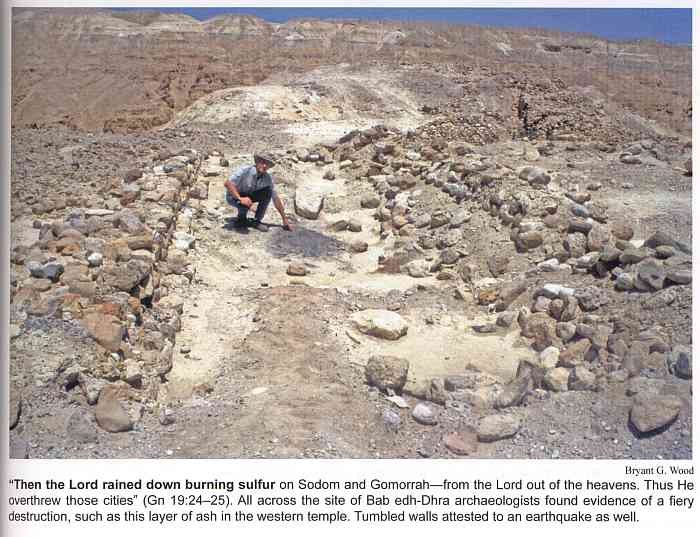
However, some archaeological evidence has emerged that indicates that the site could be on the east bank of the Dead Sea, with two sites in Jordan - Bab edh-Dhra, and Numeira, both considered viable candidates. The Jordanian-Russian search will center on Bab edh-Dhra, which also has several Christian monuments...

More info
Ω
Complete article
Russia and Jordan have signed an agreement to search the bottom of the Dead Sea for the remains of the Biblical cities of Sodom and Gomorrah, Arabic news media reported over the weekend...
Biblical archaeologists have several theories as to where the Sodom and its associated cities were located. According to the Torah, God overturned Sodom, Gomorrah, and three other cities because of their degeneration, sin and iniquity, turning a once fertile plain into a stark wasteland. Abraham, who prayed for the cities, was unable to prevent God from mandating their destruction.
...Research has centered on the area around the Dead Sea, and the modern city of Sodom, and nearby Mount Sodom, which is made almost completely of rock salt, is considered the most likely site of the ancient cities.
However, some archaeological evidence has emerged that indicates that the site could be on the east bank of the Dead Sea, with two sites in Jordan - Bab edh-Dhra, and Numeira, both considered viable candidates. The Jordanian-Russian search will center on Bab edh-Dhra, which also has several Christian monuments...
More info
Ω
Fascinating report on a pre-historic site in the Nazareth hills of lower Galilee
Ω
Investigations at Kfar HaHoresh, a small site nestled in the Nazareth hills of lower Galilee, have revealed a stratigraphic sequence spanning the early through to the late Pre-Pottery Neolithic B (PPNB). Thirteen painstaking excavation seasons have demonstrated tremendous potential for exploring mortuary, ritual, subsistence and industrial activities in this region, and allow a glimpse into an exciting era in human prehistory.
PPNB (ca. 8500-6750 calBC) corresponds to the period when the first large village communities were established in the fertile areas of the Near East. At this time the sphere of cultural interaction had widened, stretching from central Anatolia to southern Sinai and included Cyprus. Rectilinear houses became commonplace, while public and ritual architecture are also found. Although hunting and gathering remained important, plants and animals were becoming increasingly domesticated. Evidence shows there was intensive ritual activity, and prestige items were exchanged over considerable distances....
Read more
Ω
Investigations at Kfar HaHoresh, a small site nestled in the Nazareth hills of lower Galilee, have revealed a stratigraphic sequence spanning the early through to the late Pre-Pottery Neolithic B (PPNB). Thirteen painstaking excavation seasons have demonstrated tremendous potential for exploring mortuary, ritual, subsistence and industrial activities in this region, and allow a glimpse into an exciting era in human prehistory.
PPNB (ca. 8500-6750 calBC) corresponds to the period when the first large village communities were established in the fertile areas of the Near East. At this time the sphere of cultural interaction had widened, stretching from central Anatolia to southern Sinai and included Cyprus. Rectilinear houses became commonplace, while public and ritual architecture are also found. Although hunting and gathering remained important, plants and animals were becoming increasingly domesticated. Evidence shows there was intensive ritual activity, and prestige items were exchanged over considerable distances....
Read more
Ω
Earliest modern man evolved in Israel?
Ω
Complete article
Eight human teeth dating back as far as 400,000 years ago and found at the prehistoric Qesem Cave near Rosh Ha’ayin – discovered recently by Tel Aviv University researchers – are “the world’s earliest evidence” of modern man (Homo sapiens)...
Until now, remains of humans from only 200,000 years ago have been found in Africa, and the accepted approach has been that modern man originated on that continent.
An international team of scientists performed a morphological analysis on the teeth found in the cave....The examination included CT scans and X-rays indicating the size and shape of the teeth are very similar to those of modern man. The teeth found in the cave are also very similar to evidence of modern man dated to around 100,000 years ago that had previously been discovered in the Skhul Cave on Mount Carmel and the Qafzeh Cave in the Lower Galilee near Nazareth.
The Qesem Cave is dated between 400,000 and 200,000 years ago, and archeologists working there believe that the findings indicate significant changes in the behavior of ancient man. This period of time was crucial in the history of mankind from cultural and biological perspectives, and the fact that teeth of modern man were discovered indicates that these changes are apparently related to evolutionary changes taking place at that time, they maintained.
...The findings that characterize the culture of those who dwelled in the Qesem Cave – the systematic production of flint blades, the habitual use of fire, evidence of hunting, cutting and sharing of animal meat, mining raw materials to produce flint tools from subsurface sources and much more – reinforce the hypothesis that this was, in fact, innovative and pioneering behavior that corresponds with the appearance of modern man...
According to the researchers, the discoveries made in the Qesem Cave may change the perception that has been widely accepted to date in which modern man originated on the continent of Africa
Complete article
Eight human teeth dating back as far as 400,000 years ago and found at the prehistoric Qesem Cave near Rosh Ha’ayin – discovered recently by Tel Aviv University researchers – are “the world’s earliest evidence” of modern man (Homo sapiens)...
Until now, remains of humans from only 200,000 years ago have been found in Africa, and the accepted approach has been that modern man originated on that continent.
An international team of scientists performed a morphological analysis on the teeth found in the cave....The examination included CT scans and X-rays indicating the size and shape of the teeth are very similar to those of modern man. The teeth found in the cave are also very similar to evidence of modern man dated to around 100,000 years ago that had previously been discovered in the Skhul Cave on Mount Carmel and the Qafzeh Cave in the Lower Galilee near Nazareth.
The Qesem Cave is dated between 400,000 and 200,000 years ago, and archeologists working there believe that the findings indicate significant changes in the behavior of ancient man. This period of time was crucial in the history of mankind from cultural and biological perspectives, and the fact that teeth of modern man were discovered indicates that these changes are apparently related to evolutionary changes taking place at that time, they maintained.
...The findings that characterize the culture of those who dwelled in the Qesem Cave – the systematic production of flint blades, the habitual use of fire, evidence of hunting, cutting and sharing of animal meat, mining raw materials to produce flint tools from subsurface sources and much more – reinforce the hypothesis that this was, in fact, innovative and pioneering behavior that corresponds with the appearance of modern man...
According to the researchers, the discoveries made in the Qesem Cave may change the perception that has been widely accepted to date in which modern man originated on the continent of Africa
Wednesday, December 8, 2010
2,000 year-old intact carving of Cupid found in Jerusalem
Ω
An intact carving of Cupid made of blue onyx dating from the Roman period was unearthed in the parking lot near the City of David, the Antiquities Authority announced on Monday.
The 2,000-year-old Cupid, about a centimeter long, was probably from a piece of jewelry.
The inlaid stone features cupid holding an upsidedown torch, which was used to symbolize the cessation of life. The piece is part of a series of archeological finds in the area that deal with images of mourning.
Complete article and picture
An intact carving of Cupid made of blue onyx dating from the Roman period was unearthed in the parking lot near the City of David, the Antiquities Authority announced on Monday.
The 2,000-year-old Cupid, about a centimeter long, was probably from a piece of jewelry.
The inlaid stone features cupid holding an upsidedown torch, which was used to symbolize the cessation of life. The piece is part of a series of archeological finds in the area that deal with images of mourning.
Complete article and picture
Ancient Jericho: the largest carpet mosaic in the Middle East
Ω
The small red, blue and ochre square stones, measuring nearly 900 square meters (9,700 square feet) are laid out in complex geometric and floral patterns. They cover the floor of the main bath house of an Islamic palace that was destroyed by an earthquake in the eighth century. Since being excavated in the 1930s and 1940s, the mosaic has largely remained hidden under layers of canvas and soil to protect it against sun and rain.

Visitors look at part of a mosaic, measuring around 9,700 square feet (900 square meters), in ruins of an 8th-century Islamic palace outside the West bank town of Jericho.
A small section will be laid bare for a week, as part of Jericho's 10,000th birthday celebrations. The mosaic then will be covered up again until the money is found to build a roof that would serve as a permanent weather shield, said Palestinian archaeologist Hamdan Taha. Marking the 10,000th birthday is entirely random, though, with archaeologists saying they could be off by hundreds of years in dating the first human settlement in the area.
Hamad said it's the largest carpet mosaic in the Middle East, a claim backed by Marwan Abu Khalaf, an archaeology professor at Al-Quds university and a fellow at the W.F. Albright Institute of Archaeological Research in Jerusalem. Abu Khalaf said the fine workmanship suggests that the Umayyads hired master artists instead of ordinary craftsmen to lay the mosaic.
The small red, blue and ochre square stones, measuring nearly 900 square meters (9,700 square feet) are laid out in complex geometric and floral patterns. They cover the floor of the main bath house of an Islamic palace that was destroyed by an earthquake in the eighth century. Since being excavated in the 1930s and 1940s, the mosaic has largely remained hidden under layers of canvas and soil to protect it against sun and rain.

Visitors look at part of a mosaic, measuring around 9,700 square feet (900 square meters), in ruins of an 8th-century Islamic palace outside the West bank town of Jericho.
A small section will be laid bare for a week, as part of Jericho's 10,000th birthday celebrations. The mosaic then will be covered up again until the money is found to build a roof that would serve as a permanent weather shield, said Palestinian archaeologist Hamdan Taha. Marking the 10,000th birthday is entirely random, though, with archaeologists saying they could be off by hundreds of years in dating the first human settlement in the area.
Hamad said it's the largest carpet mosaic in the Middle East, a claim backed by Marwan Abu Khalaf, an archaeology professor at Al-Quds university and a fellow at the W.F. Albright Institute of Archaeological Research in Jerusalem. Abu Khalaf said the fine workmanship suggests that the Umayyads hired master artists instead of ordinary craftsmen to lay the mosaic.
Subscribe to:
Posts (Atom)