Wednesday, February 19, 2014

2,300-year-old village discovered in Israel


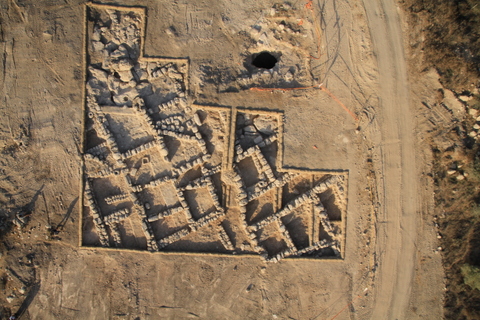
Aerial photographs. Photo credit: Skyview, courtesy of the Israel Antiquities Authority


The remnants of a rural settlement that was occupied for approximately two centuries during the Second Temple Period were uncovered in August 2013 – January 2014 near the 'Burma Road' (not far from Mitzpe Harel). The find was made during an Israel Antiquities Authority archaeological salvage excavation, before the start of work on a natural gas pipeline to Jerusalem as part of a national project directed by Israel Natural Gas Lines (INGL).

In June 2013, Israel Natural Gas Lines began construction of the 35km-long project, which runs from the coastal plain to the outskirts of Jerusalem. In light of the finds, the Israel Antiquities Authority and the INGL have agreed that engineering plans for the gas line are to be revised, bypassing the site and preserving it as an accessible archaeological site beside the Burma Road.

The excavations, which covered about 750 square meters, revealed a small rural settlement with a few stone houses and a network of narrow alleys. Each building, which probably housed a single nuclear family, consisted of several rooms and an open courtyard. According to Irina Zilberbod, excavation director on behalf of the Antiquities Authority, "The rooms generally served as residential and storage rooms, while domestic tasks were carried out in the courtyards".

The site, whose name has not survived, is nestled at the top of a spur 280 meters above sea level, with commanding views of the surrounding countryside. These large tracts of land were used as they are today to cultivate orchards and vineyards, which were the economic mainstay of the region’s early settlers.
The excavations have shown that the site reached the height of its development in the Hellenistic period (during the third century BCE), when Judea was ruled by the Seleucid monarchy following Alexander the Great, and that it was abandoned at the end of the Hasmonean dynasty.

It is not known why the site was abandoned, but it is probably related to economic problems and not to a violent incident. As Jerusalem Regional Archaeologist Dr. Yuval Baruch explains, "The phenomenon of villages and farms being abandoned at the end of the Hasmonean dynasty or the beginning of Herod the Great's succeeding rule is one that we are familiar with from many rural sites in Judea, and it may be related to Herod's massive building projects in Jerusalem, particularly the construction of the Temple Mount, and the mass migration of villagers to the capital to work on these projects."

The excavations yielded numerous and varied finds from all occupation periods, including basalt and limestone grinding and milling tools for domestic use, pottery cooking pots, jars for storing liquids (oil and wine,) pottery oil lamps for domestic use, and over sixty coins, including coins from the reigns of the Seleucid King Antiochus III and the Hasmonean King Alexander Jannaeus.


Coin from the reign of King Antiochus III. Photo: Clara Amit, courtesy of the Israel Antiquities Authority

Saturday, February 15, 2014

Earliest evidence of human footprints outside Africa discovered


Extraordinary find of 800,000 year old footprints In England makes a direct connection to the earliest humans in northern Europe


A team of scientists led by the British Museum, Natural History Museum and Queen Mary University of London have discovered a series of footprints left by early humans in ancient estuary muds over 800,000 years ago at Happisburgh in Norfolk, The footprints are direct evidence of the earliest known humans in northern Europe. The new evidence, published today in the science journal PLOS ONE reveals how the footprints were discovered and recorded on the foreshore at Happisburgh during May 2013.

The footprint surface was exposed at low tide as heavy seas removed the beach sands to reveal a series of elongated hollows cut into compacted silts. "At first we weren’t sure what we were seeing," explains Dr Nick Ashton of the British Museum "but as we removed any remaining beach sand and sponged off the seawater, it was clear that the hollows resembled prints, perhaps human footprints, and that we needed to record the surface as quickly as possible before the sea eroded it away." Over the next two weeks the surface was recorded using photogrammetry, a technique that can stitch together digital photographs to create a permanent record and 3D images of the surface. It was the analysis of these images that confirmed that the elongated hollows were indeed ancient human footprints, perhaps of five individuals. Ashton concludes "this is an extraordinarily rare discovery. The Happisburgh site continues to re-write our understanding of the early human occupation of Britain and indeed of Europe".

The analyses showed that the prints were from a range of adult and juvenile foot sizes and that in some cases the heel, arch and even toes could be identified, equating to modern shoes of up to UK size 8. Dr Isabelle De Groote from Liverpool John Moores University studied the prints in more detail. "In some cases we could accurately measure the length and width of the footprints and estimate the height of the individuals who made them. In most populations today and in the past foot length is approximately 15% of height. We can therefore estimate that the heights varied from about 0.9 m to over 1.7 m. This height range suggests a mix of adults and children with the largest print possibly being a male." The orientation of the footprints suggests that they were heading in a southerly direction.

Over the last ten years the sediments at Happisburgh have revealed a series of sites with stone tools and fossil bones, dating back to over 800,000 years. This latest discovery is from the same deposits. "Although we knew that the sediments were old, we had to be certain that the hollows were also ancient and hadn’t been created recently." Say Dr Simon Lewis, a geoarchaeologist at Queen Mary University of London. "There are no known erosional processes that create that pattern. In addition, the sediments are too compacted for the hollows to have been made recently."

The age of the site is based on its geological position beneath the glacial deposits that form the cliffs, but also the association with extinct animals. Simon Parfitt of the Natural History Museum and University College London has studied the mammalian fossils from Happisburgh. "These include an extinct type of mammoth, extinct horse and early forms of vole. Together they support an age of over 800,000 years." The site also preserves plant remains and pollen, together with beetles and shells, which allows a detailed reconstruction of the landscape. At this time Britain was linked by land to continental Europe and the site at Happisburgh would have been on the banks of a wide estuary several miles from the coast. There would have been muddy freshwater pools on the floodplain with salt marsh and coast nearby. Deer, bison, mammoth, hippo and rhino grazed the river valley, surrounded by more dense coniferous forest. The estuary provided a rich array of resources for the early humans with edible plant tubers, seaweed and shellfish nearby, while the grazing herds would have provided meat through hunting or scavenging.

So who were these humans? Fossil remains of our forebears are still proving elusive. However, as Professor Chris Stringer of the Natural History Museum explains "The humans who made the Happisburgh footprints may well have been related to the people of similar antiquity from Atapuerca in Spain, assigned to the species Homo antecessor ('Pioneer Man'). These people were of a similar height to ourselves and were fully bipedal. They seem to have become extinct in Europe by 600,000 years ago and were perhaps replaced by the species Homo heidelbergensis. Neanderthals followed from about 400,000 years ago, and eventually modern humans some 40,000 years ago."

The importance of the Happisburgh footprints is highlighted by the rarity of footprints surviving elsewhere. Only those at Laetoli in Tanzania at about 3.5 million years and at Ileret and Koobi Fora in Kenya at about 1.5 million years are more ancient. As Nick Ashton concludes "these footprints provide a very tangible link to our forebears and deep past." The work at Happisburgh continues, but as the cliffs erode, new sites are being discovered, but also destroyed by the encroaching sea. The footprints were unfortunately rapidly eroded away, but it is hoped that new footprints will be revealed in the future.

The work at Happisburgh forms part of a new major exhibition at the Natural History Museum Britain: One Million Years of the Human Story opening on 13 February 2014.

Wednesday, February 12, 2014

Clovis boy's family is the direct ancestor to 80 % of all present day Native Americans


America's only Clovis skeleton had its genome mapped

They lived in America about 13,000 years ago where they hunted mammoth, mastodons and giant bison with big spears. The Clovis people were not the first humans in America, but they represent the first humans with a wide expansion on the North American continent – until the culture mysteriously disappeared only a few hundred years after its origin. Who the Clovis people were and which present day humans they are related to has been discussed intensely and the issue has a key role in the discussion about how the Americas were peopled. Today there exists only one human skeleton found in association with Clovis tools and at the same time it is among the oldest human skeletons in the Americas. It is a small boy between 1 and 1.5 years of age – found in a 12,600 old burial site, called the Anzick Site, in Wilsall, Montana, USA. Now an international team headed by Danish researcher Eske Willerslev has mapped his genome thereby reviving the scientific debate about the colonization of the Americas.

Roughly estimated some 80 % of all present-day Native American populations on the two American continents are direct descendants of the Clovis boy's family. The remaining 20 % are more closely related with the Clovis family than any other people on Earth, says Lundbeck Professor Eske Willerslev from the Centre for GeoGenetics at the Natural History Museum of Denmark, University of Copenhagen. This surprising result has now been published in the scientific journal Nature. The discovery is so decisive that Nature has chosen to send the article to the press at a later time than usual as they fear the media embargo may be broken. A comprehensive international telephone press conference has been arranged and will be held in the Crow tribe's reservation in Montana – close to where the boy was found. Behind the results are a group of international researchers led by Professor Eske Willerslev from Centre of Excellence in GeoGenetics, Natural History Museum at University of Copenhagen, Denmark.

The missing link

It is almost like finding the 'missing link' to the common ancestor of the Native Americans. The Clovis boy's family is the direct ancestor to roughly estimated 80 % of all present day Native Americans. Although the Clovis culture disappeared its people are living today. Put simply it is a sensation that we succeeded in finding an approximately 12,600 year old boy whose closest relatives can be regarded as the direct ancestor to so many people, Eske Willerslev says and adds:

This also means that Clovis did not descend from Europeans, Asians or Melanesians, a theory that a number of scientists have advocated. They were Native Americans – and the Native American ancestors were the first people in America. This is now a fact.

Shane Doyle, a historian from the Apsaalooke (Crow) tribe, who helped the team with consultations to the Montana tribes agrees:

This discovery by Eske and his team proves something that tribal people have never doubted - we've been here since time immemorial and all the ancient artifacts located within our homelands are remnants from our direct ancestors. But the discovery is only part of the importance of this study. The other part being Eske and his team's respectful commitment to interacting face to face with tribal communities and listening to Native American leaders, which has lead directly to the reburial of this little boy."

Also Sarah Anzick, a molecular biologist in the study and the steward of the remains that were found on private land is excited:

After 46 years since the discovery on my family land, we are finally hearing this child's story through his genetic legacy. I find it remarkable that the descendants of the Clovis culture, which seemed to have vanished 12,600 years ago, are still alive and thriving today.

Interestingly, the teams find that Native American ancestors coming in from Siberia split into two groups. One group is ancestors to the Native Americans presently living in Canada and the other one – which is represented by the Clovis boy – is the ancestor to virtually all Native Americans in South America and Mexico. The US is still a white spot on the map when it comes to genome-wide data from Native Americans. The team members hope to be able to accessing such data in the future to understand the full picture.

The study validates the concept of continuity in the history of Native Americans, and suggests that modern Native Americans are direct descendants of the first people occupying this land, says Rasmus Nielsen, a co-author on the study and a Professor at UC Berkeley, who developed the method used for determining that many modern native Americans are direct descendants of the Clovis boy's family.

An Asian homeland for the First Americans

The first humans came from Siberia via the so-called Beringia Land Bridge, which during the latest ice age connected Siberia with North America and did not bring the Clovis culture with them. The Clovis culture arose after they arrived in America and the boy from Anzick was more a descendant of the first immigrants.

Michael Waters, the key archaeologist connected to the study and who has worked on many Clovis and older sites in North America elaborates:

The genetic findings mesh well with the archaeological evidence to confirm the Asian homeland of the First Americans, more clearly define their genetic heritage, and is consistent with occupation of the Americas a few thousand years before Clovis. The findings do not support a western European origin of the First Americans as suggested by the Solutrean hypothesis. The genetic information provided by the Anzick boy is part of the larger story of modern human dispersal across the Earth and is shedding new light on the last continent to be explored and settled by our species.

Then who were the first immigrants? We don't know. Yet. Maybe a Native American, maybe an ancestor related to the Mal'ta boy from Siberia and another one who was East Asian. We don't know. But our results eliminate all other theories about the origins of the first people in America. The first people in America were the direct ancestors of Native Americans, says Professor Willerslev and continues:

We can see that the Clovis boy shares about 1/3 of his genes with the 24,000 year old child from Mal'ta at the Siberian Lake Baikal who we have analyzed previously. The same goes for all present day Native Americans. Therefore the encounter between East Asians and the Mal'ta group happened before Clovis.

The human remains from the Anzick site will be reburied sometime this year in cooperation with Native American tribes in Montana. Eske Willerslev has in connection with the genome work on the Clovis boy visited several of Montana's Native American tribes with Crow historian Shane Doyle to discuss the findings. All the members of the research team hope that the Anzick study leads to more and enhanced cooperation between Native peoples and scientists. Therefore he has also chosen the Crow reservation in Montana to hold the press conference.

Monday, February 3, 2014

Israel's First Camels


Archaeologists pinpoint the date when domesticated camels arrived in Israel

Camels are mentioned as pack animals in the biblical stories of Abraham, Joseph, and Jacob. But archaeologists have shown that camels were not domesticated in the Land of Israel until centuries after the Age of the Patriarchs (2000-1500 BCE). In addition to challenging the Bible's historicity, this anachronism is direct proof that the text was compiled well after the events it describes.

Now Dr. Erez Ben-Yosef and Dr. Lidar Sapir-Hen of Tel Aviv University's Department of Archaeology and Near Eastern Cultures have used radiocarbon dating to pinpoint the moment when domesticated camels arrived in the southern Levant, pushing the estimate from the 12th to the 9th century BCE. The findings, published recently in the journal Tel Aviv, further emphasize the disagreements between Biblical texts and verifiable history, and define a turning point in Israel's engagement with the rest of the world.

"The introduction of the camel to our region was a very important economic and social development," said Dr. Ben-Yosef. "By analyzing archaeological evidence from the copper production sites of the Aravah Valley, we were able to estimate the date of this event in terms of decades rather than centuries."

Copper mining and camel riding


Archaeologists have established that camels were probably domesticated in the Arabian Peninsula for use as pack animals sometime towards the end of the 2nd millennium BCE. In the southern Levant, where Israel is located, the oldest known domesticated camel bones are from the Aravah Valley, which runs along the Israeli-Jordanian border from the Dead Sea to the Red Sea and was an ancient center of copper production. At a 2009 dig, Dr. Ben-Yosef dated an Aravah Valley copper smelting camp where the domesticated camel bones were found to the 11th to 9th century BCE. In 2013, he led another dig in the area.

To determine exactly when domesticated camels appeared in the southern Levant, Dr. Sapir-Hen and Dr. Ben-Yosef used radiocarbon dating and other techniques to analyze the findings of these digs as well as several others done in the valley. In all the digs, they found that camel bones were unearthed almost exclusively in archaeological layers dating from the last third of the 10th century BCE or later — centuries after the patriarchs lived and decades after the Kingdom of David, according to the Bible. The few camel bones found in earlier archaeological layers probably belonged to wild camels, which archaeologists think were in the southern Levant from the Neolithic period or even earlier. Notably, all the sites active in the 9th century in the Aravah Valley had camel bones, but none of the sites that were active earlier contained them.

The appearance of domesticated camels in the Aravah Valley appears to coincide with dramatic changes in the local copper mining operation. Many of the mines and smelting sites were shut down; those that remained active began using more centralized labor and sophisticated technology, according to the archaeological evidence. The researchers say the ancient Egyptians may have imposed these changes — and brought in domesticated camels — after conquering the area in a military campaign mentioned in both biblical and Egyptian sources.

Humping it to India

The origin of the domesticated camel is probably the Arabian Peninsula, which borders the Aravah Valley and would have been a logical entry point for domesticated camels into the southern Levant. In fact, Dr. Ben-Yosef and Dr. Sapir-Hen say the first domesticated camels ever to leave the Arabian Peninsula may now be buried in the Aravah Valley.

The arrival of domesticated camels promoted trade between Israel and exotic locations unreachable before, according to the researchers; the camels can travel over much longer distances than the donkeys and mules that preceded them. By the seventh century BCE, trade routes like the Incense Road stretched all the way from Africa through Israel to India. Camels opened Israel up to the world beyond the vast deserts, researchers say, profoundly altering its economic and social history.

Wednesday, January 29, 2014

Neanderthal ancestry in present-day humans


More than thirty thousand years ago, Homo sapiens migrating out of Africa began encountering Neanderthals, a lineage that had diverged from modern humans hundreds of thousands of years before. Despite their differences, Homo sapiens and Neanderthals mingled, and over time, produced children with genes from both lineages. Today, the biological remnants of that collision between two distinct populations remain alive in the genomes of humans with European and Asian ancestry.

Now, Howard Hughes Medical Institute (HHMI) researchers at Harvard Medical School have analyzed exactly which areas of the human genome retain segments of Neanderthal DNA, passed down throughout the generations. The findings were published January 29, 2014 in Nature.

"The goal was to understand the biological impact of the gene flow between Neanderthals and modern humans," says David Reich, an HHMI investigator at Harvard Medical School and the lead scientist on the new research. "We reasoned that when these two groups met and mixed, some new traits would have been selected for and remained in the human genome, while some incompatibilities would have been selected against and removed."

Reich has been interested in what happens when populations collide. "Throughout history, groups of humans have been on the move. Until recently, researchers did not have the ability to learn much about what happened when two populations met each other, and in particular whether they mixed or one replaced the other," Reich says. What really happens, he argues, is that populations mix, and that later people carry DNA from both ancestral groups.

In late 2013, Reich was one of the leaders of a team that published the complete genome of a Neanderthal woman, based on analysis of DNA isolated from a toe bone discovered in modern-day Siberia. To determine how the human-Neanderthal genetic mixing may have played out, Reich and his colleagues compared that completed Neanderthal genome with the genomes of 1,004 present-day humans from around the globe.

"If a gene variant is absent in Africans today, but present in modern day non-Africans as well as the Neanderthal genome, that's good evidence that it originates from Neanderthals," Reich says. Since humans met Neanderthals as they migrated out of Africa, those populations that remained in Africa had little contact or genetic mixing with Neanderthals. Reich's group also leveraged other genetic information, including the size of different gene fragments, to determine whether genes were inherited from Neanderthals or not.

The researchers found that today, humans in east Asia have, on average, more of their genome originating from Neanderthals than Europeans, and modern-day Africans have little or none. Those findings confirmed previous studies. But then, the scientists took their analysis a step further and examined which genes most often have Neanderthal ancestry in present-day people. They found that some genes had variants of Neanderthal origin in more than sixty percent of Europeans or Asians, while other genes were never of Neanderthal heritage.

The scientists discovered that the genetic changes most often inherited from Neanderthals were disproportionately in genes related to keratin, a component of skin and hair.

"This suggests that as humans were adapting to the non-African environment they were moving into, they may have been able to exploit adaptations that Neanderthals had already achieved," Reich says. More work is needed, however, to show the exact biological implications of the Neanderthal keratin genes and how they differ from the versions of keratin related proteins that would have already been present in modern humans.

His group analyzed not only which Neanderthal genes remain in the human population today, but also which parts of today's genomes lack Neanderthal genes altogether.

"The most interesting findings were about the places in the genome that are devoid of Neanderthal genes – 'Neanderthal ancestry deserts'," says Reich. "At these locations, Neanderthal genetic material was not tolerated by modern humans and removed by the action of natural selection."

The most striking area of the human genome that lacked Neanderthal genes was the X chromosome—one of the sex chromosomes. In humans, women have two X chromosomes and men have an X and a Y chromosome. The team's observation that the X chromosome had very little Neanderthal ancestry suggested something the scientists hadn't predicted -- a biological phenomenon called hybrid sterility. When two organisms are distantly related, Reich explains, genes related to fertility, inherited on the X chromosome, can interact poorly with genes elsewhere in the genome. The interference between the pairs of genes can render males—who only have one X chromosome—infertile.

"When you have populations that have sufficiently diverged, this male-only sterility can occur," Reich says.

To confirm whether hybrid sterility could have occurred during the interbreeding between modern humans and Neanderthals, Reich's team looked at whether genes expressed in the testes were more or less enriched in Neanderthal DNA. Indeed, genes important for the functioning of the testes had a particularly low inheritance of Neanderthal ancestry. The combined evidence that both the testes and the X chromosome lack Neanderthal DNA, Reich says, suggests that modern human males who inherited a Neanderthal X chromosome often may have been unable to have children, and therefore pass along this X chromosome. Today, that translates into a near- absence of Neanderthal DNA on the X chromosomes of humans.

"It tells us that when Neanderthals and modern humans met and mixed, they were at the very edge of being biological compatible," he says.

Further studies on the legacy of Neanderthal genes in human biology could help shed light on not only human history, but the overall biological idea of hybrid sterility.

"The other direction we want to go is to use this information as a tool for understanding human disease genes," Reich adds. Already, the new study revealed that genetic changes that affect risk for lupus, diabetes, and Crohn's Disease likely originate from Neanderthals.
Monday, January 27, 2014

300,000-Year-Old Hearth Found in Israel


Humans, by most estimates, discovered fire over a million years ago. But when did they really begin to control fire and use it for their daily needs? That question – one which is central to the subject of the rise of human culture – is still hotly debated. A team of Israeli scientists recently discovered in the Qesem Cave, an archaeological site near present-day Rosh Ha’ayin, the earliest evidence – dating to around 300,000 years ago – of unequivocal repeated fire building over a continuous period. These findings not only help answer the question, they hint that those prehistoric humans already had a highly advanced social structure and intellectual capacity.

Excavations in Qesem Cave have been ongoing since 2000. The team is headed by Profs. Avi Gopher and Ran Barkai of Tel Aviv University. Dr. Ruth Shahack-Gross of the Kimmel Center for Archeological Science at the Weizmann Institute has been involved in this archaeological research since excavations began, and she collects samples on-site for later detailed analysis in the lab. Shahack-Gross, whose expertise is in the identification of archaeological materials, identified a thick deposit of wood ash in the center of the cave. Using infrared spectroscopy, she and her colleagues were able to determine that mixed in with the ash were bits of bone and soil that had been heated to very high temperatures. This was conclusive proof that the area had been the site of a large hearth.

Next, Shahack-Gross tested the micro-morphology of the ash. To do this, she extracted a cubic chunk of sediment from the hearth and hardened it in the lab. Then she sliced it into extremely thin slices – so thin they could be placed under a microscope to observe the exact composition of the materials in the deposit and reveal how they were formed. With this method, she was able to distinguish a great many micro-strata in the ash – evidence for a hearth that was used repeatedly over time. These findings were published in the Journal of Archaeological Science.

Around the hearth area, as well as inside it, the archaeologists found large numbers of flint tools that were clearly used for cutting meat. In contrast, the flint tools found just a few meters away had a different shape, designed for other activities. Also in and around the area were large numbers of burnt animal bones – further evidence for repeated fire use for cooking meat. Shahack-Gross and her colleagues have shown that this organization of various “household” activities into different parts of the cave points to an organization of space – and a thus kind of social order – that is typical of modern humans. This suggests that the cave was a sort of base camp that prehistoric humans returned to again and again. “These findings help us to fix an important turning point in the development of human culture – that in which humans first began to regularly use fire both for cooking meat and as a focal point – a sort of campfire – for social gatherings,” she says. “They also tell us something about the impressive levels of social and cognitive development of humans living some 300,000 years ago.” The researchers think that these findings, along with others, are signs of substantial changes in human behavior and biology that commenced with the appearance in the region of new forms of culture – and indeed a new human species – about 400,000 years ago.

Friday, January 24, 2014

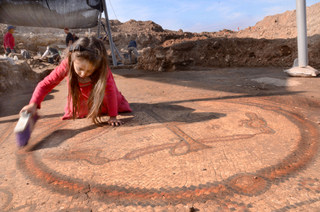
Discovered in Israel: Major church with a splendid mosaic from the Byzantine period


Photographic credit: AFP PHOTO/MENAHEM KAHANA

The discovery was made during a salvage excavation as part of development work by the Israel Land Authority prior to the construction of a new neighborhood at Moshav Aluma, near Pelugot Junction * Israel Antiquities Authority archaeologists say, "The church probably served as a center of Christian worship for neighboring communities."


Photographic credit: Yoli Shwartz, Dr. Davida Dagan. courtesy of the Israel Antiquities Authority


Impressive archaeological finds including a major church some 1,500 years old with a magnificent mosaic and five inscriptions were uncovered during Israel Antiquities Authority salvage excavations, prior to the construction of a new neighborhood at Moshav Aluma in Shafir Regional Council, near Pelugot Junction. The excavations were directed by archaeologists Dr. Daniel Varga and Dr. Davida Dagan, and funded by the Israel Land Authority.

According to archaeologist Dr. Daniel Varga, directing the excavations on behalf of the Israel Antiquities Authority, "An impressive basilica building was discovered at the site, 22 meters long and 12 meters wide. The building consists of a central hall with two side aisles divided by marble pillars. At the front of the building is a wide open courtyard (atrium) paved with a white mosaic floor, and with a cistern. Leading off the courtyard is a rectangular transverse hall (narthex) with a fine mosaic floor decorated with colored geometric designs; at its center, opposite the entrance to the main hall, is a twelve-row dedicatory inscription in Greek containing the names Mary and Jesus, and the name of the person who funded the mosaic's construction."

The main hall (the nave) has a colored mosaic floor adorned with vine tendrils to form forty medallions. The medallions contain depictions of different animals, including: zebra, leopard, turtle, wild boar, various winged birds and botanical and geometric designs. Three medallions contain dedicatory inscriptions in Greek commemorating senior church dignitaries: Demetrios and Herakles. The two were heads of the local regional church. On both sides of the central nave are two narrow halls (side aisles), which also have colored mosaic floors depicting botanical and geometric designs, as well as Christian symbols.

A pottery workshop, mainly for the production of jars, was also uncovered during the excavations and yielded numerous finds, including: amphorae, cooking pots, kraters, bowls and different kinds of oil lamps. Glass vessels typical of the Byzantine period were also discovered at the site. The finds indicate a rich and flourishing local culture.

This church is part of a large and important Byzantine settlement that existed in the region. The settlement was located next to the main road running between Ashkelon on the sea coast to the west, and Beit Guvrin and Jerusalem to the east. Excavations by the Israel Antiquities Authority along this road have revealed other communities from the same period, but no churches have been found in them. The recently uncovered church may have served as a center for Christian worship for all the surrounding communities. Wine presses and pottery workshops found in the region attest to the economy of the local residents during the Byzantine period, who made their living from the production and exportation of wine via the coast to the entire Mediterranean region.

As for the future of the site, it has been decided to cover it over and preserve it for future generations. The magnificent mosaic that has come to light will be conserved, removed from the site and displayed to the public at a regional museum or visitors' center.