Wednesday, September 25, 2013
The pilgrimage economy of Early Roman Jerusalem (1st century BCE–70 CE)
Journal of Archaeological Science
Volume 40, Issue 12, December 2013, Pages 4369–4376:
Religious and historical sources suggest that pilgrimage formed a major source of Jerusalem's economy during the Early Roman period due to the Temple's role as a religious and judicial center for the Jewish diaspora. Until now, this assertion has been supported by little material evidence.
In this study, the carbon and nitrogen isotope values of local arcahaeological and, modern wild herbivores from known environments were used to determine the environmental origins of domesticated sheep and goat that were traded and consumed in Early Roman Jerusalem. Pinpointing the environmental origins of these herd animals can determine if they were raised in specialized farms in the vicinity of Jerusalem, brought to the city by local pilgrims, or were part of organized importation of sacrifice animals from desert regions that lie beyond the boundaries of the province of Judea.
The results indicate that at minimum 37% of the goat and sheep consumed in Jerusalem during the Early Roman period were brought from desert regions. The inter-provincial importation of animals to Jerusalem to meet high demands for sacrifice by pilgrims is the first material evidence for large scale economic specialization in the city. Furthermore, the results imply that desert animals were further marketed for domestic use in contemporaneous farm sites out of Jerusalem.

Great article on excavating Masada
Read it here.
Here's a small sample:
On 11 August 1963, under the headline "New siege of Herod's fort", the Observer published an appeal for international volunteers to join the excavation of Masada, an ancient fortress in the Judean desert. Interested parties had to be available for a minimum of two weeks, fund their own travel to and from Israel, be prepared for harsh conditions, and apply in writing to PO Box 7041, Jerusalem.
"One of the greatest surprises – and delights – of the enterprise, long before we had put scoop to rubble, was the response," wrote Yigael Yadin, the former Israeli military chief of staff turned archaeologist, who was the mastermind, driving force and public face of the dig, in his 1966 book Masada. "We were flooded with applications."
According to Ronald Harker, an Observer journalist who introduced a book on Masada produced by the paper, the applicants were "men and women, rich and poor, young and old, and from 28 countries. None was under any illusion about the nature of the task ... It was made clear that the work would be hard and often boring, the food adequate but not appetising, that the heat of the day would be severe and the nights cold, the comforts (with 10 beds to a tent) would be limited, and recreation primitive if not minimal. Yet ... pleas to join from all parts of the world continued to flow in."
Almost 10,000 people responded to the appeal; many were turned away by overwhelmed organisers. By mid-October the first batch assembled at the desert town of Arad, to be taken by truck to the base of the majestic 2,000-year-old clifftop fortress that was waiting to be uncovered. "They arrived by bus, or hitch-hiked, with rucksacks, suitcases, banjos and typewriters, in shorts, jeans, slacks and skirts," according to a contemporary account in the Jerusalem Post. "Bearded and bespectacled, clean-shaven and clear-eyed, they came from all over Israel and all over the world...
14th century B.C. gate complex of an Egyptian fortress in Jaffa, Israel
The Tel Yafo excavations in June and July 2013, directed by Aaron A. Burke and Martin Peilstöcker, centered on the exposure of the intensively burned remains of the fourteenth century B.C. gate complex of an Egyptian fortress in Jaffa, Israel—the only Egyptian gate excavated in Israel to date. The extent of the burning attested within the gate complex was already evident during the 2012 season when a commemorative scarab of Amenhotep III dated to the mid-fourteenth century B.C. was discovered within the upper layers of the destruction, having fallen from what was likely a second story administrative office.
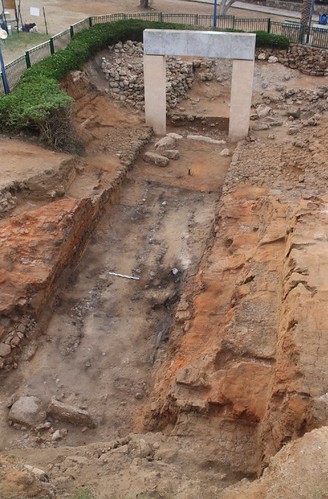
The 2013 excavations permitted the complete exposure of the gate’s passageway below more than 1.5 meters of accumulated destruction debris. Major finds included several arrowheads, a spearhead and lead weight, the antlers from at least four deer, decorative ivory inlays, thousands of seeds, a number of unique ceramic vessels, and nearly two dozen timbers belonging to the gate’s roof and upper story. While the arrowheads and spearhead may be indications of the battle to take the fortress before it was deliberately razed, the antlers strewn along one side of the passageway provide a glimpse into its appearance when it was in use. These artifacts suggest that the gate was not a stark and utilitarian space as many reconstructions of Egyptian gates suggest. Instead, it would seem that Egyptian soldiers hung these items within the passageway as trophies of their hunting around Jaffa.
The timbers recovered within the gate are likely cedars from Lebanon used in the construction of the gate’s second story and roof. These constitute the earliest and largest such samples of timbers from Israel to date. They will provide not only important chronological data such as evidence for the date of the construction of the gate complex but also will contribute to refining our understanding of the evolution of Egyptian rule in Canaan since the gate is one in a sequence of gates providing evidence for the earliest Egyptian fortress in Canaan. As important proxies for climate change, the timbers also offer a unique opportunity for an improved study of Late Bronze Age environment.
The discovery of the timbers was given even greater chronological significance because of the unusual preservation of thousands of seeds retrieved from the base of the destruction debris that will permit extensive radiocarbon testing. Among the seeds are barley, olive pits, grape pips, and chick peas charred black but identifiable to the naked eye on the floor of the gate. Such remains were unexpected in this context, given that monumental architecture does not frequently yield good evidence for the consumption practices of the inhabitants of a site. The seeds along with the artifacts recovered from the destruction within the gate reveal that Egyptian gate complexes were not exclusively defensive structures, but that they also served to house administrators, storerooms, and other support facilities.
The 2013 excavations were funded by the National Endowment for the Humanities as part of a project titled “Insurgency, Resistance, and Interaction: Archaeological Inquiry into New Kingdom Egyptian Rule in Jaffa.” This program, which began in 2011, centers on understanding the nature of interactions between the ancient Egyptian garrison and the region’s populations by examining evidence for both conflict and social integration at the site that occurred between the foundation of the fortress in 1460 B.C. until the collapse of Egyptian rule in Canaan during the twelfth century B.C.
Saturday, September 21, 2013
Neandertals, not modern humans, made first specialized bone tools in Europe
One day in 2011, undergraduate student Naomi Martisius was sorting through tiny bone remnants in the University of California, Davis, paleoanthropology lab when she stumbled across a peculiar piece.
The bone fragment, from a French archaeological site, turned out to be a part of an early specialized bone tool used by a Neandertal before the first modern humans appeared in Europe.
"At the time, I had no idea about the impact of my discovery," said Martisius, who is now pursuing her doctoral degree in anthropology at UC Davis.
Martisius' opportunity was the result of a decade of excavation and research by two international teams. Their findings were published in the Proceedings of the National Academy of Science in August.
"Previously these types of bone tools have only been associated with modern humans," said Teresa E. Steele, associate professor of anthropology at UC Davis, who also served as a co-author on the article and adviser to Martisius at UC Davis and at archaeological excavations in France.
"However, our identification of these pieces in secure Neandertal contexts leaves open the possibility that we have found, for the first time, evidence that Neandertals may have influenced the technology of modern humans," she said.
Used to smooth tough animal hides, the tools were made about 50,000 years ago by Neandertals -- not just the humans who came after them, as researchers had earlier theorized. The specialized tools are still used today, in similar form, to smooth and refine leather made into high-end purses and jackets.
The bone tools were found in deposits containing typical Neandertal stone tools and the bones of hunted animals including reindeer, red deer and bison. Three of the four pieces were from the site of Abri Peyrony, France. The animal bones from that site had been exported to UC Davis for analysis in Steele's lab where Martisius worked with her to study the material.
Now in her second year of doctoral studies at UC Davis, Martisius will carry on her research of these pieces. She, Steele and their colleagues will use resources available at UC Davis to conduct experimental studies to manufacture -- and use -- new, similar animal bone tools for comparison.
Using sophisticated imaging techniques, Martisius will examine the pieces made by the Neandertals, comparing those with the ones first made by the first modern humans in Europe and the ones she manufactures at UC Davis. She said she also will look at animal bones from nearby sites to see if she can identify additional pieces made by Neandertals.
The tools described in their current work were recovered in archaeological sites in the French countryside that had been explored for more than 100 years, but modern archaeological techniques enabled researchers to recognize these smaller pieces now identified as pieces of once-sophisticated tools, Steele said.
Tuesday, September 17, 2013
Mt. Zion dig reveals possible second temple period priestly mansion
In excavating sites in a long-inhabited urban area like Jerusalem, archaeologists are accustomed to noting complexity in their finds -- how various occupying civilizations layer over one another during the site's continuous use over millennia. But when an area has also been abandoned for intermittent periods, paradoxically there may be even richer finds uncovered, as some layers have been buried and remain undisturbed by development.
Such appears be the case at an archaeological dig on Jerusalem's Mount Zion, conducted by the University of North Carolina at Charlotte, where the 2013 excavations have revealed the well-preserved lower levels of what the archaeological team believes is an Early Roman period mansion(first century CE), possibly belonging to a member of the Jewish ruling priestly caste.
If the mansion does prove to be an elite priestly residence, the dig team hopes the relatively undisturbed nature of the buried ruin may yield significant domestic details concerning the rulers of Jerusalem at the time of Jesus.

IMAGE: Unusual for the period, a bath chamber with bathtub was found buried at Mt. Zion first-century mansion site, connected to the structure's mikveh. Credit: Shimon Gibson
Particularly important in the season's discoveries were a buried vaulted chamber that has proven to be an unusual finished bathroom (with bathtub) adjacent to a large below-ground ritual cleansing pool (mikveh) -- only the fourth bathroom to be found in Israel from the Second Temple period, with two of the others found in palaces of Herod the Great at Jericho and Masada.
Shimon Gibson, the British-born archaeologist co-directing the UNC Charlotte excavation, notes that the addition of the bathroom to the mikveh is a clear sign of the wealth and status of the resident.
"The bathroom is very important because hitherto, except for Jerusalem, it is usually found within palace complexes, associated with the rulers of the country," Gibson said."We have examples of bathrooms of this kind mainly in palatial buildings."
The other example of a contemporary mikveh with an attached bathroom is at a site excavated in Jerusalem in the nearby Jewish Quarter."A bathroom that is almost a copy of ours was found in an excavation of a palatial mansion," noted Gibson. "It is only a stone's throw away and I wouldn't hesitate to say that the people who made that bathroom probably were the same ones who made this one. It's almost identical, not only in the way it's made, but also in the finishing touches, like the edge of the bath itself."
"The building in the Jewish Quarter is similar in characteristics to our own with an inscription of a priestly family," Gibson added. "The working theory is that we're dealing also with a priestly family."

This image shows the archaeological site at Jerusalem's Mt. Zion, beneath the city's (Turkish) wall. The site reveals many layers of the city's cultural history, including a first-century mansion, which was then in Jerusalem's elite district. Credit: Shimon Gibson
Gibson notes that there are other details about the site that suggest that its first century residents may have been members of the ruling elite."The building that we are excavating is in the shadow -- immediately to the southeast -- of the very, very large palace of Herod the Great, his compound and the later seat of the Roman governors (praetorium)."
The location is a strong indication of a high-status resident. "Whoever lived in this house would have been a neighbor and would have been able to pop into the palace," he speculated.
While also cautious about reaching premature conclusions, dig co-director James Tabor, a UNC Charlotte scholar of early Christian history, believes there might be significant historical information uncovered, should the building turn out to be a priestly residence.
"If this turns out to be the priestly residence of a wealthy first century Jewish family, it immediately connects not just to the elite of Jerusalem -- the aristocrats, the rich and famous of that day -- but to Jesus himself," Tabor said. "These are the families who had Jesus arrested and crucified, so for us to know more about them and their domestic life -- and the level of wealth that they enjoyed -- would really fill in for us some key history."
Though the artifacts found this season are still being evaluated, one set of items in particular stand out as highly unusual: a large number of murex shells, the largest number ever found in the ruins of first-century Jerusalem. Species of murex (a genus of Mediterranean sea snail) were highly valued in Roman times because of a rich purple dye that could be extracted from the living creature.
"This color was highly desired," Gibson said. "The dye industry seems to be something that was supervised by the priestly class for the priestly vestments and for other aspects of clothing which were vital for those who wished to officiate in the capital precincts."
Why anyone in Jerusalem would be in possession of such "a very large quantity" of murex shells, however, remains a mystery to the excavation team, since the shells are not involved in the actual dye making process. Gibson hypothesizes that the shells may have been used to identify different grades of dye, since the quality of the product can vary from species to species. Some species are used to make a turquoise blue dye.
"It is significant that these are household activities which may have been undertaken by the priests," Gibson said. "If so, it tells us a lot more about the priests than we knew before. We know from the writings of Josephus Flavius and later rabbinical texts about their activities in the area of the Jewish temple, but there is hardly any information about their priestly activities outside the holy precinct. This is new information, and that is quite exciting. We might find in future seasons further aspects of industries which were supervised by these priestly families."
The domestic details of the first-century Jewish ruling class may yield insights into New Testament history, Tabor notes. "Jesus, in fact, criticizes the wealth of this class," Tabor said. "He talks about their clothing and their long robes and their finery, and, in a sense, pokes fun at it. So for us to get closer to understanding that -- to supplement the text -- it could be really fascinating."
Gibson also notes that historical legends from several centuries later point as well to the possibility that the building is a priestly residence."Byzantine tradition places in our general area the mansion of the high priest Caiaphas or perhaps Annas, who was his father-in-law," Gibson said. "In those days you had extended families who would have been using the same building complex, which might have had up to 20 rooms and several different floors."
Further discoveries this season suggest still other details of history from first century Jerusalem. At the bottom of the residence's large, 30-foot deep cistern, the excavators found cooking pots and the remains of an oven. While Gibson stresses that it is again too early to draw conclusions about these items, he and the other researchers are considering these items as a possible indication that the emptied cistern was used as a refuge by Jewish residents hiding from Roman soldiers during the siege of 70 CE.
"When we started clearing it we found a lot of debris inside, which included substantial numbers of animal bones and then right at the bottom we came across a number of vessels, which seemed to be sitting on the floor -- cooking pots and bits of an oven as well," Gibson said."We still need to look at this material very carefully and be absolutely certain of our conclusions, but it might be that these are the remnants of a kitchen in use by Jews hiding from the Romans -- their last resort was to go into these cisterns. It was a common practice, but this conclusion is theoretical. It makes for a very good story and it does look that way, but we've got to be certain."
Gibson notes that the Roman-Jewish historian Titus Flavius Josephus talks about such a scene in his description of the siege:
One John, a leader of the rebels, along with his brother Simon, who were found starved to death in the cisterns and water systems that ran under the city. Over 2000 bodies found in the various underground chambers, most dead from starvation. (Josephus, War 6:429-433)
Gibson credits the rich amount of detail and archaeological information present at the first century level of the dig with the accident of the site's location in Jerusalem. Ruins in major urban areas are rarely preserved with parts of the structure buried intact because subsequent residents tend to cannibalize buildings for materials for their own structures. However, when the Jerusalem of Jesus's era was destroyed by the occupying Romans in 70 CE, it was deserted for 65 years, until the Roman Emperor Hadrian re-built a city (Aelia Capitolina) on the ruins in 135 CE. At that point however,the new development was on the other side of the present-day city and Mount Zion was left unoccupied.
"The ruined field of first-century houses in our area remained there intact up until the beginning of the Byzantine period (early 4th Century)," Gibson said. "When the Byzantine inhabitants built there, they leveled things off a bit but they used the same plan of the older houses, building their walls on top of the older walls."
Subsequently, the sixth century Byzantine Emperor Justinian contributed another layer of preservation when he completed the construction of a massive new cathedral, the Nea Ekklesia of the Theotokos, just to the north-east of the site on Mt. Zion. The construction involved the excavation of enormous underground reservoirs and the excavation fill was dumped downhill, burying the more recent Byzantine constructions.
"The area got submerged, " Gibson said. "The early Byzantine reconstruction of these two-story Early Roman houses then got buried under rubble and soil fills. Then they established buildings above it. That's why we found an unusually well-preserved set of stratigraphic levels."
Monday, September 16, 2013
When the First Dynasty of Kings Ruled Egypt
For the first time, a team of scientists and archaeologists has been able to set a robust timeline for the first eight dynastic rulers of Egypt. Until now there have been no verifiable chronological records for this period or the process leading up to the formation of the Egyptian state. The chronology of Early Egypt between 4500 and 2800 BC has been reset by building mathematical models that combine new radiocarbon dates with established archaeological evidence. Over 100 fresh radiocarbon dates were obtained for hair, bone and plant samples excavated at several key sites including the tombs of the kings and surrounding burials.
The findings are published in the journal Proceedings of the Royal Society A.
Egypt was the first territorial state to be brought under one political ruler, and the new dating evidence suggests that this period of unification happened far more quickly than previously thought.
Until now scholars had relied on archaeological evidence alone, using the evolving styles of ceramics excavated at human burial sites to try to piece together the timings of key chronological events in the Predynastic period and the First Dynasty. For example, among the most significant pieces of evidence surviving today are two mud seals, excavated at the royal tombs at Abydos, containing lists in successive order of the First Dynasty kings.
Using the fresh radiocarbon dates combined with existing archaeological evidence, the research team's mathematical model pinpointed the likeliest date for each king's accession. The date for each king is thought to be accurate to within 32 years (with 68% probability). The modelled timeline reveals lengths of reign that are approximately what you would expect in terms of lifespan, say the study authors.
The Egyptian state is often defined as starting when King Aha acceded to the throne. According to the new model, this is likely to have happened between 3111 BC and 3045 BC (with 68% probability). It also shows that the Predynastic period -- when inhabitants along the River Nile started to form permanent settlements and concentrate on crop farming -- was shorter than previously thought. It had been widely assumed that the Predynastic period started around 4000 BC. However, this model suggests it was probably closer to 3800-3700 BC, and the Neolithic period that preceded it lasted longer and finished later.
Lead author of the study Dr Michael Dee, from the Research Laboratory for Archaeology at the University of Oxford, said: 'The origins of Egypt began a millennium before the pyramids were built, which is why our understanding of how and why this powerful state developed is based solely on archaeological evidence. This new study provides new radiocarbon dating evidence that resets the chronology of the first dynastic rulers of Ancient Egypt and suggests that Egypt formed far more rapidly than was previously thought.'
The first kings and queens of Egypt in order of succession were Aha, Djer, Djet, Queen Merneith, Den, Anedjib, Semerkhet and Qa'a. They would have ruled over a territory spanning a similar area to Egypt today with formal borders at Aswan in the south, the Mediterranean Sea in the north and across to the modern-day Gaza Strip in the east.
Organic materials from key burial sites of the Badarin and Naqada periods and the First Dynasty were dated using the Oxford Radiocarbon Acceleterator Unit (ORAU) at the Research Laboratory for Archaeology, Oxford. All the remains were from museum collections in Europe and North America with freshly excavated seed samples from the Gaza Strip.
Dating of Beads Sets New Timeline for Early Humans
An international team of researchers led by Oxford University have new dating evidence indicating when the earliest fully modern humans arrived in the Near East, the region known as the Middle East today. They have obtained the radiocarbon dates of marine shell beads found at Ksar Akil, a key archaeological site in Lebanon, which allowed them to calculate that the oldest human fossil from the same sequence of archaeological layers is 42,400-41,700 years old. This is significant because the age of the earliest fossils, directly and indirectly dated, of modern humans found in Europe is roughly similar. This latest discovery throws up intriguing new possibilities about the routes taken by the earliest modern humans out of Africa, says the study published online by the journal PLOS ONE.
The research team radiocarbon dated 20 marine shells from the top 15 metres of archaeological layers at Ksar Akil, north of Beirut. The shells were perforated, which indicates they were used as beads for body or clothes decoration by modern humans. Neanderthals, who were living in the same region before them, were not making such beads. The study confirms that the shell beads are only linked to the parts of the sequence assigned to modern humans and shows that through direct radiocarbon dating they are between 41,000-35,000 years old.
The Middle East has always been regarded as a key region in prehistory for scholars speculating on the routes taken by early humans out of Africa because it lies at the crossroads of three continents -- Africa, Asia and Europe. It was widely believed that at some point after 45,000 years ago early modern humans arrived in Europe, taking routes out of Africa through the Near East, and, from there, along the Mediterranean rim or along the River Danube. However, this dating evidence suggests populations of early modern humans arrived in Europe and the Near East at roughly the same time, sparking a new debate about where the first populations of early humans travelled from in their expansion towards Europe and which alternative routes they may have taken.
In Ksar Akil, the Lebanese rockshelter, several human remains were found in the original excavations made 75 years ago. Unfortunately since then, the most complete skeleton of a young girl, thought to be about 7-9 years of age buried at the back of the rock shelter, has been lost. Lost also are the fragments of a second individual, found next to the buried girl. However, the team was able to calculate the age of the lost fossil at 40,800-39,200 years ago, taking into account its location in the sequence of archaeological layers in relation to the marine shell beads.
Another fossil of a recently rediscovered fragment of the upper jaw of a woman, now located in a museum in Beirut, had insufficient collagen to be dated by radiocarbon methods. A method using statistical modelling was used to date by association the jaw fragment at 42,400-41,700 years old.
Ksar Akil is one of the most important Palaeolithic sites in Eurasia. It consists of a 23 metre deep sequence of archaeological layers that lay undisturbed for thousands of years until a team of American Jesuit priests excavated the rockshelter in 1937-38, and again after the end of the WWII, in 1947-48. The cave layers were found to contain the human fossils and hundreds of shell beads, as well as thousands of stone tools and broken bones of hunted and consumed animals.
Study lead author Dr Katerina Douka, from the School of Archaeology at the University of Oxford, said: 'This is a region where scholars have been expecting to find early evidence of anatomically and behaviourally modern humans, like us, leaving Africa and directly replacing Eurasian Neanderthal populations that lived there for more than 150,000 years. The human fossils at Ksar Akil appear to be of a similar age to fossils in other European contexts. It is possible that instead of the Near East being the single point of origin for modern humans heading for Europe, they may also have used other routes too. A maritime route across Mediterranean has been proposed although evidence is scarce. A wealth of archaeological data now pinpoints the plains of Central Asia as a particularly important but relatively unknown region which requires further investigation.'
The earliest European modern fossil, from Romania, dates to between 42,000-38,000 years before the present time, and specialists have estimated the age of Kent's Cavern maxilla from southern England, between 44,000-41,000 years, and that of two milk teeth in southern Italy, at 45,000-43,000 years old. The new dating evidence from Ksar Akil is largely comparable to these ages, if not slightly younger.
Subscribe to:
Posts (Atom)