Friday, April 5, 2013

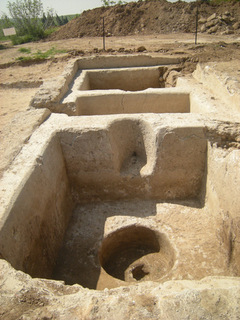
An impressive wine press were recently excavated near Hamei Yo'av in the remains of a Byzantine settlement .


R


photograph: Saar Ganor, courtesy of the Israel Antiquities Authority

According to Dr. Rina Avner, the excavation director on behalf of the Israel Antiquities Authority,

"The wine press exceeded 100 square meters in area. It consisted of a large treading floor sarounded by six compartments that situated north and east of the treading floor. These compartments were used for fermenting grapesupon their arrival from the vineyards, allowing to produce high quality of wine. The treading floor slopes westward thus, causing the juice to flow westward through and into a setling vat. The juice flow from the treading floor through a led pipe to the setling vat, where the wastes and dirt sank. Two additional led pipes connected the setling vat with two collecting vats. The three vats situated in a row along the wetern wall of the treading floor.

At the center of the treading floor we found the cavity of a screw that enabled to press the grape waste from the compartments and to produce vinegar and low quality wine, mentioned in Rabbinic sources as "paupers' wine". The owner of the wine press was probably a Christian, because near it we found


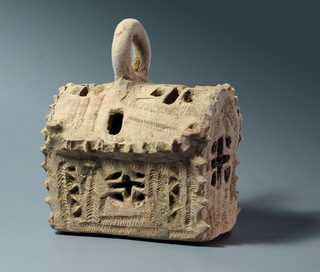
photograph: Clara Amit, courtesy of the Israel Antiquities Authority

a ceramic lantern decorated by five crosses. The lantern was designed as a miniature church building, with an oval opening on one side that enabled to insert an oil lamp. The other sides of the lantern were decorated by geometric impressions creating a design of palm branches. The crosses were carved in the walls of the lantern, so when the lantern was lit in a small room glowing crosses were projected on the walls and the ceiling."

Sa'ar Ganor, the Ashkelon district archaeologist of the Israel Antiquities Authority pointed-out that "the wine press at Hamei Yoav and three similar wine presses are located along the ancient road leading from Beth Guvrin to ancient Ashkelon and its port, thus, facilitating the transportation and exportation of the wine to Ashkelon and from the port of Ashkelon to Europe and North Africa. The wine press will undergo conservation and will be incorporated into the modern complex of the garden event, near the spa of Hamei Yo'av."

Thursday, April 4, 2013

Bronze warship ram reveals secrets


Analysis of a bronze battering ram from a 2000 year-old warship sheds light on how such an object would have been made in ancient times.

Known as the Belgammel Ram, the 20kg artefact was discovered by a group of British divers off the coast of Libya near Tobruk in 1964. The ram is from a small Greek or Roman warship – a “tesseraria”. These ships were equipped with massive bronze rams on the bow at the waterline and were used for ramming the side timbers of enemy ships. At 65cm long, the Belgammel Ram is smaller in size and would have been sited on the upper level on the bow. This second ram is known as a proembolion, which strengthened the bow and also served to break the oars of an enemy ship.

Since the Belgammel Ram was discovered, other rams have been found, some off the coast of Israel near Athlit, and more recently, off western Sicily. The latter finds look to be the remains of a battle site.

Leading marine archaeologist, Dr Nic Flemming a visiting fellow of the National Oceanography Centre, co-ordinated a team of specialists from five institutes to analyse the artefact before it was returned to the National Museum in Tripoli in May 2010. Their results have been published in the International Journal of Nautical Archaeology.

Dr Flemming said: “Casting a large alloy object weighing more than 20kg is not easy. To find out how it was done we needed specialists who could analyse the mix of metals in the alloys; experts who could study the internal crystal structure and the distribution of gas bubbles; and scholars who could examine the classical literature and other known examples of bronze castings.

Dr Chris Hunt and Annita Antoniadou of Queen’s University Belfast used radiocarbon dating of burnt wood found inside the ram to date it to between 100 BC to 100 AD. This date is consistent with the decorative style of the tridents and bird motive on the top of the ram, which were revealed in detail by laser-scanned images taken by archaeologist Dr Jon Adams of the University of Southampton.

It is possible that during its early history the bronze would have been remelted and mixed with other bronze on one or more occasions, perhaps when a warship was repaired or maybe captured.

Micro-drilled samples show that the composition of the bronze was 87 per cent copper, 6 per cent tin and 7 per cent lead. The concentrations of the different metals vary throughout the casting. Scanning Electron Microscopy, SEM, reveals that the lead was not dissolved with the other metals to make a composite alloy but that it had separated out into segregated intergranular blobs within the alloy as the metal cooled.

These results indicate the likelihood that the Belgammel Ram was cast in one piece and cooled as a single object. The thicker parts cooled more slowly than the thin parts so that the crystal structure and number of bubbles trapped in the metal varies from place to place.

The isotope characterisation of the lead component found in the bronze (an alloy of copper and tin) can be used as a fingerprint to reveal the origin of the lead ore used in making the metal alloy. Up until now, this approach has only provided a general location in the Mediterranean. But recent advances in the analysis technique means that the location can be identified with higher accuracy. The result shows that the lead component of the metal could have come from a district of Attica in Greece called Lavrion. An outcome of this improved technique means that the method can now be applied to other ancient metal artefacts to discover where the ore was sourced.

Nic Flemming continued: “We have learned such a huge amount from the Belgammel Ram and have developed new techniques which will help us unpick future mysteries.

“We will never know why the Belgammel Ram was on the seabed near Tobruk. There may have been a battle in the area, a skirmish with pirates. It could be that it was cargo from an ancient commercial vessel, about to be sold as salvage. The fragments of wood inside the ram show signs of fire, and we now know that partsof the bronze had been heated to a high temperature since it was cast which caused the crystal structure to change. The ship may have caught fire and the ram fell into the sea as the flames licked towards it. Some things will always remain a mystery. But we are pleased that we have gleaned so many details from this study that will help future work.”
Wednesday, April 3, 2013

Archaeologists Reopen Investigation of Early Humans at Manot Cave in Israel


Situated in the western Galilee region of present-day Israel, Manot Cave lies about 10 km north of the Hayonim Cave site and 50 km northeast of the well-known Mt. Carmel cave sites... the cave has recently yielded evidence of human occupation dated back to at least Upper Paleolithic times, when early modern humans and Neanderthals are suggested to have coexisted around the Mediterranean and further north into present-day Europe. Adding to evidence uncovered at other similar locations, scientists hope that the finds of the cave will help elucidate the story of early modern human and Neanderthal existence in the Levant, and perhaps even help answer questions related to one possible stage in the spread of modern humans from Africa to Europe...

Complete article

Cologne Archeological Dig Revives Ancient Jewish Heritage


Complete article


...An archaeological dig in western Germany has unearthed myriad traces of daily life in one of Europe's oldest and largest Jewish communities....


From the 10th to 12th centuries, Cologne, today Germany's fourth-largest city, was one of Europe's biggest cities, even ahead of Paris and London, with about 50,000 inhabitants.


Its prosperous Jewish community numbered nearly 1,000 at its height.


On Hebrew-inscribed fragments of slate, aspects of daily life from the Middle Ages have intriguingly come to light via school children's teachings, rules and regulations, a bawdy knight's tale and even a bakery's customer list, AFP reported.


The history of the city's Jewish quarter spans 1,000 years, from Late Antiquity to the Middle Ages, and far from being closed-off, it was open and adjoined the Roman governor's imposing palace and later the city hall.


"Excavations show that the Jews in Cologne for a very long time were on good terms with the Christians, that their cohabitation saw long phases of peace and harmony," Schuette said.


He pointed to the synagogue's gothic-style and richly decorated altar having been constructed by craftsmen, possibly French, who had been working on the nearby cathedral building site.


But two events finally sounded the death knell for the Jewish quarter – a crusader massacre in 1096, followed by its eventual annihilation in 1349 when the Christians made the Jews the scapegoat for a black plague epidemic...

Tuesday, March 26, 2013

Farming in Israel Began 5,000 Years Earlier Than Thought

AVDAT, Israel — For thousands of years, different groups of people have lived in the Negev desert, building stone walls and cities that survive to this day. But how did they make their living?

The current thinking is that these desert denizens didn't practice agriculture before approximately the first century, surviving instead by raising animals, said Hendrik Bruins, a landscape archaeologist at Ben-Gurion University of the Negev.
But new research suggests people in this area, the Negev highlands, practiced agriculture as long ago as 5000 B.C., Bruins told LiveScience. If true, the finding could change historians' views of the area's inhabitants, who lived in the region in biblical times and even before, he added...

He found three distinct layers in the earth indicating that the field had been cultivated, corresponding to three different periods of activity, with long gaps in between. The first one dated from 5000 B.C. to 4500 B.C., followed by another from 1600 B.C. to 950 B.C. and a final layer dating from A.D. 650 to A.D. 950.
The first group of people that farmed here has no current known name, he said, but developed flint tools that have been found throughout the region.

The Exodus

The second period of agriculture, from 1600 B.C. to 950 B.C., corresponds to the time in which the Jews made their way from Egypt to modern-day Israel, according to Exodus and other books of the Bible, Bruins said.

The site where Bruins conducted his research, south of Beersheba, is likely to the south and east of where historians place the Israelites during this time period, he said. But it could possibly have been home to tribes associated with the Amalekites, a group living in the area at the time that was hostile to the Israelites, Bruins said..

Complete article


Sunday, March 17, 2013

Growing Legumes and Cultic Sexual Symbols at an Israeli Stone Age Site


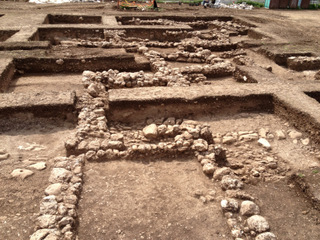
The excavation area. Photograph: Dr. Ya'akov Vardi, courtesy of the Israel Antiquities Authority

Among the finds: thousands of broad bean seeds and a large number of arrowheads and stone axes.


A new site dating to the Stone Age was exposed in large scale archaeological excavations the Israel Antiquities Authority is carrying out at Ahihud Junction prior to the construction of a new railroad line to Karmiel by the National Roads Company. In the excavations, which are spread over 1,800 square meters, remains of two main periods were discovered: the Pre-Pottery Neolithic period and the Early Chalcolithic period (seventh millennium BCE – fifth millennium BCE).
According to Dr. Yitzhak Paz and Dr. Yaʽakov Vardi, excavation directors on behalf of the Israel Antiquities Authority,

“For the first time in the country, entire buildings and extensive habitation levels were exposed from these early periods, in which the rich material culture of the local residents was discovered”. The ancient settlement remains ascribed to the Pre-Pottery Neolithic period were discovered on top of the bedrock in which the ancient inhabitants hew different installations, and even built plaster floors in several spots.

“We found a large number of flint and obsidian arrowheads, polished miniature stone axes, blades and other flint and stone tools. The large amount of tools made of obsidian, a material that is not indigenous to Israel, is indicative of the trade relations that already existed with Turkey, Georgia and other regions during this period”.

According to the archaeologists, “Another unique find that can be attributed to this period is the thousands of charred broad bean seeds that were discovered together inside a pit. The Neolithic and Chalcolithic societies were agrarian societies that resided in villages, and it was during these periods that the agricultural revolution took place, when plants and animals were domesticated. This is one of the earliest examples of the proper cultivation of legumes in the Middle East”.

The remains of the Early Chalcolithic period (fifth millennium BCE) that were revealed at the Ahihud site include a village where there were a number of buildings with rectilinear rooms. Inside the buildings’ walls, which were very thick, were discovered installations that were built of stone and clay, some of which were covered with plaster. Remains of the Wadi Rabah culture were revealed inside the buildings and in the open areas between them.


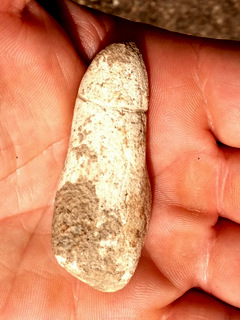
The phallic figurine. Photograph: Dr. Ya'akov Vardi, courtesy of the Israel Antiquities Authority


These include a large number of pottery vessels indicative of a highly developed pottery industry, flint tools, stone objects, as well as a number of unique artistic artifacts, among them a phallic figurine and a palette on which female genitals are schematically etched – these symbols also represented the fertility of the earth.

A preliminary analysis of the animal bones discovered at the site shows that pigs were a principal staple in the diet of the inhabitants.

Thursday, March 7, 2013

The Egyptian Fortress in Jaffa


Fascinating article:

Situated on the central coast of Israel, on the south side of Tel Aviv, and 60 km to the northwest of Jerusalem, Jaffa’s antiquity and importance as a Mediterranean port was well established before the resumption of excavations in 2008 by the Jaffa Cultural Heritage Project. While the biblical texts have served as a primary historical referent, Jaffa’s importance in other periods is much more clearly understood in classical sources including Josephus, but also even from Egyptian New Kingdom literature and administrative documents. Following excavations during the 1950s of the archaeological remains of an Egyptian fortress in Jaffa, a fortress that existed for most of the Late Bronze Age (ca. 1460 to 1130 BC), seeking to understand Jaffa’s role in the Egyptian New Kingdom imperial control of Canaan became of paramount importance...

(At the) Battle of Megiddo (ca. 1456 BC)... the pharaoh Thutmose III fell upon the Asiatic coalition, which was led by the king of Kadesh on the Orontes. In the wake of the pharaoh's victory numerous towns were listed as subjugated, their troops likely among the defeated coalition at Megiddo. Among these towns, and the most southern settlement listed, was the coastal city of Jaffa, known to have been inhabited since the Middle Bronze Age, from at least ca. 1800 BC.

While little outside of the listing of Jaffa can shed light on the historical circumstances surrounding its conversion from Canaanite town to Egyptian stronghold, new archaeological data combined with well-known historical texts of the Late Bronze Age are now shedding light on the nature of interactions between the Canaanite inhabitants of Jaffa and its environs and the Egyptian inhabitants of the New Kingdom fortress built atop the city’s earlier remains. The resulting picture is one colored by episodes of violence and peaceful social interactions in Jaffa over a period of more than 300 years, from ca. 1460 to 1130 BC...